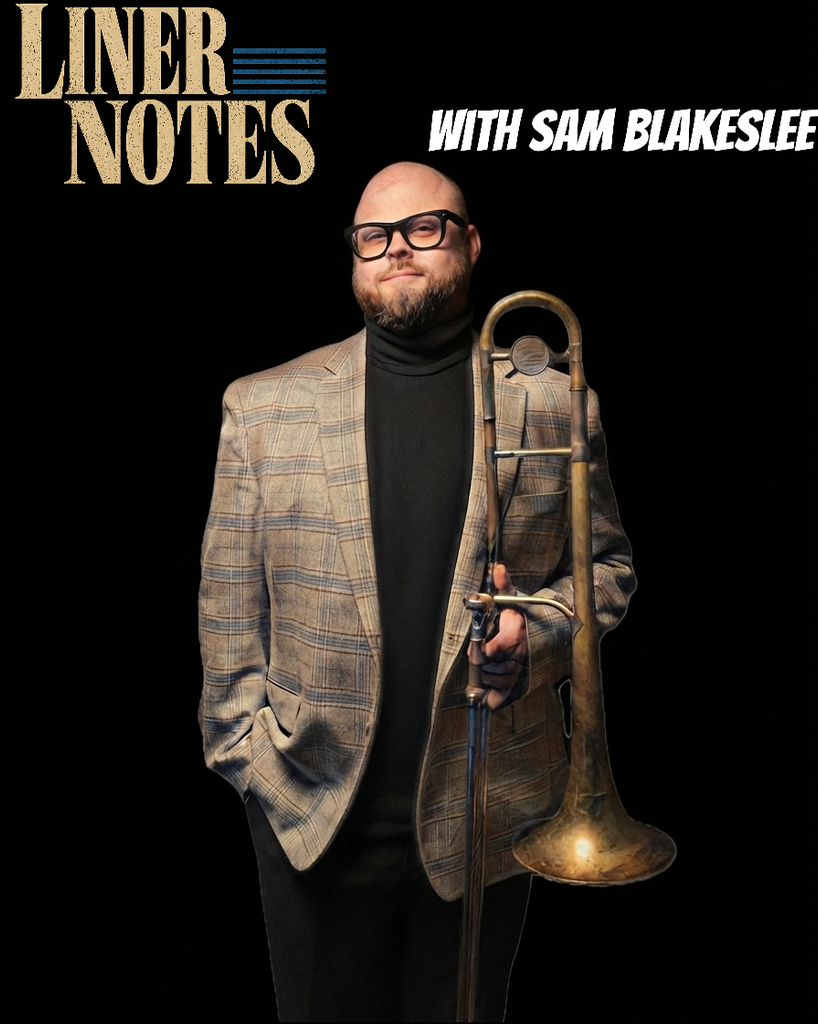
“Liner Notes” is a Sounds Visual Media spinoff series where musicians, composers, DJs, beatmakers, and collectors dig into their crates to share favorite records. In this installment, award-winning jazz trombonist and composer Sam Blakeslee discusses the release of his big band record, “New Blood,” detailing how his musical journey from Ohio to the New York City scene shaped his approach to modern large-ensemble composition. He also highlights several of his favorite albums by artists including Bob Brookmeyer, Count Basie, and Kenny Wheeler.
___
My name is Sam Blakeslee. I’m a jazz trombonist and composer based in Connecticut, near New York City. I’m also on faculty at the University of Hartford’s Hart School of Music, where I direct the Jackie McLean Institute of Jazz Big Band and serve as a professor of jazz trombone.
I’m really excited because I have a new record coming out with my jazz orchestra, the Sam Blakeslee Large Group. The record is called New Blood, and it’s coming out on September 25th on Brooklyn Jazz Underground Records. I’m very happy to have it produced by one of my mentors and heroes in the large-ensemble medium, Alan Ferber, as well as a dear friend and important composer of my generation, Brian Krock. It also features some great New York City musicians, including Michael Thomas, Matt Pavolka, Pete McCann, and Charles Pillow, just to name a few.
The Large Group got its start back in 2013 in Akron and Cleveland, Ohio, where I went to school and where my musical life really began. At that time, a lot of musicians were sticking around town after school, and several venues opened up that were genuinely supportive of creative, original music.
Track Spotlight: “New Blood”
When I put the band together, I wanted to capture that feeling in a song called “New Blood,” which, all these years later, became the title track of this record.
That idea of new beginnings and new chapters has taken on new meaning with the upcoming arrival of my son in October, so having those two things coincide under this song is very meaningful to me. The tune is also heavily inspired by my former teacher at Youngstown State University, Dave Morgan, who was responsible for a lot of the original writing that shaped that area’s sound. I’m excited to finally get it out into the world after it sat waiting since 2013.
Track Spotlight: “Divisive Statements”
Another important track on this record is “Divisive Statements,” written around 2014 — a moment when I naively believed the country was probably as polarized as it could get (laughs). I wanted to write something that captured that feeling. It features two of my longest-running friends and collaborators from back home in Ohio: Chris Coles on tenor saxophone and Nathan-Paul on alto saxophone.
Something I try to keep at the front of my mind in my writing is giving space to soloists — I think that’s important for the trajectory of large-ensemble music today. The telepathic interplay between Chris and Nathan-Paul is remarkable; I’ve heard them play this piece maybe 30 or 35 times since the group started, and it’s different every time. They never repeat themselves. It was fun to try to capture that lightning in a bottle during the session, which also features some great ensemble playing from the band.
Track Spotlight: “Slow Growth, New Growth”
A third standout track is “Slow Growth, New Growth.” I was fortunate to have this piece receive the 2018 David Baker Prize in Composition from the Ravinia Steans Music Institute, an amazing music center outside Chicago. It was originally written as part of their Bridges Residency, which creates music that deliberately straddles the line between jazz and classical — in this case, for string quartet, piano, bass, and drums. Expanding it for big band was a fun orchestration exercise, and I’m happy to have the final version on this record. It features an amazing bass solo from one of my favorite bassists and composers on the scene, Matt Pavolka, along with Martha Kato on piano and some really nice woodwind playing from the section. This track represents a more orchestral, chamber-music-influenced side of my writing, and it was interesting to see how the original string-quartet concept translated to big band.
___
Sounds Visual: Sounds Visual: If you were pulling a few records from your shelf that really defined your path as a listener, which ones would you put on?
SB: I’ll keep it specific to large ensemble — it’s hard to choose, since I love so much music in this category.
Bob Brookmeyer’s New Art Orchestra: Waltzing with Zoe (Challenge Records, 2002) — This was the first Brookmeyer record I heard. I already knew him as a trombonist but hadn’t checked out much of his writing. My teacher Dave Morgan at Youngstown gave me the CD, and the first track, “See-Saw,” hooked me instantly. From that moment on, I knew I wanted to focus on large-ensemble composition. His compositions have such a unique warmth and resonance, but they’re also daring — I love that juxtaposition.
Kenny Wheeler’s Music for Large and Small Ensembles (ECM, 1990) — The “Sweet Time Suite” on this record has become the gold standard for contemporary big band writing. The melodies are gorgeous, the harmonies rich. It’s a record I keep coming back to.
Duke Ellington‘s Masterpieces by Ellington (Columbia, 1951) — This was hugely influential for me early on. The writing is masterful, with some great contributions from Strayhorn, and the arrangements really stretch both form and orchestration. “The Tattooed Bride” was one of the first Ellington pieces I played, in the Columbus Youth Jazz Orchestra in high school, and that’s really where I started wanting to take jazz seriously as a career.
Count Basie‘s Chairman of the Board (Roulette, 1959)— I love all eras of Basie, but the “New Testament” band of the early ’60s is, to me, the pinnacle of ensemble playing and feel. One of my favorite things about playing in a big band is when 17 or 18 people all feel the beat and phrase things exactly the same way — it’s hard to replicate that kind of power and joy, and this record captures it, with incredible writing and playing throughout.
John Hollenbeck‘s Large Ensemble: Eternal Interlude (Sunnyside Records, 2009) — I love all of Hollenbeck’s writing, but this one coincided with my discovery of Brookmeyer’s music, and it’s fascinating to hear the common thread, since Hollenbeck studied with Brookmeyer. He also brings in a lot of minimalist influence — Steve Reich, for instance — translated brilliantly to big band. The first track, “Foreign One,” based on Thelonious Monk’s “Four in One,” grabs you immediately and helped solidify my desire to be a large-ensemble composer. Hollenbeck’s ability to create so much freedom for soloists alongside so much organization in the other horns is something I really admire and try to bring into my own writing. As a trombonist in big bands, it’s easy to get overly focused on the writing, and while I’m happy to help realize any composer’s vision, I think it’s always important to leave real interpretive power to the soloists.
Alan Ferber‘s The Compass (Fresh Sound New Talent, 2007) — This was one of the first contemporary “small large ensemble” records I heard, and it’s amazing. I’ve been fortunate to work with Alan quite a bit, including on and off since 2019 through the BMI Jazz Composers Workshop. Like Brookmeyer, he creates compositions that are daring and complex but never overly complicated — accessible to read and to listen to, yet deeply sophisticated, with grooves that are always infectious. His orchestration for a smaller band sounds so full that you never miss extra horns.
What I love most about Alan, both in his writing and in what he brought to this session, is his bird’s-eye view — he’s always thinking about the big picture and how the music feels from start to finish. He’s aware of the details without being controlled by them, which I think is genuinely difficult for composers to do. His feedback during the studio sessions and through the BMI workshop, on how to shape the best start-to-finish experience, has been hugely meaningful to my writing. Another record of his, March Sublime — his big band record — came out right around the same time as New Blood, and I had to admit to him that I may have been heavily inspired by some of that music while writing my own.
The Thad Jones/Mel Lewis Orchestra, Live at the Village Vanguard (Solid State, 1967) — “Little Pixie” was the first Thad Jones piece I ever heard, and the angular nature of his writing, especially the unusual interval choices, changed how I thought about freedom within composition — particularly over standard song forms. “Little Pixie” is based on rhythm changes, but the way he interprets and develops that melodic thread is something I keep coming back to. That band went through many iterations and always focused on commissioning new work from living composers, Brookmeyer among them. Discovering that record led me to Jim McNeely, Slide Hampton, and everyone else who collaborated with the Vanguard band over the years.
Leave a Reply
You must be logged in to post a comment.