A career-spanning talk on her discovery by Duke Ellington, the “rote” hits of Invictus, and the discipline behind her legendary voice.
Freda Payne: It’s a funny thing, looking back on childhood—those years when I was seven, eight, or nine.
At that age, I didn’t sing at all. My sister was the singer—the more gregarious, outgoing one. I was painfully shy—and when I say “painfully,” I mean extremely so. I found other outlets, though. I was athletic, loved being outdoors, and spent hours riding my blue Schwinn bike around the neighborhood.
I didn’t even realize I had a singing voice. Of course, everyone has a voice—some good, some not—but I had no idea mine was any good until I was about twelve. Our mother enrolled us in piano lessons when I was six. Today, I don’t really play—I can read music and know the notes, but I can’t just sit down and move easily across the keyboard. I’m no Roberta Flack in that regard. [laughs]
My piano teacher, Ruth Ann Johnson, was the first to notice something. One day during a lesson, she said, “Freda, I’d like to hear you sing. For the next recital, I want you not only to play a piece, but also to sing with the ensemble.” She accompanied me as I tried a few lines, then stopped and said, “Freda, you have a lovely voice. I want you to do a solo.”
She chose a song for me—“Stars Are the Windows of Heaven.” After I performed it at the recital, my mother’s friends gathered around and said, “Freda, we didn’t know you could sing! You have such a nice voice.” They had always assumed my sister was the only singer.
That moment changed something for me. It gave me the chutzpah—the nerve—to believe in myself. Before then, I hadn’t thought I had any real talent.
Sounds Visual: And at 13 you had your first TV appearance?
FP: Yes, I auditioned for The Ed McKenzie Dance Hour. It came on every Saturday and was very much like Dick Clark’s show. I was thirteen and I won. Sammy Davis Jr. happened to be on the show because he was performing at a nightclub in Windsor, Canada, just across the river from Detroit. After the show, I got to take a picture with him—a black-and-white 8×10. I was actually taller than him at that point! Sammy wasn’t known to be a big guy.
That picture appeared in The Chronicle, the Black newspaper in Detroit. Six months later, they called me back to participate again, and I won a second time. I was really feeling my oats after that. Eventually, I auditioned for a radio show called Make Way for Youth, produced by Don Large at WJR. It was located in the penthouse of the Fisher Building. I sang in the choir and he gave me solos quite frequently. One thing led to another, and when I was sixteen, I got the chance to audition for Duke Ellington.
SV: Wow. Tell me about that experience.
FP: Duke was performing at a theater in Detroit. A family friend, Attorney Allen Early Jr., lived just down the street from us and was good friends with my parents. He told me, “I know Mercer Ellington; he’s a friend of mine and I want him to hear you sing.” He invited Mercer over to our house, and after I sang, Mercer said, “I want my dad to hear you.”
They arranged for me to go to the hotel where Duke and the band were staying—a Black hotel in Detroit in the ‘50s. I sang for Duke in his suite while he played for me. He said, “You remind me of Lena Horne,” likely because of my looks and my voice. He wanted to hear me with the band, but they were leaving for Pittsburgh the next morning. He told my parents that if they could drive me to Pittsburgh, he’d bring me up to do a couple of numbers at the Holiday House.
My mother and my mentor, Mack Ferguson, took me. We stayed at the same hotel as the orchestra. I remember walking outside and seeing Duke walking toward me with Billy Strayhorn—the man who wrote “Lush Life” and “Take the A-Train.” That’s how I got started. After that, things just started happening. Berry Gordy Jr. heard about me before he had even formed Motown.
SV: I want to briefly talk about your mother, because she comes up as a recurring hero in your story. She seemed very savvy about business and contracts.
FP: Absolutely. She was a smart woman. She didn’t have a college degree, but she could speak in a way that made you think she had a PhD. She was very smart in business; she went to Commerce High School in Detroit, which was dedicated to business and accounting.
She actually owned a bar in Detroit called the Collingwood Bar. It was her money that paid for it, but because of the male ego of those times, they named it “Sam Farley’s Collingwood Bar.” My mother had to take a back seat.
SV: Back to Berry Gordy: you recorded some songs with him in 1958 that are still in the archives. If you listened to those today, what would most surprise people?
FP: That the voice still sounds almost the same! [laughs] Of course, I got better, but the talent was there back then. I was there alongside Mary Wells. She signed, but I never did because our attorney, Allen Early, wanted to tweak a few things in the contract. Barry became very offended. He said, “We can stay friends, but we can’t do business. Nobody changes my contracts.” His attitude was: “Read it and sign it. Don’t change anything.”
Upon moving to New York City in 1963, Payne began collaborating with industry icons such as Quincy Jones, Pearl Bailey, and Bill Cosby.
FP: New York made me grow up very fast. I was eighteen and very innocent. My first residence was the YWCA, and I loved that Alvin Ailey held his dance classes in that same building. I’d sometimes participate or take classes with his assistant, James Truitt. I did it mostly for exercise, to keep my body limber.
Later, I met Sid Feller at ABC Paramount. Everything I wrote in my memoir, Band of Gold, about that time is true. I’m glad I dictated that to Mark Bego before my memory goes!
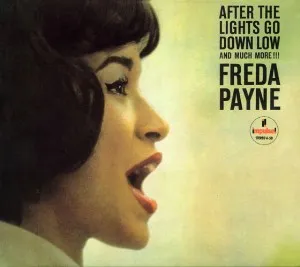
Payne’s debut jazz album, After the Lights Go Down Low and Much More!!!,arrived the following year. Arranged by Manny Albam, the record was released under the Impulse! label.
Following her 1965 debut European tour—where she recorded in Sweden with Don Gardner and Bengt-Arne Wallin—she released her second jazz album, How Do You Say I Don’t Love You Anymore (1966), on MGM Records. Alongside television appearances on The Tonight Show and The Merv Griffin Show, she began building a theatrical resume. This included understudying for Leslie Uggams in Broadway’s Hallelujah, Baby! and appearing in the Equity Theatre production of Lost in the Stars.
SV: You have a vivid memory of seeing Frank Sinatra in a dark club, his face lit by a single match. Can you share that story?
FP: That was here in LA on La Cienega. He lit a cigarette and the match illuminated his face. I said, “Oh God, that’s Frank Sinatra.” He had come to see me because Quincy Jones told him to check me out.
Later, in Miami, I was playing at the Fontainebleau and Frank was staying in the penthouse while filming a movie. He invited me up to his suite to hang out. I was just waiting for him to make a move—you know how men can be—but he never did. He eventually said to me, “Freda, I like you. You’re a good singer and you’re a lady.” I couldn’t have had a better response.
In 1969, Payne was persuaded to return to her Detroit roots by old friends Brian Holland, Lamont Dozier, and Eddie Holland, who convinced her to sign with their burgeoning new label, Invictus.
SV: Moving to the Invictus era—you went to school with Brian Holland and Lamont Dozier. Did signing with them feel like a professional transaction or a neighborhood reunion?
FP: They had already made it! They were writing hits for the Supremes and the Four Tops. I felt I needed a boost—a hit record—and they proved they had the track record. They gave me “Band of Gold.”
I initially found the lyrics immature because of the line about separate rooms on a honeymoon. I figured she was either frigid or the guy turned out to be gay! Both takes are believable. I asked the writer, Ron Dunbar, and he said the idea was that she was frigid. It’s whatever stirs your imagination.
Released in late 1970, Payne’s record became an overnight sensation. It climbed to number three on the US Billboard Hot 100—earning a Gold certification from the RIAA—and dominated the UK Singles Chart, holding the number one spot for six consecutive weeks that September. Global sales of the single topped 2 million. In 2004, Rolling Stone magazine recognized “Band of Gold” as one of the 500 Greatest Songs of All Time, ranking it at number 391.
The accompanying album also enjoyed considerable success. Following the title track, Payne released several other hits on the Invictus label, including “Deeper and Deeper,” which climbed to No. 24 in the US and No. 33 in the UK by late 1970. Other notable releases included “You Brought the Joy” and the powerful Vietnam War protest anthem “Bring the Boys Home.” The latter peaked at No. 12 on the Billboard Hot 100 in 1971, earning Payne her second Gold record.
After leaving Invictus in 1973, Payne continued to record for labels like ABC/Dunhill and Capitol—venturing into disco with the hit “Love Magnet”—though she never quite mirrored her earlier commercial heights. Her multifaceted later career saw her transition seamlessly between music, television hosting, and acting in films like Nutty Professor II: The Klumps and various Broadway productions. Throughout the 1980s and 2000s, she maintained her musical presence through jazz projects, high-profile collaborations, and frequent iconic performances of her signature hit, “Band of Gold,” on platforms ranging from PBS to American Idol. Today, she remains a celebrated performer, recently honoring legends like Ella Fitzgerald while continuing to release compilations and new recordings that span R&B, soul, and jazz.
SV: You’ve worked with big bands and trios. How do you use silence and space to create drama in a jazz standard, compared to the “Wall of Sound” at Invictus?
FP: Everything with Invictus or Motown was by rote. It was definite. I had to sing every note exactly as they wanted; I couldn’t improvise. They were almost directing me in the booth. Jazz is much freer. You can improvise. You have singers like Samara Joy today who do that very well; she’s the real deal.
I’ve said that singing jazz is like being with a lover, while R&B is like being an actress playing a role. When I do an Ella Fitzgerald tribute, I try to capture her spirit. Leonard Feather said Ella could “sing the phone book,” and it was true. Her scatting was off the chain.
SV: Freda, I’m a huge Beatles fan—and you once told a story about meeting John Lennon, so I’d love to hear it.
FP: I sat next to him at a dinner party. He looked at me inquisitively, like he was examining me. I was so inhibited! Paul McCartney was there too—he was always nice—as was Ringo Starr. Paul and Ringo are the last two left. My goodness.
Freda Payne’s music has been widely sampled in hip-hop by artists including Nicki Minaj, The Roots, Beck, De La Soul, Wu-Tang Clan, Tribe Called Quest, and hundreds more.
SV: How do you feel about your catalog being sampled, Freda?
FP: I want to get paid for it! I’m the artist; they’re taking a little piece of my life to help their life. But honestly, I probably am getting paid, because whenever I request money from the Holland Group, they write me a check.
A prime example of Payne’s enduring catalog is “Unhooked Generation” (1970), which provided the foundational sample for J.V.C. Force’s 1987 classic “Strong Island.”
SV: You’ve maintained incredible vocal and physical grace. What is your routine?
FP: Before I perform, I vocalize in my dressing room. I call it “blowing the pipes out.” I just came back from San Francisco where we rehearsed for two and a half hours. You’d think that would wear the voice out, but it’s the opposite—it exercises the voice so it’s in tip-top shape for the show. I don’t drink dairy or eat peanuts before I sing, and I always have hot tea with honey—specifically “Throat Coat” tea. It smoothes everything out.
SV: When you look back over the arc of this career and think about your legacy, what comes up for you?
FP: Survival. I have survived. We just lost [actress] Judy Pace, who was a good friend of mine. Then five days later, [tv host/actress] Kiki Shepard passed away. When I think about the death of these Black women—one my age, one just a few years younger—I realize you never know when your time has come.
You have to ask: Are you happy? Did you do the things you wanted to do? You’ve got to stop and smell the roses. Enjoy your life, enjoy food, have a glass of wine. Everything in moderation.
SV: Freda, thank you so much for your time.
FP: Thank you. I appreciate you.