
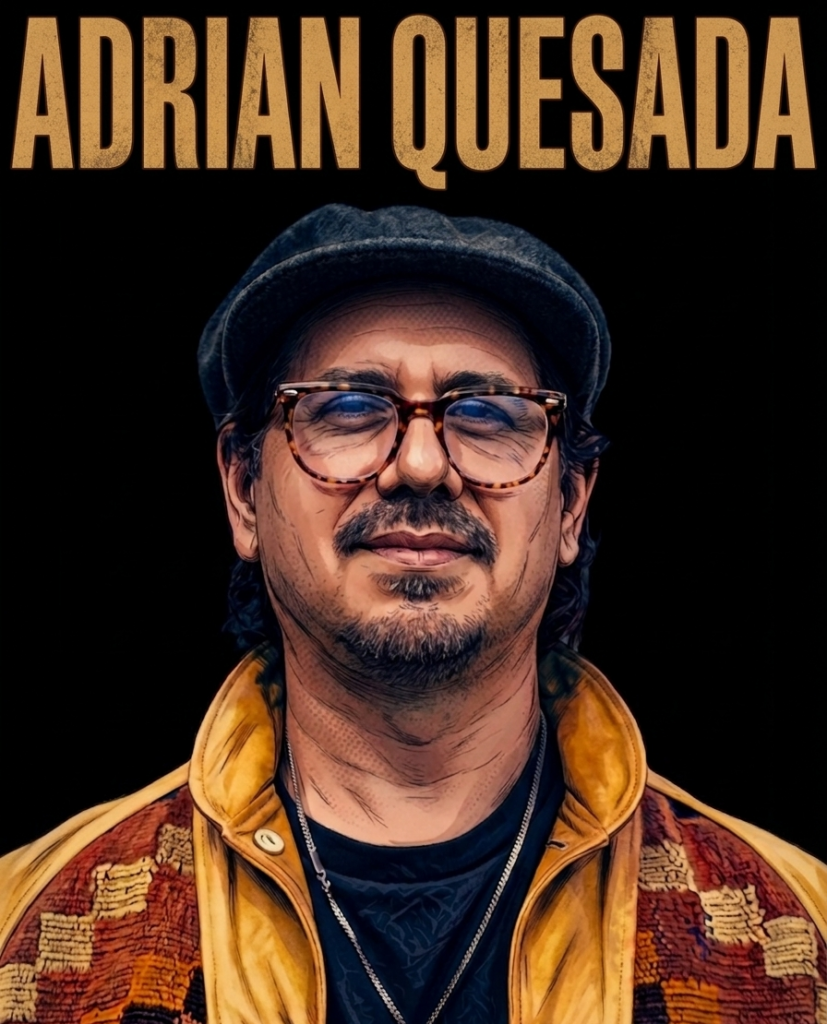
Raised in Laredo, Texas, and fueled by the Golden Age of MTV, Adrian Quesada channeled his diverse musical roots into a series of genre-bending side projects and a Grammy win, eventually skyrocketing to international fame as the co-founder of Black Pumas.
Sounds Visual: Adrian, where does the journey in music start for you?
Adrian Quesada: I was born in Laredo, Texas, which is about four hours south of Austin. Basically, if you take the interstate here and drive all the way down until you hit Mexico, that’s where I’m from.
I was really obsessed with music when I was a kid. I was an only child, so I was home a lot and left to my own devices. I was just drawing and listening to music all the time. You know, I’m from the MTV generation—back when MTV actually played videos. I discovered music that way because the radio where I grew up was a little isolated. A lot of what I discovered was through the original MTV, when they actually played music. I would watch everything from Yo! MTV Raps to 120 Minutes, and eventually Alternative Nation and even Club MTV.
I was really into whatever I was learning about from MTV. Then, I started to play guitar when I was 13 years old. My dad actually suggested that I play piano when I was 12 or 13, but at that age, I was a skater, I was into hip-hop, I had long bangs, and I was just “too cool for school.” The idea of playing piano sounded totally stupid to me back then. It’s one of the few regrets I have in life—that I didn’t start on the piano, you know?
So I remember telling him, “Well, I’ll play guitar.” Guitar seemed cool. A couple of my uncles came together and everyone chipped in; one of my uncles paid for some lessons, another bought me a guitar, and so on. It was a family effort.
I started out playing classical and flamenco. My first couple of years studying classical and flamenco were pretty damn rigid compared to what all my other friends were doing, which was just playing in garage bands. It didn’t completely hold my attention at that age. To be honest, I didn’t have the discipline back then to truly call myself a flamenco or classical guitarist, though there is a lot I’m glad I picked up from that time and that I started there.
Eventually, I connected with some people who were playing rock and roll in a garage, and that was when I joined my first bands in high school. First we played covers, and eventually we had a band that wrote and recorded some original songs on a four-track. After high school, when I got to Austin, I definitely started taking it more seriously.
SV: Before finding your core sound, you were experimenting with everything from punk and avant-garde jazz to rock and hip-hop. How did stretching out across those completely different genres early on shape your ultimate approach to rhythm and groove?
AQ: I moved here to attend the University of Texas at Austin and got an art degree. So, I was a painter when I first moved here. But I secretly knew that I was really here for the music. I knew Austin was the closest music town where I could still be near family but make a living—or at least attempt to make a career out of music. And yeah, I just never left. I graduated high school and three days later I was in Austin. Like I said, I was a painter when I was in college, but I was already playing in bands and immersing myself in the music scene.
That took me on a journey of being in multiple projects and multiple bands, and here I am now.
When I first moved here, I connected with a couple of guys in my dorms, and we started a sort of punk, avant-garde take on “poor man’s jazz” music. I started to get really into jazz. Again, I never fully had the discipline to deeply learn jazz, but we did our own punk rock take on it. That eventually led me to connecting with some other guys from my hometown who had moved here a year after me. That’s when we started the first real band that I toured with and followed a career path with, called Grupo Fantasma.
That was a few guys who were also from Laredo who moved here around ’96 or ’97. We were just hanging out all the time, digging into cumbia crates, and getting into old-school Latin stuff. We were discovering the music that had been all around us when we were kids. Back then, we wanted to play hip-hop, metal, and rock; we didn’t want to play our grandparents’ music. It wasn’t until we were in college that I really went back to those Latin roots that we had grown up around. That was what became Grupo Fantasma, and it was just perfect, beautiful serendipity—being in the right place at the right time.
Back then, there was a bit of a void in Austin for bands doing that. There were definitely some incredible Latin bands and musicians, but they were in a completely different scene from ours. There were Latin clubs and Latin nights, and I am still friends with incredible players from that scene, but our friend group, gatherings, and hangout spots were always a little bit more diverse. We would hang out at a club where they would have a hip-hop night, the next night a Latin night, and then a reggae night. We hung out at punk clubs and rock and roll clubs as well. We actually felt a little intimidated by the traditional Latin scene, so our path started in a unique corner of the Austin music scene.
Renowned for their innovative, multi-ethnic sound and high-energy live performances, Grupo Fantasma’s cultural importance has been cemented by an induction into the Austin Music Hall of Fame, a Grammy Award win for Best Latin Rock or Alternative Album, and high-profile collaborations with major artists like Prince.
SV: When a band is touring heavily and finding mainstream success with a specific sound, what drives the need to launch a side project? Is it more about scratching a different creative itch, or does it serve a practical purpose for staying sharp and engaging your local music scene?
AQ: Well, Grupo originally came out of a jam session between two bands that used to get together and play a coffee shop for fun. Then we started playing house parties, and that style was more Latin funk. We were discovering early ’70s Afro-Latin funk—everything from Mandrill to a lot of B-boy breakbeats. That was actually what we sounded like originally.
Then with Grupo, we started to learn a bunch of cumbias, and that seemed to be what audiences reacted to, so we went down that path. But after a few years of doing that, I remember us getting together in my apartment and talking. Half-joking, we said, “Let’s get the band back together and go back to what we used to sound like before we focused exclusively on cumbia.” That’s when we started Brownout as a side project. That was the next evolution.
Brownout has earned widespread critical acclaim from outlets like NPR and Rolling Stone for their progressive, razor-sharp fusion of Latin rhythms, psychedelic rock, and hard-driving funk. Beyond their own heavy, rare-groove original catalogs, their immense musical respect earned them roles as the go-to backing band for icons like Prince, Bernie Worrell, and GZA. Their importance as contemporary “keepers of the funk flame” was further cemented by their brilliant Brown Sabbath and Fear of a Brown Planet projects, which seamlessly recontextualized classic metal and hip-hop through a living, generational Afro-Latin lens.
We were touring with Grupo quite a bit, and it was definitely taking off, but we wanted a project where we could play multiple nights in Austin without burning out the market. Plus, it kept our chops up and kept it fun. We would never tire of any one particular style because we were constantly learning different things and trying to get better. Like I said, it allowed us to play Friday night in Austin and then Saturday night in Austin as well, and there would be two completely different crowds.
SV: You’ve also done some incredible work with Martín Perna from Antibalas under the name Ocote Soul Sounds. I absolutely love these records and would love to hear more about how you two connected.
AQ: I believe Martín and I connected in 2003, if I remember correctly. Yeah, almost positive it was 2003. When Grupo started, it was about a year after Antibalas had started playing in New York City. I was a huge fan of Antibalas. They were very much a blueprint for what I imagined Grupo doing—not necessarily musically, but the idea of a big band digging into the past and learning these traditions, but updating them and keeping that big band sound alive.
So they were a huge influence on me. Back then, my current wife was my girlfriend, and she had moved to New York for a bit. She knew I was a huge Antibalas fan. Right after she got to New York, she called me and said, “Hey, my roommate is really good friends with the Antibalas guys.” It was super serendipitous.
She connected the dots, and we eventually did a recording session. I remember being there on tour, connecting with him and an early trumpeter from Antibalas whose name I can’t recall, and we did a session where they played on an instrumental album I was working on. We just stayed in touch after that.
Eventually, Martín converted a Mercedes-Benz station wagon to run on vegetable oil. I don’t know if he told you that part of the story, but nowadays there are resources for it, electric cars, and all that. But when he did it back then, he was a pioneer. I imagine there was only a handful of people in the country doing it—maybe a couple of handfuls—but it was a huge deal at the time. There just wasn’t a lot of information or resources available. He literally would get vegetable oil from Chinese restaurants and McDonald’s.
He took this road trip from New York all the way to Mexico to apply for land he had down there, and on the way, he stopped in Austin. He stayed at our house, and we had a little party that night. The next morning, we recorded a couple of songs that would end up on the first Ocote Soul Sounds album.
To rewind a little bit, he had already recorded a few singles under the name Ocote Soul Sounds. So when we first collaborated, we didn’t really know what it was for; we just did it. After that, he went down to Mexico and stayed for a bit. On his way back from Mexico to New York, he let me know he was coming through. But his car broke down about an hour outside of Austin, in San Antonio I think, and he had to drive super slow to Austin. He figured he would park here and find somebody to fix it.
He ended up staying with us for a while because he couldn’t find anyone who knew how to fix that car. In that process, we made most of our first Ocote Soul Sounds album. We continued to make Ocote Soul Sounds records on and off throughout the years.
Another little excursion we had involved the guys from Grupo and Brownout. We got asked to play a residency at a really tiny club. We wanted to do it, but we thought, “There’s no way a 10-piece band can fit on that stage and make any money.” The idea of a side gig was to make some extra money and play for fun.
Right around that time—or maybe just before—a compilation called The Roots of Chicha came out. It was put together by Olivier Conan, who started Chicha Libre; he’s an incredible music historian and musician. Chicha was a Peruvian, psychedelic, stripped-down take on cumbia. They took the instrumentation of surf music—surf guitar with reverb and a combo organ—and applied it to a stripped-down combo to make an instrumental variation of cumbia.
At the time, we didn’t know much about it. A friend of mine who was a deep-crate digger from Mexico brought a bunch of records from Peru and showed them to me. He said, “How have you guys never heard this? That’s exactly how you and Beto (the other guitar player) play guitar.” He turned us on to it, and we realized other people had done this style way before us, interpreting what a piano would typically play between two guitars.
Long story short, we had been asked to do this residency but couldn’t see how to make it work with Grupo. I sent an email to everybody with a dollar sign ($) and the word “Chicha” in the subject line because we were always talking about how to make money. I wrote, “That’s it. We just do a stripped-down Chicha band. Learn a bunch of Chicha covers.” And that band became Money Chicha.
When it came time to come up with a band name, we wondered, “Well, what do we call ourselves?” Someone said, “I don’t know, Money Chicha—that’s what the email said.” So we started it as a side project. It was a stripped-down, incredibly fun band where we started out covering stuff but eventually wrote a lot of original music, too. We did that residency, and it became another little excursion from the Grupo camp that lasted for a few years.
Eventually, I left Grupo and Money Chicha just because I was getting heavily into producing and wanted more time for other things. I bowed out of those but continued with Brownout.
The only other project where we released music was through Ubiquity Records. I was label-mates with an incredible musician and producer out of the UK named Shawn Lee. I always loved Shawn Lee’s stuff, and Ubiquity told me he was going to be in town for South by Southwest a long time ago. They suggested we hook up, so I met up with him.
We made a record completely remotely, way before the pandemic forced everyone to work that way. We did it so comfortably, and it was so much fun. We would just email parts back and forth. Because of the time difference with the UK, by the time I’d get up in the morning, I’d already have drum tracks in my inbox. I would wake up, have my coffee, add bass, guitar, or keys—whatever was needed—and send it right back to him. Sometimes I’d catch him while he was still at the studio and he’d send it right back. Sometimes we’d finish a full song in a day.
We released that as the Electric Peanut Butter Company and had a bit of success with it. We were never really a traditional band—we never played live shows and were never honestly in the same room—but we had some success with sync placements on TV and film. So, we decided to make a second record, and I actually made my parts for that one while on tour.
I was on tour with another band I was in called Spanish Gold. That Spanish Gold tour was a promo tour, meaning we weren’t going to make any money; it was strictly for promotional purposes. In my head, having been raised to be a workhorse, I thought, “How do I work and monetize this time?” I decided I would make the second Electric Peanut Butter Company record in my hotel rooms on that tour.
I took a small mobile recording setup and told Shawn that was the window of time I had. I recorded in hotel rooms and sent all my parts back, and we made a second Electric Peanut Butter Company record completely on the road.
SV: You mentioned the band Spanish Gold in the last segment. Let’s talk about that project for a moment.
AQ: Yeah, yeah. Spanish Gold was a one-off project I was a part of with Dante Schwebel. Back then, he was playing guitar in a band called City and Colour, and before that, he had been in a great band called Hacienda. He and I were from the same hometown and actually went to the same high school.
He reached out to me—I don’t remember what year it was—and asked me to help produce some songs he was working on. We got together, cut a few demos all in one day, and really liked the chemistry. Then he called one day and said, “Hey, do you want to come up to Nashville?” He was living in Nashville at the time and doing a bunch of stuff with Dan Auerbach. He asked, “Do you want to come up to Nashville and we can record this stuff?” I said, “Sure, man.”
Originally, it was just me producing his solo album. But then he said, “Well, hey, I talked to Patrick Hallahan from My Morning Jacket, and he’s down to be a part of this as well.” So I went up to Nashville and we started a band. We went into Dan Auerbach’s studio, Easy Eye Sound, which was incredible, and we cut about half of what became the Spanish Gold album in a couple of sessions.
After that, we decided to make it an official band project and said, “Let’s record the rest of the record in everyone’s hometown.” Patrick was from Louisville, so we did a bunch of songs in Louisville, and then we did the same in Austin to finish the album. That way, we had parts of it done in Nashville, Louisville, and Austin. We did one tour, put out a record that I think is really cool, and then everybody went back to their respective worlds. It was definitely a one-off project.
SV: You were also the music director for a series of concerts that the Lincoln Center did called Out of Doors. One of the concerts was based on an album you produced called Look at My Soul, which celebrated the interplay between Latin artists in Texas and rhythm and blues. Another event was a tribute to the music of Selena. As a Texan yourself, I imagine this was an incredibly enriching experience all around. Can you tell me how this work as a musical director for Lincoln Center came to be?
AQ: I got asked a few years ago to be the music director for Lincoln Center and an organization out of L.A. called Selena for Sanctuary. We were doing a tribute to Selena. At this point, she’s a total cultural icon, but sometimes I have to double-check with people because it took a while for her to reach that status outside of Texas after her passing. I remember her being a huge international star, obviously, but outside of Texas, not everybody was completely familiar back then. Today, she’s a straight-up cultural icon. They wanted to do a tribute to her with a bunch of artists and asked me to be the music director.
That music is something I very much grew up with. Not only that, but one of the guys who was in her band and co-wrote most of her hits, Pete Astudillo, is actually a family friend. He sang at my wedding and is a really good friend of my dad’s. So, I had this deep, personal connection to that music. I served as the musical director for that tribute for a couple of years and had a blast. I got to work with incredible artists and represent Texas on that stage in New York City, connecting all those dots.
Later, I got asked to do another show at Lincoln Center as the musical director for the album I made called Look at My Soul, which I had released fairly recently, right around the same time we started Black Pumas. I got to act as the musical director for that at Lincoln Center as well.
SV: Now we come to the last few years and a new project you embarked on as a member and producer of a group called The Black Pumas. Tell me how this all came to be.
Adrian Quesada: Yeah, it’s been quite a ride. In 2017—to rewind a little bit—I just mentioned the Look at My Soul album. That album was something I had been wanting to do for a long time. It’s funny, I actually found a spreadsheet I had put together maybe 16 years ago for that project. I had this idea all the way back in the Grupo days.
In Texas, there is a whole style of music called Tejano music, which is a unique regional interpretation of many styles, from Mexican rancheras to cumbia, etc. It has its own unique sound, and there are a few pioneers of the genre here in Texas like Rubén Ramos, Little Joe, and Sunny Ozuna from Sunny & the Sunliners. I started to collect a lot of their old vinyl.
I initially met Rubén Ramos during an interview, and he mentioned that he didn’t even really start singing in Spanish until much later in his career. He talked about how, as a Mexican-American, he grew up on rock and roll, soul, and Black music. Then I started collecting their early vinyl around the time the Texas Funk compilation came out. Reading those liner notes and connecting the dots, I realized all these guys had a cool, random funk track hidden away—whether it was a Meters cover or an original—and had their own unique take on soul music before they established the sound that is now called Tejano music.
I went on a deep dive about 16 years ago exploring that for a number of reasons. One was to put my own roots in perspective. We were these kids from Laredo who eventually ended up in a reputable Latin orchestra, but originally we were into hip-hop, and then we got really into funk. I realized all these elders had been on a similar trajectory and had opened the doors for us without us even knowing it. When I heard Sunny & the Sunliners’ name when I was in high school, I imagined formal ballroom dances in Laredo, not a dope soul record. I had no idea until years later. Now, Big Crown Records has re-released a bunch of Sunny’s stuff, which is great because it’s opening it up to a new audience, and there’s a resurgence of “Brown-eyed soul,” for lack of a better description.
Anyway, I had always wanted to make a record connecting those dots, back when I was still in Grupo, using Grupo as the house band. I wanted to connect the dots between these old-school guys while they were still alive and what we were doing, revisiting that old material. I pitched it to a lot of different people, but it just wasn’t the right time. Today there’s a whole Chicano soul resurgence, but 16 years ago, outside of a few heavy record collectors, people just dismissed the idea.
I kept putting it out there every few years, and people would say, “That’s a cool idea,” but nobody ever moved on it. Then around 2016, Tomas Cookman from Nacional Records, which is based in L.A., heard the idea. He said, “Man, I actually really like this. We’re working with Amazon on some projects; let me pitch it to them.” He pitched it to them, and I went up, had a meeting, and pitched it to Amazon as well.
They were really on board with the idea of it being almost like a documentary to help tell that story. They committed to getting behind the project, which was great because it meant I actually had a budget to make it happen. I didn’t want to be calling in too many favors or asking people to play for free, especially some of these older legends.
I got the budget and started working on it. I blocked out my calendar for a few months to just focus on writing and demoing. But what happened was, in 2017, as I sat down to start demoing stuff for Look at My Soul, I instead knocked out a completely different batch of instrumentals. I thought, “God, I know this is not for that album, but this is something else that’s really cool.”
Eventually, I did go back to Look at My Soul, brought in a bunch of my friends, and we tracked all those instrumentals live. But I stashed that other batch of songs aside and started asking people, “Hey, do you know anyone who could write and sing on these tracks to help me bring them to life?”
I asked Shawn Lee, friends in L.A., and friends all over the place. They would suggest different people, but I never actually reached out to anyone until a mutual friend in Austin said, “Oh yeah, man, you’ve got to try Eric Burton.”
It was interesting because I googled him and thought, “How have I never heard of this guy?” I had been in Austin for so long, and I felt like if there was a guy local doing soul music at that level, I would have already known him. But he had just moved to Austin about two years prior. So I reached out to him.
It’s funny because he didn’t know who the hell I was either, so he didn’t respond to me for about two or three weeks. He finally called one day, we got together in the studio, and we recorded “Black Moon Rising” and “Fire” on that very first afternoon. Those turned out to be the first singles we put out, and that was the beginning of what would eventually become Black Pumas. That was 2017.
SV: Did you and Eric have any idea of how successful this project would ultimately become?
AQ: You know, it’s funny because I remember back then, when Eric and I first started working, we didn’t know what we were going to do with it—which kind of seems to be a recurring theme for me at this point. Just record some songs and figure out what to do later. But I remember getting goosebumps and thinking, “Man, this is ridiculous.”
By that point, I’d been in a lot of bands, and it was almost a running joke that I was going to start another side project. But I had already removed myself from the Grupo Fantasma and Money Chicha world. Ocote Soul Sounds was on permanent hiatus, and Electric Peanut Butter Company wasn’t super active. I wasn’t really in too many bands, but I started to feel like people thought I was just starting groups for the sake of starting groups. I didn’t really want to start a band, but God, man, this material was way too dope.
I remember telling Eric, “I feel like we should play live just to hear this stuff,” because we had never played out or anything. And he was like, “Agreed, man. Agreed. Let’s do it.” We just said, “Listen, let’s do it for fun until it’s not fun anymore.”
I remember definitely feeling like, “This is so good, and I know people are going to react.” I felt very confident about it. At the same time, I think we’re just in another universe now. We’ve completely shattered that ceiling altogether. We’re in a place where I just can’t even… I would have never in a million years fathomed where we are now. It’s wild.
Black Pumas achieved rapid mainstream success with their 2019 self-titled debut album and its smash hit single “Colors,” which propelled them to worldwide tours and a performance at the 2021 presidential inauguration. The duo has secured widespread critical acclaim and a career total of seven Grammy Award nominations, including nods for Best New Artist, Record of the Year, and Album of the Year.
SV: Adrian, in terms of live performance, there are a couple of other artists I’d love to ask you about that you’ve been fortunate enough to play with. One of them is GZA from the Wu-Tang Clan.
AQ: Oh yeah! We were backing GZA quite a bit. When we were with Brownout, we were GZA’s backing band. We connected with him over South by Southwest. We backed him for one show and eventually backed him throughout the years on a number of things. Probably some of the bigger ones were Bonnaroo, and then we did a couple of shows in Brooklyn with him, along with some random one-off stuff. But it was always a blast playing with GZA.
SV: And you also got to do some live gigs with Prince?
AQ: That was during early Grupo Fantasma, when we didn’t even really have our swagger or confidence yet. And he believed in it, man. He believed in us. He saw something and took us under his wing for a bit. For a few years, we went from just playing at his club to suddenly being his backup band for a few performances, and we did quite a few rehearsals and whatnot. Just an incredible man. It was probably the most life-changing experience I’ve had musically.
SV: Adrian, thanks for your time today.
AQ: Thanks for having me, man.
Leave a Reply
You must be logged in to post a comment.