
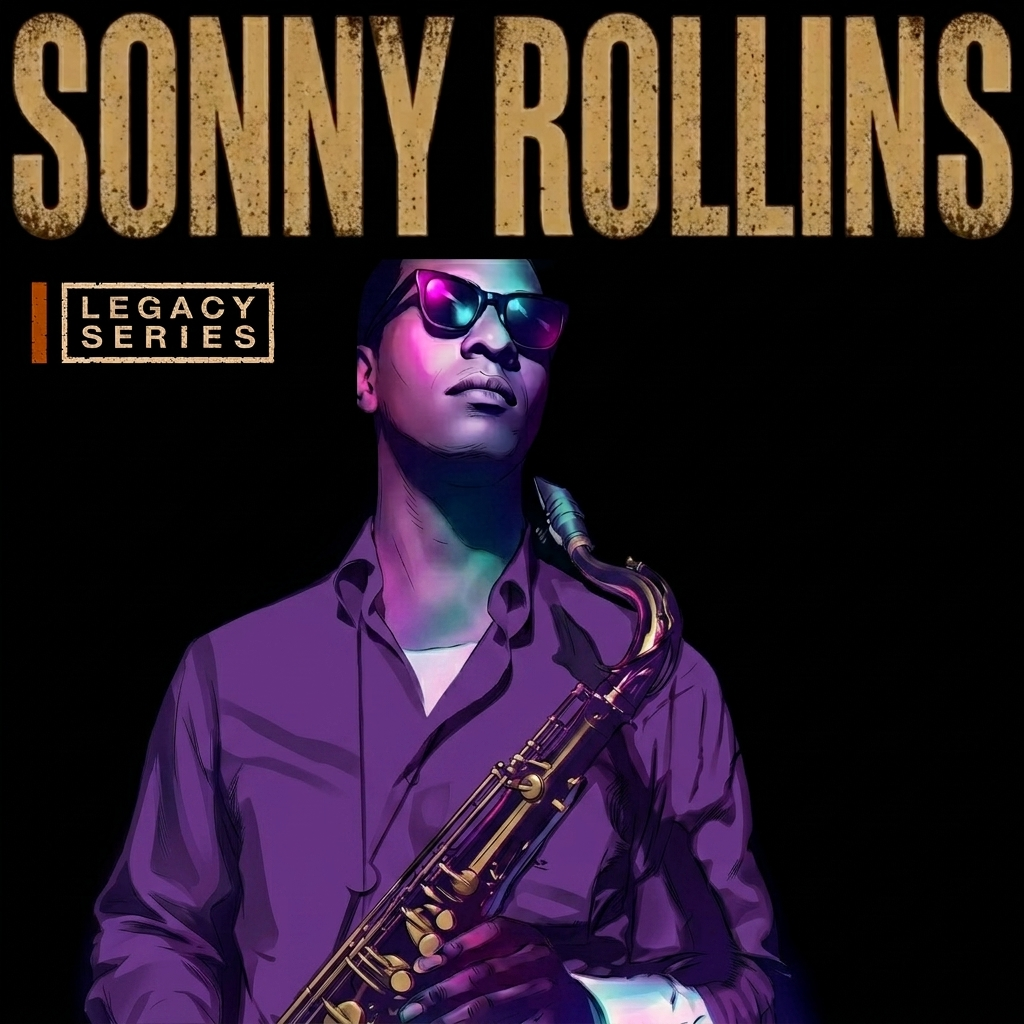
The Legacy Series cuts through the static to pay dues to the departed masters. In this installment, the legendary jazz saxophonist reflects on his upbringing during the Harlem Renaissance, his civil rights activism and milestone recordings, and how his embrace of yoga and meditation ultimately transformed his approach to musical improvisation.
___
Sounds Visual: Sonny, you were born in 1930 and raised in New York City during the Harlem Renaissance. I’m wondering what early memories you have of growing up in such an artistically vibrant environment.
Sonny Rollins: Well, it was a great, great place. There was music—the war—all kinds of music, of course. One thing that sort of straightened me out when I was a child—I would say I was a young, young child, maybe two, three, or four years old—was my older brother, who was five years my senior. He was a violin player, and I used to listen to him practice around the house, which was always nice.
But other than that, I just have to refer to my upbringing and listening to jazz. As I said, that affected all of it. My other favorite at that time was Louis Jordan and his Tympany Five. I mean, he was really very big. I had all of those Louis Jordan records. I used to see him whenever he was in a movie playing a big part or something, and I’d listen to his records on the jukebox and things like that. So, this was sort of my introduction, but I liked all kinds of music. I heard classical music in school a little bit, and as I said, I heard the serious playing my brother did.
My mother was a very special parent because she used to always take the children to cultural places. You know, she really got us on the right track. When I was a little boy, we used to go up to Colonial Park and see Gilbert and Sullivan’s The Pirates of Penzance. She would always take us to City Center in New York where they had these operas, and she would take us to Radio City Music Hall to see a stage show besides the movies. So, my mother always introduced us to the cultural aspects of life, which was really great.
But when I heard Fats Waller, it was like the sun came out, and I realized that this is it. This is it. Whatever I had seen in my short moments on Earth, nothing impressed me like this. I realized that jazz was it for me. Of course, the great personality of Fats Waller cannot be neglected when talking about him, but beyond his personality, the musicianship was great. So, that is one of the things I would say about growing up in Harlem that caught me right early on.
In January of 1949, Rollins made his recording debut alongside jazz vocalist Babs Gonzales on a session for Capitol Records.
SV: Sonny, do you remember those early sessions from your career?
SR: Oh yeah. Well, Babs was really great—a great figure for me because he had me playing with a lot of his pick-up bands when I was certainly the youngest guy there. I was playing with people like Fats Navarro and other older, great musicians. So, I got a chance to improve my level of musical contribution and learn about life from these guys. Babs took a liking to my playing, and I have always had a great admiration for him.
Just recently, a guy sent me a small book from England by Babs, commemorating his 100th birthday. It’s just a small paperback, but it has a lot of reminiscences about Babs. Of course, knowing Babs, he was quite a character. I have nothing but the best to say because he really helped my career a great deal.
SV: Sonny, I asked you a few minutes ago about growing up in Harlem, and now I’d love to follow up on that to hear about the scene on 52nd Street in New York City. I can’t even imagine what it must have been like to walk down 52nd Street amongst all these now-storied clubs and legendary musicians who were your contemporaries. Can you tell me a little bit about that?
SR: Well, when I say “we,” I’m talking about my group of peer musicians: Walter Bishop Jr., Arthur Taylor, Jackie McLean, Kenny Drew, and Idrees Sulieman. We had our own little bands, but we used to go down to 52nd Street, and of course, that was The Street. Everybody was there. Of course, we were looking for Charlie Parker, Dizzy Gillespie, those people, and Billie Holiday.
There was a club on the street for everybody; it was almost fantastic. So, we went down there as youngsters, and eventually, as we kept going in the business, we actually had an opportunity to play on 52nd Street with our own bands, holding it down, you might say. So, I actually played on the street. I lived the whole episode of going down there as a youngster and then ending up being able to perform on 52nd Street.
SV: As someone who has had such a long and incredible career, spanning the better part of seven decades and having worked alongside so many iconic jazz musicians, I’m wondering if you are ever at all nostalgic for the old days, so to speak.
SR: Somehow, I’m not yet. I mean, I may get nostalgic as I get a little older, but it has not been a problem for me at this point. Of course, I had to stop performing, so that was something to get nostalgic about, if you want to put it that way. But not really.
I do get nostalgic in the sense that many of the great people I played with are no longer playing. So, that’s somewhat nostalgic regarding friends like Thelonious Monk, Miles Davis, John Coltrane, Charlie Parker, and J.J. Johnson—some of those guys I was pretty intimate with. Yeah, I get nostalgic every now and then for them. But you know, I also have a talent for recall, so I can recall these people, and they just exist as if they were still here on the planet functioning. I just think about them and they are there. They are never far from my mind, and they are never far from the reality of my thoughts. So, in this sense, yeah, I guess I’m nostalgic in a way, but these people are never far from my thoughts. I mean, I think about Bud Powell, and bang—Bud Powell is in my mind, and we are reliving some of the things I went through with him and things like that. So, yes and no.
SV: Bud Powell and Miles Davis may be gone, but the music they made—and the music you make—keeps inspiring people. In a very real sense, their souls live on through their art, giving them a kind of immortality.
SR: Yes, the soul is here forever, absolutely. You hit that right on the head.
SV: Sonny, I know you’re very humble when it comes to the influence you’ve had on other musicians and on jazz itself. But do you ever feel the urge to go back and revisit some of these milestone records you’ve made, and are you able to appreciate them objectively?
SR: No, I don’t. For much of my career, I didn’t usually listen to my records because I’m always criticizing myself. You know, I’m a great critic of what I’m doing. I’m sorry I was that way, because I think I would have gotten a lot of information to help my own music if I had been like Miles. Miles was different. Any time he played, he had a tape of the performance, and he’d be listening to it that night after we got back. He’d be listening to it, finding criticisms, and noting things he said. I wish I was like that, but I never did it.
So now I don’t listen, but strangely enough, in recent times—very recent times—when I happen to hear a record of mine on the radio or something like that, I’m more able to listen to it than I was when I was actively performing. Now, when [someone] mentions Saxophone Colossus, yeah, I remember. Sure, that was a nice record. I had some good people on it: Tommy Flanagan, Doug Watkins, and of course, the great Max Roach.
Yeah, I like that record. I don’t remember it particularly, except that I introduced “St. Thomas” on that record, and that became a big hit, introducing calypso into jazz, as they said. So, I remember that was a big part of the album, and yeah, I guess people liked it because there were some other things on there they liked too.
SV: One of the most fascinating contradictions about jazz is that you have to practice rigorously just to learn how to be truly spontaneous—to instantly play whatever you’re thinking or feeling. I remember reading a description of your playing that called it a ‘devotion to the immediacy of performance,’ and you can really hear that; your work always sounds so incredibly fresh and unpredictable. Since you’ve always been such a melodic improviser, I’ve always wondered: what did those endless hours of practice look like for you? What were you listening to or working on to build that mindset?
SR: Thank you very much for that. I don’t remember working on anything particularly; I was just trying to get my technicalities down to play the horn and all of that. But the only thing is, you know, I just had my favorites: Coleman Hawkins, all these guys. Coleman Hawkins was next after Louis Jordan. I still say that “Body and Soul” by Coleman Hawkins is the greatest jazz record.
But yeah, I didn’t really practice anything in particular. I was able, to an extent, to play like a Lester Young, or to try a bit of Coleman Hawkins. It’s pretty hard playing like Coleman Hawkins—I mean, in the sense that a lot of people try to, but really playing like Coleman Hawkins is tough.
Anyway, I didn’t really copy. I did when I was starting out, but once I sort of realized what they were doing, I tried to do my own thing. I didn’t consciously think, “Oh, I’ve got to get my own style.” No, I didn’t do that. My playing came to me in a very natural way, but it was the product of listening to all of these other guys. I just didn’t try to emulate them.
People tell me, “Sonny, when I listen to you, it’s always a surprise.” I say, “I never thought about it like that.” And I say, “Wow, gee, that’s good, man. I’ve got to feel a little better then about my work.” Because that is a sign of surprise—I don’t know where it’s going to go. So, I guess that’s what comes out, you know? That’s how it comes out.
SV: I’d like to ask you about your 1958 album Freedom Suite, which was released during a crucial phase of the Civil Rights Movement. In your original sleeve notes for the record, you said: “How ironic that the Negro, who more than any other people can claim America’s culture as his own, is being persecuted and repressed; that the Negro, who has exemplified the humanities in his very existence, is being rewarded with inhumanity.” I’m wondering if you can talk to me a little bit about the link between jazz and the Civil Rights Movement in this era.
SR: Well, of course, in my case, when you say jazz and civil rights, I assume you are acknowledging that the pulse of jazz comes from an African beginning.
SV: Of course.
SR: Okay. So when you’re talking about the civil rights aspect, even as a little boy, my grandmother was an activist. She was very much into activism, and she used to take me with her when I was a three- or four-year-old child. She used to take me with her when we were marching up and down Harlem for certain causes and for certain people. We were marching up and down Lenox Avenue for W.E.B. Du Bois, Paul Robeson, and for the Scottsboro Boys, you know, which happened down south. And then we marched for things like opening up a big department store right in Harlem where Black people weren’t allowed to sit at the lunch counter—those same sorts of things. So, we would be marching for that.
I got an early education on Marcus Garvey and all these people who were very civic-minded and civil rights-minded. I would say I was probably the only one among my siblings who experienced this; I had an older brother and sister, but they were busy in school. My mother was also very much an activist. My father was in the Navy, so he wasn’t always around. So, it was me and my grandmother—I guess I should say my grandmother and me.
Anyway, that’s when I got my introduction into the racial issues that confronted Black people in the United States. I remember W.E.B. Du Bois, I think, was one of the people who said that if you ever achieved any prominence in your field of endeavor, you should not forget to talk about civil rights and whatever privileges were denied you because of your race. So, you know, that rang a bell with me, and when I got to the point where I was making records and all of that, I always kept that in mind.
So I was always thinking in those terms. Regarding Freedom Suite, when I got to a point where I was leading my own sessions, I remembered that. The fellow who was my producer at the time was Orrin Keepnews, a good jazz producer. He wanted to get me to record on his label, Riverside, which he started with a fellow named Bill Grauer. Anyway, Orrin wanted me to record with him. So I said, “Okay, well, I’ll record, but I want to do my Freedom Suite. If I can do that, I’ll make a record.”
And Freedom Suite was not just music; it included a caption that I wrote on the album cover which, at that time, raised a lot of hackles in the industry. It was considered loaded and revolutionary. But that was nothing new for me. I had always been thinking about those issues, and I wanted to represent them as far as my ability allowed me to do it, you know?
SV: Sonny, looking back at your career, you famously took two major steps back from the music world to focus inward. In 1959, you began practicing on the Williamsburg Bridge, and ten years later, in 1969, you traveled to study yoga and Eastern philosophy. What did those two distinct periods of solitude and study give you, both as a musician and as a person?
SR: When I went to India, I had been studying yoga and reading a lot of books on Buddhism and everything. So when I went to India, I was directed to an ashram. You know what an ashram is? It’s a holy monastery, I guess, in Western terms. But anyway, while I was at the ashram, I spoke to the Swami who was the director of activities there. One day we were talking, and I told him, “Well, you know, Swami, I’ve always had a difficult time meditating because I’m from New York City, and we used to stay up all night—not only on the music scene, but even if I was at home, we’d be listening to the radio all night long. So, there were always background noises in my life. Because of that, I find it very difficult to quiet everything down and just get into a meditative state.”
The Swami told me, “Well look, sir, when you are playing your horn, you are meditating.” It just made me think, Wow.
SV: So, ultimately, yoga’s meditative quality allows you to tap into a deeper, subconscious connection with your saxophone, transforming how you relate to your music…
SR: Absolutely. You know, I’m not doing anything negative to anybody; I’m trying to think in high, celestial terms in that sense. So in effect, playing is meditating. I respect the Swami very much for that, and that’s how I’ve looked at music, meditation, and everything. I just love to practice and play; it’s not just about performing, I just love to play my horn.
SV: Do you have a particular composition of yours that stands out as a favorite for either artistic or sentimental reasons?
SR: Well… no, not really. I haven’t gotten to the place yet where I can listen to all of my music and genuinely find something that I could put above all other things. I don’t want to say there is anything I am completely proud of or that I feel is worthy of getting my absolute approval, because I’m a very tough critic.
SV: It’s no secret that making a living in the arts—especially jazz—feels harder than ever right now. Yet, so many musicians are still out here putting everything on the line to record and tour. Having devoted so much of your life to this music, what are the biggest pitfalls you think emerging artists need to avoid?
SR: Well, regarding pitfalls, I mean bringing up the dangers of being a jazz musician. As you know, there are many dangers that have to do with the lifestyle—especially during my [bad] period, though perhaps not as much today. Being out at night creates these dangers. Whenever I was a young guy coming up, my grandmother would say, “Oh, honey, why are you out all night long with the music?” She didn’t really approve, you know, and in many respects, she was right. I did pick up a lot of bad habits by being out late at night and all that stuff, until I began to make a little headway in music and then she softened up a bit.
Actually, you know, I don’t know how it is today. I don’t know how many musicians are out all night like they were when I was coming up. Back then, we were in these jazz clubs, performing in environments that were questionable to some degree. I don’t know about today; maybe these guys don’t have the same type of negative environment that we had. I think a lot of them don’t. There are a lot of guys now who try to eat health foods, keep their bodies together, and maintain a healthy lifestyle. So, I think things have progressed in that sense.
Then again, I’m not out there anymore with these young guys. Young guys come to me and ask me questions, but I don’t know what their day-to-day life is like when they are out partying. But the ones who do talk to me, I always give them the same advice: just try to keep a clean life and keep yourself healthy. Don’t feel you have to be out until four o’clock in the morning. When we were coming up, we didn’t get out of the clubs until 4:00 AM. I think the last set was at 3:00 AM, and by the time they said “last call for alcohol,” we had gone on at 3:00 and played our last set until 4:00 AM.
SV: Have you held on to any sort of treasured musical possessions or keepsakes after all this time?
SR: I had things during my career, but a lot of them got lost. I had a nice scrapbook when I was coming up. When I was a boy, Coleman Hawkins lived not far from me, and I used to go by his house and wait on the stoop. I was just a kid, and I would wait for Mr. Hawkins to come home. I actually got an autographed picture from him that he signed for me. I went to school one day, came home, and waited on the stoop, and I treasured that. I had some things like that which got lost over the years. I don’t have them anymore. I just have my memories. The more you think about it, the more it comes into view. You just think about it, you recall it, and it appears in your mind.
SV: Sonny, my last question for you today: when all is said and done, how would you like to be remembered?
SR: I want to be remembered as a nice guy. In other words, a well-meaning person. Of course, we believe in reincarnation, but in this life, I was always a generous person. I loved giving to people. If somebody needed something and I had it, I gave it—not because I needed to get the credit for it, but just knowing that somebody else got something that would work well for them.
And then, I had a pretty good sense of humor as a boy. They used to call me “The Jester” because I was always making jokes. This is going way back. I’d like to be remembered as a nice guy, really. You know, it’s a significant thing to say because I can honestly say that all of the great musicians I met turned out to be nice guys. All of them: Sonny Stitt, Coleman Hawkins, Miles Davis—all of them. Fats Navarro, Clifford Brown—the great ones. All of these guys were really sensitive people. Sensitivity is key, and I guess that came out in their music, but they were also really good people.
So, how would I like to be remembered? I’d like to be remembered well. I hope I have done something that’s memorable. But I’d like to be remembered as someone people can look back on and say, “Oh man, Sonny played a joke on me,” or something like that. I would get a kick out of that.
SV: Well, it’s like the old saying goes: “Don’t take life so seriously, you’ll never make it out alive.”
SR: Yeah, I know! That’s great, man, because you don’t make it out alive! (Laughter) Yeah, no, it’s great, man, because you make the world happy. You make the world happier. You inspire other people to have a good thought.
You know, that’s what the world is, man. It’s about always coming out with that sort of attitude and understanding towards life. Look at it as a good trip. And it is all a good trip, really. I mean, with reincarnation, if you don’t get it right this time, you get it right the next time. If not the next time, then the next time, or the next time—whenever you’re ready, it will end up right. See, in one of your lives, you finally find out the Golden Rule and all this stuff, and that’s when it clicks.
SV: Sonny, I can’t even begin to tell you how overjoyed I am to speak with you today. The world is truly a better place for all the music you’ve given us.
SR: It was very nice to meet you, Justin—very nice to meet you, man. The impression I have of you… well, you gave me a lot of compliments, so I better not make it sound like I’m just praising you back because you complimented me. But you sound like a nice person. You don’t come to hasty conclusions; instead, you’re open to things, and you can be influenced in a positive way. You sound like that type of guy.
SV: Thanks again, Sonny. It’s been such an honor.
SR: Thank you very much, Justin. God bless. You take care of yourself.
Sonny Rollins passed away on May 25, 2026.
Leave a Reply
You must be logged in to post a comment.