
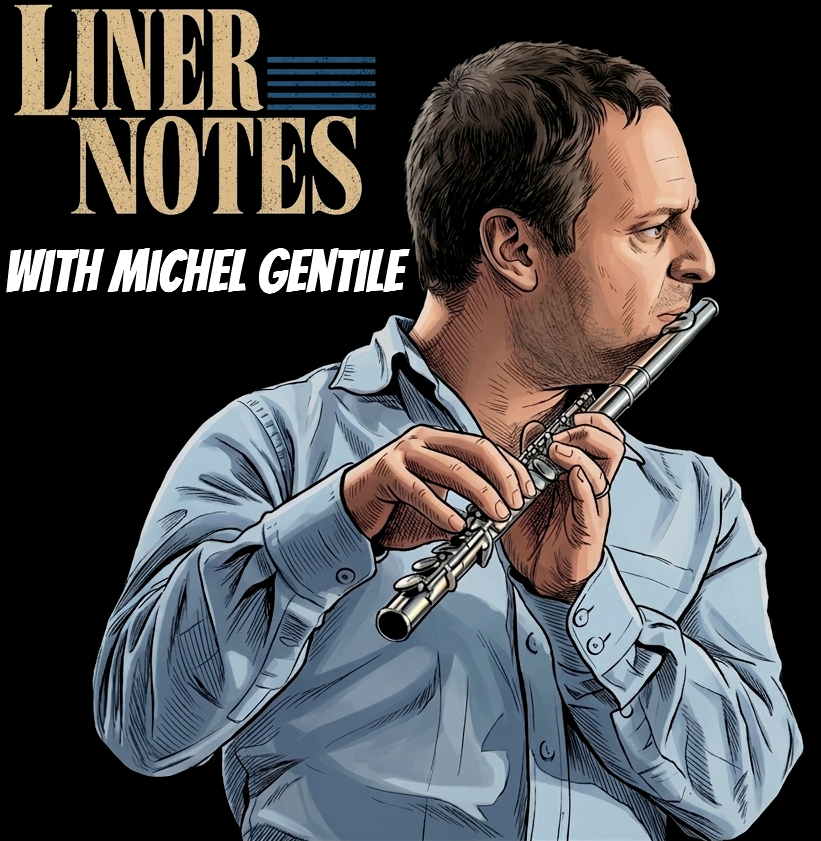
“Liner Notes” is a Sounds Visual Media spinoff series where musicians, composers, DJs, beatmakers, and collectors dig into their crates to share favorite records. In this installment, flutist/composer Michel Gentile discusses his album album Light Of Day, which features his ensemble “Flow” performing complex, evocative compositions designed to foster a state of energized focus through rich, varied instrumental interplay.
___
Michel Gentile: I am a flutist, improviser, composer, and bandleader. I’m here to talk about my very first release as a leader. While I have been recording and releasing music for many years, it has usually been in collaboration with others or as a sideman. This is the first time I’ve put out my own project, which is incredibly exciting.
The album is called Light of Day, and it is released on Connection Works Records, a nonprofit organization that I run alongside drummer Rob Garcia. We primarily present music in Brooklyn, and I am incredibly proud of what we’ve built. We have hosted world-class musicians—everyone from Joe Lovano to Mark Dresser; you name them, they have performed in our series. Running this organization has ultimately allowed me to release this record.
The recording features an incredible band. Michael McGinnis on clarinet,
Jacob Garchik on trombone, Chris Lightcap on bass, Tom Rainey on drums, and myself on flute, alto flute, bass flute, and piccolo.
This specific instrumentation is one of the aspects I find most interesting about the recording. It gives the album a distinct personality and a truly unique sound. This lineup allows for deliberate timbral choices on my part and creates a lot of space, giving each instrument its own sonic arena to play in. I am deeply pleased with how it turned out. Everyone who has heard the band or listened to the record comments on how distinct the writing and overall sound are.
Speaking of the writing, I am thrilled with the final result. When I compose, I try to ensure that each piece establishes its own distinct personality. I feel this recording successfully achieved that; each piece dictates its own form, approach, and improvisational style. We explore many different ways of balancing improvisation and composition.
Track Spotlight: “Light of Day”
I wrote this piece in honor of my wife, and I wanted to ensure it was up to the task. I didn’t want it to be just a simple nod to someone I care so deeply about; I wanted it to be sophisticated and complex, reflecting the nature of who we are. Dedicating it to her helped me delve much deeper into the structure and writing.
The piece consists of several sections. The opening section features three very different musical identities that coexist simultaneously. Following the opening, we transition into a four-part canon, which is quite unusual for this genre of music. From there, the piece evolves into a rhythmic hocket, for which I drew heavy inspiration from the Pygmy music of the Congo.
Finally, we arrive at an amazing drum solo by Tom Rainey. As we transition back out of the solo through the hocket, we return to the opening section. This time, however, everything has been transformed by what came before. The three distinct identities from the beginning have adjusted, falling into a much more unified and cohesive whole. I love when a piece influences itself and evolves as it moves through the composition.
Track Spotlight: “Chthonian”
The second piece on the album is called “Chthonian.” I love the spelling itself, but the fact that it refers to spiritual entities inhabiting the underworld gives it an even more interesting layer. This track has a completely different vibe and is heavily influenced by chamber music.
I play the alto flute on this track, which immediately shifts the sonic palette. I share the melody with the clarinet, and we move into stationary sections where time seems to stand still before the momentum picks back up. The approach to improvisation is also entirely unique here: the alto flute improvises over a rhythmic pattern, and then the clarinet and trombone play a duo over the structure of the piece. We then reiterate the head before heading out into the underworld and into eternity.
Track Spotlight: “Flesh and Steel”
This piece follows a much more traditional song form. However, when we get to the improvisation, each player receives an unaccompanied cadenza—a solo section where everyone else completely lays out. That is highly unusual for this style of music.
This structure was inspired by the fact that the piece was composed in response to 9/11. I wanted to find a way to express how we all shared a deeply similar experience of that tragic event, yet everyone’s individual experience was entirely unique. While the band plays together, each soloist is given a dedicated moment alone. This is another example of a fluid, creative approach to composition and improvisation.
Sounds Visual: If you were pulling a few records from your shelf that really defined your path as a listener, which ones would you put on?
MG: If I were to talk about the music that has shaped me over the years, it would be easy to list icons like John Coltrane, Ornette Coleman, Charles Mingus, J.S. Bach, György Ligeti, Stevie Wonder, The Beatles, or the Nevilles—I could go on forever. To avoid that, I want to highlight five specific recordings that most people might not have heard of, but which I carry deeply within my consciousness because they help me keep an open mind.
Paul Motian Trio, It Should Have Happened a Long Time Ago (ECM, 1985): Featuring Joe Lovano and Bill Frisell, everyone sounds spectacular on this record. What makes it particularly remarkable is that you can hear the melody sustained throughout the entire album. Even during intense improvisation, each player—or the accompanist—is still actively playing the melody. We often hear stories about great improvisers keeping the melody in their heads, but this is a whole other level because you can actually hear it woven directly into the notes they choose. The amount of work required to get everyone on the same page like that is truly impressive.
Lhasa de Sela, La Llorona (Atlantic/Audiogram, 1997): Lhasa de Sela was a phenomenal singer. Though she operated more within the pop idiom, her delivery deeply reminds me of Billie Holiday; it is unlike anything else I’ve ever experienced. La Llorona consists entirely of Spanish and Mexican songs. The orchestration and production are magnificent, blending modern and traditional instruments. It features those exciting creative choices where the piece itself dictates the form—whether that means a long cello interlude, a clarinet solo, or Lhasa simply singing the song straight. It is wonderfully orchestrated, so please check it out.
Colin Turnbull (Field Recording), The Pygmies of the Ituri Forest (Folkways, 1958): As I mentioned earlier, Pygmy music has been a massive influence on me, and I was thrilled to see this field recording become available online. Listening to it reveals an entirely different way of conceptualizing music. They don’t approach music the way Western traditions do. It feels as though everyone collectively understands they are part of a singular happening. Yet, to my foreign ear, it is amazing how comfortable each individual feels moving and shifting things around. There is immense room for improvisation, with voices and rhythms constantly weaving in and out of a cohesive sound. I never tire of it.
Air, Air Lore (Arista Novus, 1979): This album deserves far more recognition. It features the great trio Air, with Henry Threadgill and Steve McCall, performing early jazz and Dixieland songs by the likes of Bix Beiderbecke. It is fascinating to hear a highly modern trio tackle early jazz repertoire, showcasing how deeply connected they are to the history of the music while allowing the compositions to retain their core identity.
Dave Douglas, Charms of the Night Sky (Winter & Winter, 1998): This album features a potent chamber music vibe, utilizing a distinct lineup of accordion, trumpet, and bass. The pieces are beautiful. It serves as a perfect example of a record where each song retains its own unique identity, yet a unified, incredible band sound binds the entire project together.
Thank you once again, Justin, for hosting me and for everything you do. And thank you to everyone out there for listening to the music if you get a chance.
Leave a Reply
You must be logged in to post a comment.