
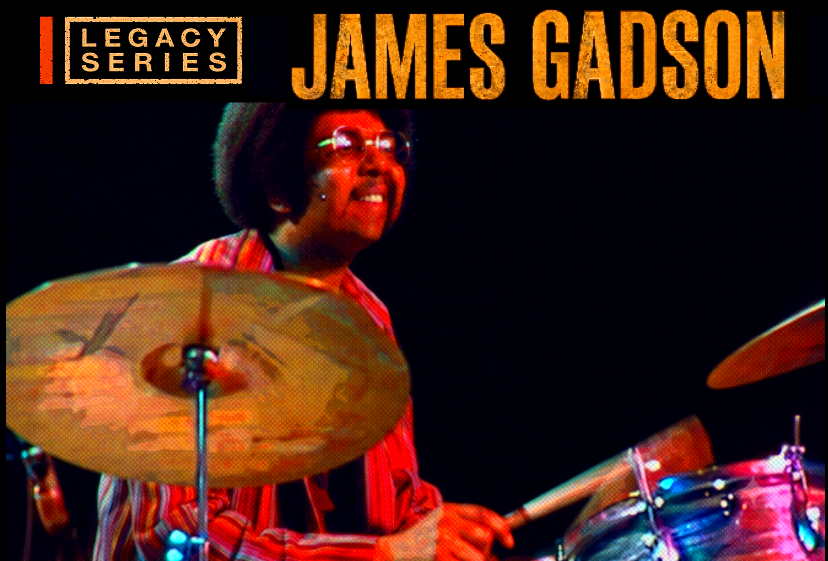
The Legacy Series cuts through the static to pay dues to the departed masters. In this reflective conversation, James Gadson takes us through his storied career by revisiting his iconic drum contributions, offering personal anecdotes and technical insights.
___
James Gadson: I’m from Kansas City, Missouri. I was a doo-wop guy. I loved to doo-wop sing. We had a group called the [Kansas City] Carpets. My brother and I, and we were singing. And I went into the Air Force. Unbeknownst to me when I got out of the Air Force, my brother had a group, had been learning to play guitar during the four years that I was gone, and he had a working band. So he invited me into the band.
I wasn’t a drummer at the time. I could play a snare drum, some beats, and stuff. And I played a little piano and I was a frontman. I sang and danced, and the drummer was a bass player. So I had to take the drum chair. And I had to get my drum chops up. You know, I had to, actually I had to learn how to play a set of drums. And so doing that at the time, when I was playing with him, I was learning. And that’s how I got it together. I think I was 21 years old when I started playing–really started playing a set of drums. So it’s been a blessing.
My father was a drummer. But he didn’t want me to touch his stuff. And he didn’t want me to be in the music business. So he bought us cornets. And so I played that in the high school group. I played the marches and stuff like that. But I didn’t really like it. I was trying to be a doo-wop cat. I liked all the doo-wop things. That group stuff. So I would play hooky a lot from school.
Some friends of mine were on the television show “Soul Train.” I thought they had made the big time. Great. So they said, “Come on out.” So I came out and I couldn’t play the music, but because by that time, I had gotten into jazz. I wasn’t playing the—at that time we called it rock and roll. You know, R&B was rock and roll at that time. And I couldn’t play the R&B stuff. I was a jazz cat, you know. I was playing the B3 organs was happening, So I was playing jazz.
It was pretty rough out here for me for about five years. Back when I first came out to California, I met a famous drummer from New Orleans named John Boudreaux. He had played on a lot of those R&B records, but he was a jazz drummer, too. Since I was starving to death and things were pretty rough, he said, “Man, I’ll get you a gig.”
So he got me a gig with Charles Wright and the Watts 103rd Street Rhythm Band. Charles was the left-handed guitar stomper who played the chinks in the studio. He was a studio musician, and I didn’t even know anything about studio musicians—I didn’t even know they existed. He fired me about five times, but I don’t think he could get anybody else, so he finally said, “Man, just play fours.”
So I just played fours: fours on the hi-hat, fours on the snare, fours on the bass drum. I just kept the time and didn’t play any fills because I didn’t know anything about that world. I was a jazz cat, so the fills I played were way different from the ones used in R&B or pop drumming.
I had to learn, so I started listening to different things—Motown and Stax. At that time, there were so many different regional recordings from places like D.C., the Carolinas, Atlanta, Detroit, and Memphis, so I would listen. A lot of people would call me to do sessions once they knew I was a new session player—they used to call them “scab sessions.” I guess most of the time I didn’t even get paid because what I did was awful. I thought I knew but I didn’t know.
Anyway, I finally got it together. A friend of mine—the famous guitarist and former Earth, Wind & Fire member Al McKay, who has his own band now—used to play club gigs with me. We’d sometimes run into each other after a gig at a hamburger eatery to grab a bite to eat and talk. One night, I saw Roland Bautista, who was with Earth, Wind & Fire at the time.
Roland said, “Man, you want a session?” I said, “Yeah.”
The famous radio disc jockey Art Laboe had a record company and a studio called Original Sound, and Dyke & the Blazers was one of his artists. So I had a session up there, and the first session I played on turned out to be a hit record called “Funky Broadway.” I didn’t know it was a hit, and I didn’t know I had done it well, but I was just glad to get the session and get $50. If it was scale wages, it might have been $35.
At the same time, I was playing with the Watts 103rd Street Band before they even had that name. Once we became the Watts 103rd Street Rhythm Band, we got a contract with Warner Brothers, and I played on our first hit record, which was called “Do Your Thing.”
It was built on the vamp from the Otis Redding version of “Satisfaction,” and we laid a groove over that vamp, which became the hit record “Do Your Thing.” After that came “Love Land,” which was a record that I sang—a number two pop record. The leader [Wright] and I didn’t agree with one another about the writing of “Love Land” and other writing that I had done that he thought he should be included in. So I left.
But during that time, I met Bill Withers over at Charles Wright’s house. Later on, I went to the studio with Bill, and it was awful. The first stuff we did, nobody knew what they were doing. But anyway, I guess about a year or two later, he had a hit out—”Ain’t No Sunshine”—and it was big. I said, “Well, that was great.”
The trombonist in the Watts band had been working with Bill on the demos, working with his timing and everything. They kind of fell out because I think he thought he was going to produce Bill, which Bill’s camp thought would have been right. But some of the company didn’t recognize this dude and didn’t want that to happen, so they got Booker T. Jones—the famous Booker T.—to produce “Ain’t No Sunshine.”
Anyway, Booker T. got busy, and so we did a few gigs for Bill on the road. We were working with him on the road, and I was still playing this beat. I made up the beat for “Use Me.” We came back to L.A., and they gave him three days of studio time because they were looking for a producer for him. He didn’t trust their productions because they didn’t know anything about him producing. Anyway, we went in the studio, cut the track “Use Me,” and it turned out to be pretty big. He didn’t look back after that.
And so, I did some stuff with him and did a couple of albums with him. It was pretty big—Just As I Am and Still Bill, which were great. We had a good time, but he wanted to do something else, so we parted ways.
I happened to be doing a session one day at the Record Plant, which was on Third Street at that time—the famous Record Plant. A contractor by the name of Bill Mitchell saw me and said, “Man, James, guys have been looking for you over at Motown for two years. Can you read music?”
I said, “Yeah,” which was a lie.
Anyway, I started doing sessions over at Motown, and it was kind of rocky at first because my reading was nothing. But I would come home every evening and study. I got some books and studied, and for some reason, they would still let me come in every so often. So I got it together, and everything started to turn positive. That was great; I learned a lot. Motown was a school for me.
I was blessed because I had to learn how to play R&B. I couldn’t play R&B like everybody else at first, which is how I got my own style and why they used me. Playing with me and Bill Withers was a different type of drumming than Motown drumming, so when I went to Motown, I had to learn how to play Motown. It was all great, and I was learning.
I played for a lot of different people, and I’m on 500 gold records in my career. I think that’s great, and I feel very blessed. I’m a Christian, so I feel very blessed to have accomplished what I have accomplished. Although I wanted to be a singer—that was my thing, and I was a better singer than I was a drummer at one time—it turned around. It happens like that.
Sounds Visual: A lot of session musicians didn’t get proper credit for their work at Motown. Who were some of the artists you worked with during that time?
JG: The Temptations, the Jackson 5, Smokey Robinson. Oh man, Gladys Knight. I mean, you know, with the Four Tops. Wow, I mean, you know, I worked with everybody over there—the Supremes, you know. And I was on some hit records with almost everybody, you know. “Dancing Machine” with the Jackson 5 was one of them.
SV: You also got to do some session work with Marvin Gaye for the song “I Want You.” Can you talk to me about that?
JG: Leon Ware [was producing that session]. Well, I had done some stuff with Marvin prior to that. He was producing a group called the Originals, and I did some work for him. But then Leon Ware was producing Marvin. I think Leon was working on his own, and when Marvin Gaye heard what Leon was doing, he thought that might be good for himself. I don’t know, but I think that might have happened like that.
So that’s how “I Want You” came out. The story on that was, I had been over at Motown for about two years, and I was kind of worried because the arranger hadn’t showed up. I was nervous—even though I would have gotten paid, I didn’t know that at the time—so I just started playing.
When Jack Ashford came in with his tambourine, he looked at me and said, “Man, what are you doing?”
I said, “Well, the arranger hasn’t showed up.”
He said, “Man, keep playing that.”
And Leon came in and said, “Man, keep playing that.” So we cut the track. That was the track.
SV: The next record here in my stack that I wanted to ask you about is by Eddie Kendricks. It’s his 1974 record called For You, and the specific song that I wanted to highlight is called “Shoeshine Boy.”
JG: Eddie Kendricks’ “Shoeshine Boy”—I played the sixteenth notes in that one. Because a lot of it… at Motown I didn’t get to play a lot of the sixteenth notes, you know, at first, but on “Shoeshine Boy,” I got to play that. They had a certain way that they wanted the drums.
SV: Skipping ahead a little bit to 1982, and the album is The Nightfly by Donald Fagen…
JG: What happened with that was they had called me to do three weeks’ work and they changed their mind at the last minute. They changed their mind and said, “Well, we think we’re going to use Jeff Porcaro.” And so they gave me a session. I thought that they would just pay me. You know, I said, “Well, maybe they’ll just pay me, I won’t have to go in.”
And so I had to go in for that one because, you know, the union at that time required that they’d have to pay me or give me a session for them to all of a sudden change. So I came in, and they got a drum sound. They got a drum sound in about five minutes—it wasn’t even ten minutes long. It was Roger Nichols in there, and he’s known for getting a great drum sound.
So I didn’t think they were going to use it. I mean, I think I did about four songs in about an hour. It was just me and the click track, and whoever was there was saying, “Hey, don’t play no toms and when you hit the cymbal crashes, hit them soft.” They had the music, and I could read drum music by that time. So I remember that one, “Ruby Baby”—I think that’s the one they kept that I did.
SV: And then the amazing work just continues. You went on to do three records with Patti LaBelle…
JG: Yeah, that was up in San Francisco with David Rubinson. That was interesting up there and we had a good time. I think the one that I remember the most that I liked up there was “You Are My Friend.”
SV: And then you had like a five or so album run with Smokey Robinson?
JG: Well, the biggest one was “Cruising” with Smokey. That was a big one.
SV: You also cut some records with the so-called three kings of blues: Freddie King, Albert King, and B.B. King. What a trifecta!
JG: I worked with all the kings almost. Albert King and Freddie King. Yeah, and the first time I worked with Freddie King was in Kansas City for 35 hours. And then later on, I recorded with him.
And then Albert King, I think I did a couple of albums with him. Cadillac Assembly Line was one of them. And I had done some movies during that time, and B.B. was there. I had done different things with different artists with B.B., so we kind of knew each other.
What was the name of that one [I played on]? It was a hit.
SV: And you also played on a record by Leonard Cohen in 1992 called The Future, right?
JG: Yes, you know, they won’t give me credit for that. And I enjoyed working with Leonard Cohen. It was out in—what was that studio?—on Magnolia. I can’t think of the name of the studio, but man, while I was working with him, I met a famous bass player out there who was playing with him. Man, it was great. We had a good conversation that day. We had a good time over there talking, and so I got to meet him at the time I was doing the Leonard Cohen album.
SV: You played some drums for Paul McCartney on his album Chaos and Creation in the Backyard.
JG: It was great, man—you know, one of the biggest pop stars going on in the world. He was very, very nice.I would ask him about different things, and he was very gracious-I said, “Well, I mean, how did you write ‘Yesterday’?”
So, I mean, he was great, man. He told me, he said, “Little Richard taught us everything we know.” He was great.
SV: Next up in my stack of records here are a few from Herbie Hancock. You’re playing on some of these great mid- to late-70s records that Herbie cut, including Man-Child and Secrets.
JG: Yeah, that was great. I did that a lot at that time in San Francisco, and David Rubinson was his manager at that time. Working with Herbie Hancock–that was great.
SV: Next up I’ve got a record from Minnie Riperton from 1977 that you’re playing on called Stay in Love.
JG: Oh man, she was beautiful. She was such a beautiful singer and a beautiful lady. Working with her was great, man—Freddie Perren was producing her. It was just great.
SV: Moving over to another great female vocalist that you worked with, Patrice Rushen, and you played on one of her biggest hits, which is called “Hang It Up.”
JG: That was great, man, because it was a jazz-funk record—the first time I did that style. It was an instrumental record, and that first one I did was great. She was a wonderful educator, even back then, because she made it very comfortable for me to play her music. She knew what she wanted and made sure it got to be that way.
SV: The next record I wanted to ask you about is by organist Charles Kynard. And it’s a self-titled record that he released in 1971 on the Mainstream label.
JG: He was from my hometown in Kansas City, Missouri, and his father was a top, famous jazz musician. That was the first session I did when I came to Los Angeles, California, and I thought it was awesome, even though I didn’t think I did a good job at all.
He was trying to get me into Motown—he and Carol Kaye were on the gig, saying, “Get him a gig at Motown.” The volume was so intense it might have made my teeth shake because I didn’t know what I was doing. He was a great musician; Jimmy Smith and all of them used to come just to listen to him.
SV: Here’s one from the vocalist Marlena Shaw. You’re playing on her record Sweet Beginnings, which was her first record for Columbia after leaving the Blue Note label.
JG: Yeah, that was great, too. Bert DeCoteuax was her producer [on that record]. Yeah, I was over at Total Experience Studios. I remember that. And I worked with her. I got to work with her on a couple of live engagements. At the time, the jazz club Per George was on La Brea in Washington at that time. So I got to do a couple of, you know, engagements with her. Fantastic, fantastic artist.
SV: You also cut some records with Blue Mitchell, one date for RCA and two for Impulse…
JG: Wow…Blue Mitchell. We had met before. I used to have a Sunday gig from six in the morning to two in the afternoon at an after-hours jazz club on the East Side. The FBI had been peeking in, and with the prostitutes and everybody out at the same time—even Cannonball would come over there sometimes.
That’s where I met Blue, and later on I got to record with him. It was kind of fun, but also strange that day because Blue wanted me to stretch out a little more, while the producer kept saying, “Man, just play the R&B, play that, don’t stretch out.” It was funny—Blue would say one thing, and the producer another. I don’t know what that session was, but it was something else.
SV: JWe’ve come to the last, but certainly not least, record in my stack here to ask you about, and it’s by D’Angelo. The record is called Black Messiah. Tell me about working with D’Angelo.
JG: That song “Sugah Daddy”—I was one of the writers of that. What happened was I was warming up, doing hand claps, and playing a rhythm on my chest and my foot, and the engineer recorded it without me knowing.
It was great to work with D’Angelo. I worked with him and Pino Palladino—that’s where I first met him. It was a wonderful, wonderful experience.
SV: James, so many of these records that you’ve been featured on–and specifically, drum tracks that you’ve played on–have been sampled hundreds of times in the world of hip-hop. How do you feel about that?
JG: Well, it’s evolution. I don’t get paid like I think I should. For one thing, if a hip-hop artist brings a drum beat in, he gets half the writers’ shares. That doesn’t happen if they sample us. If we get paid at all—a lot of times we don’t—for some reason, they just don’t get it.
It’s good in one sense to be loved by the youngsters, but then again, that part of it might not be so cool if you know what I’m saying. If they sample you, you might get $15. Meanwhile, whoever the artist was on the original record gets another fee—a big fee as the artist.
When you hear your records and your work, I always hear something I could have done better. But I got a reuse check for “Don’t Push It, Don’t Force It” by Leon Haywood, and I didn’t even remember the record. I went to YouTube and put it on, and it was good. So things like that happen.
I miss the Bill Withers days; I miss that. And I never take a session for granted. I go in there and I try… it’s like a heavyweight championship fight. It’s very serious to me. When somebody calls me to play the music, I take it very seriously.
SV: Alright, James. Well, thank you so much for talking with me. From one drummer to another, you’ve been such an inspiration to me, and I really enjoyed the chat.
JG: Well, thank you for inviting me. God bless you.
___
James Gadson passed away on April 2, 2026.
___
Further listening:
As leader / solo projects
Good Taste in Love (Cream, 1972)
James Gadson (Cream, 1972)
As sideman
Charles Wright & the Watts 103rd Street Rhythm Band – Express Yourself (Warner Bros., 1970)
Bill Withers – Still Bill (Sussex, 1972)
Marvin Gaye – Let’s Get It On (Tamla, 1973)
Bill Withers – Live at Carnegie Hall (Sussex, 1973)
Herbie Hancock – Man-Child (Columbia, 1975)
Marvin Gaye – I Want You (Tamla, 1976)
The Brothers Johnson – Look Out for #1 (A&M, 1976)
Boz Scaggs – Silk Degrees (Columbia, 1976)
Bill Withers – Menagerie (Columbia, 1977)
The Brothers Johnson – Right on Time (A&M, 1977)
Cheryl Lynn – Cheryl Lynn (Columbia, 1978)
Patrice Rushen – Straight from the Heart (Elektra, 1982)
Beck – Sea Change (Geffen, 2002)
Paul McCartney – Chaos and Creation in the Backyard (Parlophone/Capitol, 2005)
D’Angelo – Black Messiah (RCA, 2014)
Leave a Reply
You must be logged in to post a comment.