
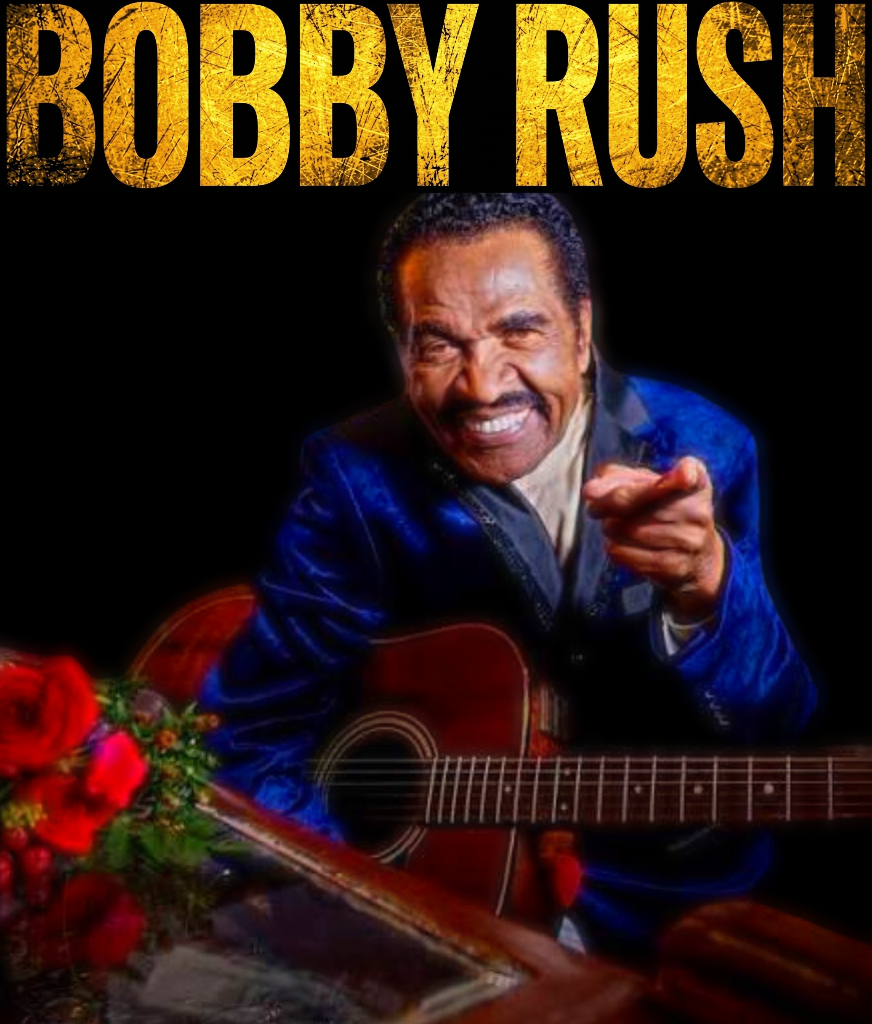
Grounded in decades of pioneering blues, funk, and storytelling, legendary 92 year-old musician Bobby Rush remains dedicated to preserving his history and passing his hard-earned wisdom on to the next generation.
___
Bobby Rush is a legendary blues icon known as the “King of the Chitlin’ Circuit” for his decades of relentless touring, energetic live shows, and unique blending of traditional blues with elements of rap, funk, and soul. Over his career spanning more than seven decades, he has been inducted into the Blues Hall of Fame, earned over a dozen Blues Music Awards, and won three Grammy Awards for Best Traditional Blues Album, including his 2024 win for “All My Love for You.“
Born to a pastor father whose guitar and harmonica sparked his early drive, Rush started out on a sugarcane bucket and a broom-wire diddley bow before his family moved to Pine Bluff, Arkansas. There, he honed his craft alongside heavyweights like Elmore James, Boyd Gilmore, and Johnny “Big Moose” Walker—forming Bobby Rush and the Four Jivers with Gilmore, Walker, Pinetop Perkins, and Robert Plunkett, and connecting with Ike Turner.
As a teenager, Rush rocked fake moustaches to sneak into juke joints and light up local crowds. By 1953, he relocated to Chicago, diving deep into the city’s legendary blues circuit. Guided by neighbors Little Walter and Muddy Waters, Rush picked up gig playing behind a curtain for white audiences at Skins, backed Jimmy Reed, and earned his stripes sharing stages with Etta James, Howlin’ Wolf, and Muddy Waters.
___
Sounds Visual: When you’re building a groove now, are you still chasing that behind-the-beat, almost dragging feel you heard in Jimmy Reed’s band some seventy years ago?
Bobby Rush: Yeah, I still have that in me, because I was part of those Jimmy Reed sessions myself. It’s almost like a waltz feel — that delayed pocket, where the “one” lands late. That’s where that beat comes from. I like straddling both sides of that fence — the “one,” and the “and” of two — plus the jazz-oriented feel I picked up from my time around New Orleans, the blues I know from Mississippi, and my father being a preacher, which gave me the gospel side too. So I had all that mixture around me growing up — New Orleans, the raw stuff, all of it in my ears. A lot of direction went into me, and when you hear me play, you’re hearing all of that stirred together. That’s how you get “Bobby Rush.” You following me?
SV: Absolutely. You’ve also credited James Brown with teaching you to imply things rather than say them outright — asking a question in a song instead of answering it, so the audience fills in the rest.
BR: You’re so right to bring that up. As a Black man coming up in that era, you couldn’t say certain things outright, especially about race. James Brown had a song called “Say It Loud – I’m Black and I’m Proud.” But if you actually listen to the record, James never sings “I’m black and I’m proud” himself — he just sings “say it loud,” and it’s the background singers who answer “I’m black and I’m proud.” That was a smart move on his part.
I learned to do the same thing. I had a record where I told a story about a woman — I said she went into the house, and I implied what happened after that without ever saying it outright. I’d flip the order of details — say one thing was “on the house” and another “on the low,” then reverse them — so the listener filled in what they thought happened. I never actually said it. That’s a trick I picked up from artists like James Brown, who couldn’t say what they wanted to say directly, so they implied it instead. That happened to a lot of Black men of that generation — especially around anything racial.
SV: Your sound has moved through blues, funk, disco, even some rap influence over the decades, without you ever stopping being a blues singer. When a new sound catches your ear, how do you decide whether it belongs in your music or if it’s just something you admire from a distance?
BR: Some things I admired from a distance, because I wasn’t going to let just anything take me somewhere I’d never really been — but I’ve always loved adapting to what’s new. Take this call, for example — fifty years ago we couldn’t have done an interview like this over the phone; you’d almost have to be sitting in the same room to get proper sound. Now people record in their bathroom, digitally, and it works fine.
I use this example a lot: when I was a kid, we didn’t have an indoor bathroom — just an outhouse that smelled bad and looked bad. Now I have nine bathrooms in my house that look and smell good. But what you actually do in there hasn’t changed. You have to modify the things around you — the tools change, but the purpose stays the same. That’s what I did with my music.
I’m glad you’re a drummer, because you’ll understand this: the drum sets the direction for everything. Whatever the beat is, that tells you where the song is going, and I write the music around that beat.
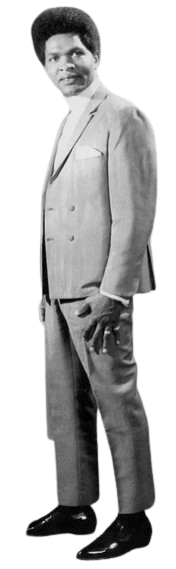
SV: That’s where it all starts, man. Let me ask about family for a bit. You took the name Bobby Rush partly out of respect for your father, who was a pastor — and then built a career on material, including some pretty flirtatious songs, that he might not have approved of. Did that tension with him ever get resolved, or did the name itself become a kind of answer?
BR: It kind of became the answer, but that’s not why I did it — I never did it thinking I’d become “the legend Bobby Rush.” My real name is Emmett Ellis Jr., named after my father, who pastored a couple of churches. I had so much respect for him that I didn’t want people announcing “Emmett Ellis is coming to town” and have folks confuse the junior with the senior — I didn’t want to make my father, as a pastor, look bad by association with the kind of material I was doing.
So I changed the name — but I’d actually had it in mind before I got popular. I’d gone through six or seven different names before that, and every one of them had two syllables. I wanted something with just one syllable. I landed on “Bobby Rush” — people wouldn’t just call me “Bobby,” and they wouldn’t just call me “Rush.” They’d say the whole thing: Bobby Rush. There are plenty of “Bobbys” and plenty of “Rushes,” but only one “Bobby Rush” — something people would actually remember.
SV: You’ve spoken about some heavier parts of your life in other interviews — losing your wife, some of your children, in-laws, a sister-in-law. Is there a version of grief that never really leaves, that you’ve just learned to carry while you keep working?
BR: I don’t think it ever fully leaves. It’s sometimes a burden on my heart, trying to carry on because of what they meant to me. I lost family members — including a sister-in-law who, along with her siblings, moved into my house when they were so young that they thought of me as a father, even though I was really their brother-in-law. Two or three of them passed. All three of my children passed. Then my wife passed. That’s a lot to carry — a lot to pick up.
I don’t talk about it as much as people ask me to, not because it’s a burden, but because I see it as a blessing that I was able to pick myself back up. In this life, it’s not a question of if you’re going to fall — everybody’s doomed to fall one way or another. What matters isn’t the falling. What matters is getting back up. And if you can’t get up, roll over and look up.
I’m blessed, and I’m still here. When people listen to me in interviews, they sometimes think I’m rambling and don’t remember what I’m saying — but I do. I just choose not to say certain things, because if there’s one thing I’ve learned through living, it’s that a man doesn’t really know anything. And I’ve found I’m better off than people who think they know everything — because someone who claims to know it all usually won’t talk for very long before that becomes obvious.
SV: I know that I know nothing…
BR: That’s right. That’s exactly right.
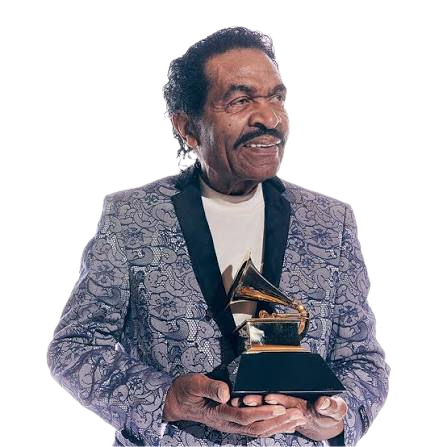
SV: You own more of your masters than any living Black blues artist. But you’ve said what you own sometimes gets treated as worthless, because some people just see you as “a blues singer.” What would it take for that to actually change — is that a fight for your lifetime, or one for after you’re gone?
BR: I’m hoping it’s already changing now, while I’m alive — that people come to understand and take advantage of what I’ve built. Every time I stop somewhere, I write something down, because most people in life lose their history simply because it was never written down. I write on everything — scraps of paper end up in my pockets constantly.
It’s not so much that I don’t remember — it’s that direction changes. One year someone points you one way, and the next year, once you’ve learned something new, you’re pointed somewhere else. You have to take all those notes and put them together, because there’s nothing new under the sun — it’s all been done before, one way or another. You look back at your notes and realize: here’s what James Brown did in 1963, and twenty years later, you see the same idea resurface. So when people say “it’s a new day,” I ask — what does that actually mean? God made this world and everything in it; you just learn what you need to learn from it, do your best with it, and go from there. It’s like writing a book — you can only write about what you actually know.
SV: You’ve said you used to perform behind a curtain — people wanted to hear your voice but not necessarily see your face. Now you’re being seen in places like the Oscars. What does it mean to you that the visibility came this late — assuming it means anything to you at all?
BR: Back in the early days, people wanted my music but not my face. Now people can see my face, but I notice both Black and white artists play the same kind of music I play, and some of them still get more of a platform than I do — it’s the same dynamic, just dressed differently.
Artificial intelligence isn’t new, in a sense — it’s been here in different forms going back to slavery. Not every enslaved person was treated identically; there was a system where lighter-skinned enslaved people were sometimes placed over darker-skinned enslaved people to control them on behalf of the people who actually held power. In some ways, similar structures persist today, with things like AI…
SV: That’s actually my next question — you’ve compared AI generating music in an artist’s style to the way some labels historically took writing credit from artists who couldn’t read contracts, and compared both of those to that practice of using lighter-skinned enslaved people to control others. Does that comparison hold all the way through, for you?
BR: Yes, all the way through — because I come from that background directly. My grandmother’s role in my family history touches on that. I had a babysitter growing up who had blue eyes, at a time when you often couldn’t tell someone’s full racial background just by looking. That’s different now, in some ways — a lot has changed — but a lot has also stayed the same.
I’ve learned, when I get hit in the face with things like this, that the wisest response is often not to say anything — just listen. Because the more someone talks, the more you understand exactly where their thinking really is.
Rush also contributed to the 2025 feature film “Sinners,” performing the harmonica parts for the character Delta Slim—most notably on the track “Juke,” a duet with Sammie (played by Miles Caton).
SV: I want to ask about Sinners. You told Ryan Coogler about the real words white patrons used to describe Black gatherings, which ended up shaping a line in the film.
BR: Let me correct that — I didn’t tell him to change anything. I was explaining to him, Black man to Black man, what had actually happened up in Mississippi. White people who saw a Black gathering, a jam session, wouldn’t think of it as people coming together to have a good time — they’d frame it in a way that implied something else, something they didn’t want to be associated with. That was the insult, to me — how that kind of gathering got characterized by outsiders. I was telling him something from my heart, because I wanted to be part of what he was building. I trusted my own experience enough to share it with him, and he understood it. He did his best with it, and I think he got it right.
SV: I’m also curious about the Broadway show based on your life that was finished but sat on a shelf for years. What can you tell me about that?
BR: It did well as a piece of work — I’ve never said this quite in an interview before, but it sometimes feels like people were content to let it sit, maybe waiting for a time when I wasn’t around anymore to benefit from it. It’s not that it isn’t good — it’s more that I’m ahead of the moment for it. I feel blessed to have lived long enough that if there’s ever profit from it, I might actually see some of that myself. That reluctance to move on it while I’m alive says something.
SV: You also worked with Delroy Lindo on his physicality and hands for Sinners, and you helped Mizz Lowe’s transition from dancer to singer for the film. What’s the difference between teaching someone to perform the blues convincingly and teaching them to actually understand it?
BR: Loving the blues and respecting the blues are two different things. Some people perform the blues because it’s profitable for them. I do the blues because it’s what I love — and I also respect it. I happen to believe the blues is the root and the mother of all music. If you don’t like the blues, you probably don’t like your own mother.
SV: Watching Delroy play Delta Slim — was there a moment where you saw something about your own body or voice that only became visible to you through someone else performing it?
BR: It reminded me of something from way back. Little Walter and I lived two streets apart in Chicago — I was on one street, he was on the next block over. I’d knock on his back door in the mornings and ask what he was working on. One time I showed him a lick I had, and a couple weeks later I heard that same lick on a Muddy Waters record — Walter had taken it and made it his own, better than what I’d originally had. I used to call him a thief for that, but really it was a compliment — he could take something I was working on and elevate it.
On the Sinners set, I was there partly to represent something for Black musicians of my generation — to make sure a place existed for musicians who don’t have the name recognition to open doors themselves. I noticed some of that generational tension — younger people sometimes carrying an attitude of “the old guys need to step aside.” But by the end, I think there was real respect, because without the people who came before doing what they did, the newer generation wouldn’t have the platform they have now.
SV: Hypothetically — if a fourteen-year-old came to you tonight with a painted-on mustache, trying to look old enough to play a juke joint, what’s the one thing you’d tell him that nobody told you?
BR: I’d probably tell him what Muddy Waters told me. I was underage myself back then — I’d lied about my age to work, and Muddy caught on. He didn’t make a big deal of it, but he basically told me: learn everything you can, and don’t get cocky about what you learn, because there’s so much you still don’t know. I tell young people to strive toward the things they can’t yet do — not just what they can already do — but to take care of themselves along the way.
I didn’t have anyone better to tell me that at the time, but I had people like Muddy Waters and B.B. King around me. Honestly, I don’t fully know what they saw in me as a fifteen- or sixteen-year-old — and sometimes I’d actually avoid them, because to me they seemed like “old men” with old ideas. They were maybe twenty years old at the time — which felt ancient to me then.
Now I’ve got young people coming to me the same way, and I’m glad of it. When I’m in Vegas now, it’s like one long jam session — most of the guys around are musicians who want to be full artists but are still auditioning for that, in a sense.
There’s a difference between a musician and an artist — like the difference between a cow and a horse. One gives milk, the other pulls a wagon; they’re both valuable, just different. You can’t really compare B.B. King the guitar player to a drummer the same way, but every part matters — your neck is important, your arm is important, but you can live without an arm. You can’t live without your neck.
SV: You’re one of the oldest active blues singers alive today. Does outliving your peers change what you feel responsible for saying now — like you’re speaking for people who no longer can?
BR: That’s exactly it. A lot of what I say now, I say because there were men who couldn’t say it while they were alive — and some younger men coming up don’t even know how to say it. So I’m speaking things they can’t say, and things that were never said. I remember accepting an award once and saying, “I’m accepting this for the men who came before me — they taught me what I know, and I’m receiving this in their honor, because without them I wouldn’t have the chance to do what I’m doing now.”
At this point, it’s not really about what people think of me personally — how I look, how I carry myself. What’s going to define me is what I’ve actually done, not what I’m doing right now.
SV: You’ve written somewhere north of four hundred songs…
BR: Closer to five hundred.
SV: …Is there one that got away from you — one you know is good but never found its audience, that you still think about?
BR: Honestly, that’s most of them, in some way. Making decisions in music is like the difference between an old man’s cry and a mother’s cry, or a child’s cry — they’re not the same, and neither is what people respond to. But the truth is, nobody really wants to hear the plain truth about life itself in a song — you have to draw people in first, and then you can entertain them with the truth. Being an entertainer means nothing if there’s nobody there to entertain. My father was a preacher, and even a servant of God means nothing if nobody’s listening. You have to have somebody there to hear you.
SV: You titled your memoir after your own song, I Ain’t Studdin’ Ya. What’s the difference between what that phrase means in a song versus what it means as the title of your life story?
BR: They’re much the same to me, but here’s where it comes from. I was maybe four, five, six years old, always hanging around my mother while she cooked — she made tea cakes, and I’d be right there in the kitchen with nine or ten other kids around. When I got underfoot, she’d say, “Boy, get outta here, I ain’t studdin’ you” — meaning, I’m not thinking about you right now, I’m not worried about what you have to say, just call me when it’s time to eat.
That phrase means: I don’t care what you say about me, I’m not worried about how you see me — I’m focused on what I have to do. That’s carried through my whole life, including in how I’ve presented myself — wanting to wear my own name, my own logo, rather than someone else’s brand, even when there was money in doing the opposite. I wanted to be myself.
SV: I have to ask you about “Chicken Heads.” A classic 45!
BR: “Chicken Head” started as a phrase. This was over fifty-five years ago — I was in Chicago, and a guy connected to Vee-Jay Records came up to me. I told him I had a song. He asked what it was called, and right about then a friend of his — a preacher — walked into the room. I said the title was “Chicken Head,” and the preacher laughed and said, “Oh, you’re from down South — y’all eat chicken heads,” and just kept repeating it, tickled by the phrase. That reaction told me the title alone was going to land.
They wanted to record it, but they needed a B-side. I was nervous to tell them what it actually was, because I’d already gotten away with a lot in the A-side without saying anything explicit. I told them the B-side was called “Mary Jane.” They assumed it was about a woman who’d done them wrong. It wasn’t — it was actually about smoking marijuana. They had no idea what I was really singing about, and I knew I could get it past them that way.
I recorded “Mary Jane,” but everyone just started calling the whole record “Chicken Head.” Within about six months, it was a number-one record across the country. I never expected that. [Note: “Mary Jane” was later sampled by the Genius (GZA).]
Above: Rush’s “Mary Jane” sampled on the “Life of a Drug Dealer” by The Genius (GZA)
SV: I also wanted to ask about your memories of “Someday.” Love this one.
BR: Jerry O came to me when he must have been around seventy years old. He was connected to Motown and knew people there, and was working on novelty dance material at the time — things like “monkey” dance records. He said if he was going to work with me, he wanted to try something different, and at first I thought he wanted me to work with Berry Gordy. But once he heard what I was doing with “Chicken Heads,” he realized that wasn’t the direction, and things went a different way instead.
Around that time, I picked up some local label work — I was a bricklayer by trade, and this same man offered to help produce a record for me if I’d help him with bricklaying around his record shop. I told him I knew someone who could do the work — meaning myself, though I didn’t tell him that. While he was gone for several hours, I finished the brickwork myself and had made real progress on the record too. When he got back, he assumed someone else had done the masonry — he had no idea it was me. That’s essentially how that record came together.
SV: Tell me about what “folk-funk” means as a label for your sound. It often comes up in pieces I read about you.
BR: That’s not a name I gave myself — someone else pinned it on me. As the story goes, Muddy Waters told someone, “I don’t know what to call Bobby Rush — he sings the blues, but he acts like James Brown, and he’s got the showmanship of someone like a Louis Jordan.” I fall in between categories — too much for one box, not quite fitting another. So somebody landed on “folk-funk.” That’s where it came from: I’m blues, I’m funky, and there’s a little jazz in there too.
SV: The funk element is one of the things that jumps out most to me listening back through your catalog — that’s part of why “Chicken Heads” caught my ear as a drummer. How do you balance humor with hard truth in your songs, so the serious message still lands?
BR: Early in my career I actually worked as a stand-up comedian. Redd Foxx was a friend of mine and wanted me to become a full-time comedian, which I didn’t want to do — but I kept the ability to tell a joke, and I carry that into my songs and my stage show. Being able to work as a comedian gives me room on stage to get away with saying things I couldn’t say plainly. I can tell a hard story in a funny way and still bring people back around to the truth in it.
I don’t lean on comedy just because people expect it from me — I only use enough of it to make people laugh and enjoy themselves, while the real substance sits underneath. For example, I’ve sung a line about a woman leaving me for the garbage man — it’s funny on its surface, because of who she supposedly left me for. But think about what that line is really standing in for: if a man dies in the war, he’s gone. If he falls from a window and dies, he’s gone. If a woman leaves you for a stranger, a neighbor, or just leaves on her own — gone is gone either way. I dress it up as something funny — “she left me for the garbage man” — but underneath, it’s not really funny at all.
SV: You mentioned Muddy Waters earlier — if you could talk to him, or B.B. King, today, as an elder yourself, what would you ask them about longevity, or why they believed in you?
BR: I wouldn’t know exactly what to ask them, but I know this: I’d treat them better now than I treated them back then. At the time, I thought of them as old men who didn’t really understand what was happening in the moment. Now I have young people around me treating me the same way I treated Muddy Waters and B.B. King — not understanding where I’m coming from. I’ve stopped trying to force that understanding. The same people I talk to now, as young as they are, will eventually understand what I was saying — the way I eventually understood the old sayings myself.
SV: You spent decades hustling, owning your masters, working the Chitlin’ Circuit before really becoming your own best producer. Now we’re in the streaming era, and, like you said, people can record a whole song in their bathroom. What part of that old-school independence is hardest to teach young artists who never had to hustle the way you did?
BR: I actually think they hustle even harder than we did, in some ways — they have more avenues available, but a much harder path to actually reach people, because there are more gatekeepers taking a cut along the way. It’s not enough to be known — you have to go through whoever controls the platform that gets you in front of people.
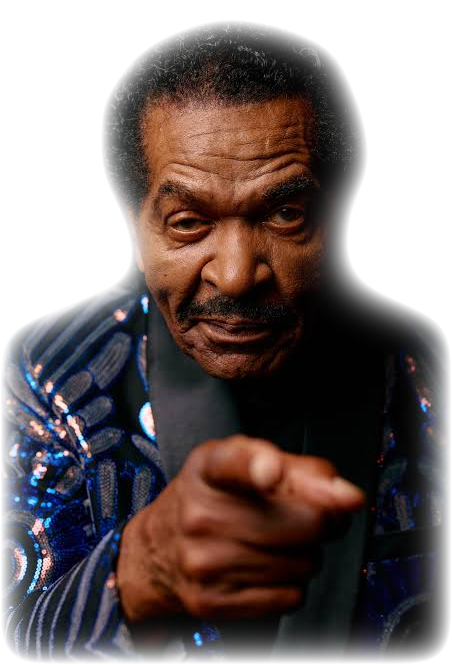
SV: That’s fair — though these are also artists who never had to deal with the especially oppressive distribution systems the labels used to run. Now someone can put a song on Spotify and reach the whole world. It’s a trade-off.
BR: Nothing’s really new under the sun, just different versions of the same problem. There’s no fundamental difference, other than what you’re able to make from it. I remember touring with my band, paying seven or eight dollars a night for a hotel room when we could even get one. That same room costs three or four hundred dollars a night now — it looks better, smells better, you’re treated with more respect — but you also pay out a lot more in taxes and overhead.
I remember Muddy Waters, B.B. King, and myself making a few thousand dollars a night back then; you make more money today, but you also spend more. When you needed a hundred dollars and only had eighty, you were in trouble. Now, when you need a million and only have eight hundred fifty thousand, you’re in the same kind of trouble — just with bigger numbers. The percentages don’t really change.
SV: The economics really are crippling in their own way.
BR: They are. Which is why you have to find a way to do things for less than what someone’s willing to pay you for them — that’s just the math of it now. You can’t pay a hundred thousand dollars for a car if it’s not going to bring back a hundred thousand dollars of value. It won’t pay off.
Take what we’re doing right now — this interview, this kind of promotion — years ago, this kind of thing wouldn’t have been possible in this form. But you still have to find a way to make it sustainable, unless you already have profit elsewhere in your life that lets you do things for free. Because nothing in life is actually free — even doing something “for free” requires that you’ve already built profit somewhere else to allow for it.
That’s exactly why I wanted this on tape. Where would the blues — and people like me — be without people like you? Think about artists like John Lee Hooker and others — some brilliant Black artists never got their due, because they didn’t have someone willing to record and preserve their story. If it weren’t for people, including white musicians and entertainers, helping carry the older blues traditions forward, where would the blues even be today?
What bothers me about the blues today isn’t who plays it — it’s that a lot of people who perform it don’t acknowledge where it actually came from. There are some, like Kenny Wayne Shepherd and a few others, who do talk about its roots — but not many. What really bothers me is hearing young Black musicians say things like, “I’ll play it this way because I think that’s what white audiences want,” or “I’ll play it this way because I think that’s what Black audiences want.” When I play what I genuinely like, and people respond to it, that’s not about race — that’s about the music.
I can say that now, at my age, in a way I couldn’t say it at twenty-five, because back then I had to play and record whatever I thought would be marketable or accepted. I don’t play for that reason anymore — I play what I believe is good, because I’m an artist now, and my stage is essentially my record shop.
SV: I love that. The tagline for this Sounds Visual series is: the story is the music…
BR: I love that too. I tell people all the time — if you’ve got a band playing but no story behind it, what’s the point? Sure, once in a million times an instrumental can carry itself, but almost always, you need a storyline. People don’t just remember me for a title — they remember “Chicken Heads” because there’s a story in it.
SV: If you could only keep two or three recordings that represent who you really are, out of your whole catalog, what would they be?
BR: Probably a song where I say, “We’ve come a long way, but I’ve still got a long way to go.” The things I used to have to do, I don’t do anymore. I used to carry water miles at a time as a young boy — it’s a shame a nine-year-old had to work that hard. I used to pick cotton in the same fields where I grew up. Now I still “pick cotton,” in a sense, but I own a piece of the field. I’m free now — I can see it. There are no more shackles on my feet or chains on my mind.
What I’ve learned is that I don’t know everything, and that’s what’s made my mind free. Anyone who sees my show can see that freedom. I don’t worry about what people think of me or how they treat me — I carry myself with the belief that God kept me here for a reason. I don’t claim to understand every reason why, but I’m thankful for it.
SV: You’ve spent your whole life blending things together — Louisiana rhythms, country storytelling, Chicago blues, gospel, funk, soul, the personalities of everyone you’ve crossed paths with — into what became “Bobby Rush.” At this point in your life, what’s still going into that mix?
BR: I want to show younger people what I’ve done and what I’m still doing, to wake them up to real life — because a lot of them have been fed a version of life shaped mostly by what’s popular in the media. The truth is, every man and woman is a child of God, and you have to find your own way through your own thinking. If you can’t think for yourself, you’re in trouble. And if you can’t quite get there alone, you should at least be willing to listen to someone who can help you.
Don’t ever believe you know it all — because the moment you think you know everything is the moment you actually know nothing. My motto now is to do all I can, while I can, because I know a day is coming when I won’t be able to — and I don’t want to carry regret over what I didn’t do while I had the chance.
SV: Bobby, I’m so glad we got to spend this time together — I can’t thank you enough!
BR: Thank you. I want to say — thank you for what you’ve done and what you plan to keep doing, because of how you represent me and artists like me to people. Thank you for keeping the blues alive. Anything you need, give me a call.
SV: You take care, Bobby.
BR: Thank you, man.
Leave a Reply
You must be logged in to post a comment.