

Dick Griffin’s fearless experimentation with multiphonics, circular breathing, and spiritual improvisation—shaped by mentors including Thelonious Monk, Charles Mingus, Sun Ra, and Rahsaan Roland Kirk—allowed him to forge a singular trombone voice beyond conventional jazz technique.
___
Dick Griffin is a pioneering jazz trombonist and master technician renowned for inventing “circularphonics,” a technique combining circular breathing and multiphonics. Over a career spanning more than six decades, he has collaborated with jazz legends like Duke Ellington and Sun Ra while establishing himself as an accomplished composer, educator, and visual artist.
___
James “Dick” Richard Griffin was born on January 28, 1940, in Jackson, Mississippi.
Sounds Visual: What do you think first drew you to musicians as a kid? Was it the sound, or the way they dressed and carried themselves — clean, no calluses, kind of a sign of freedom from manual labor?
Dick Griffin: You hit it right on the head, yeah, all of that. I grew up in a neighborhood in Jackson, Mississippi, called Under the Hill. And as early as I can remember — when I first went to church and started really recognizing gospel music — I was singing in all the little groups, choir, everything. I loved music.
Let me take it all the way back to where I really started. My mother used to sing a song that put me to sleep — she used to sing “Glory Hallelujah.” And I would always hear her saying “glory,” and that would put me to sleep. She would rock me in this rocking chair, singing “glory.” That went on to the point where I kept wanting it, and she’d say, “Okay, you’ve had two verses, now you go to bed.” I don’t know what age it was — three, four — but eventually it was, “Okay, enough of that, you go to bed now.” But I loved her singing so much that I can still hear it now.
And there was a guy, a neighbor of mine — Jesse — he played real good blues guitar for everybody in the neighborhood, every day after he got off work. That was it — that sound, that music, and how it made me feel.
And then, getting back to the Under the Hill situation — I lived in a place where, in the segregated South, they would bring the carnivals through. I remember the wheel that goes around — the Ferris wheel — and all the rest of it that they’d set up for a week. Actually, it was two weeks: the first week was for white people, and the second week was for Black people.
But the thing that impressed me about music at that time was the musicians — they didn’t have any calluses on their hands, they were just looking cool. I used to work for extra money whenever the carnival came to town — I’d go help them build the tents and set everything up, and make a little extra money. Even though it was segregated, we were the ones setting it up. But I was just so impressed by the way — I have to say — the lifestyle. They didn’t have to work hard, they were all cool, they dressed well every day, and dressing well in the South was a very special thing. If you wore a suit and tie, that indicated you were in one of two worlds — either the professional world or the underworld.
Mr. Charlie, my next-door neighbor, worked for the railroad. So he’d come in every afternoon after work in his suit and tie, his hat and his umbrella, strolling around the neighborhood. So wearing a suit and tie was a special thing — either you were a professional, a teacher, a doctor, a lawyer, a businessman — that was a big deal. But the musicians always had everything too.
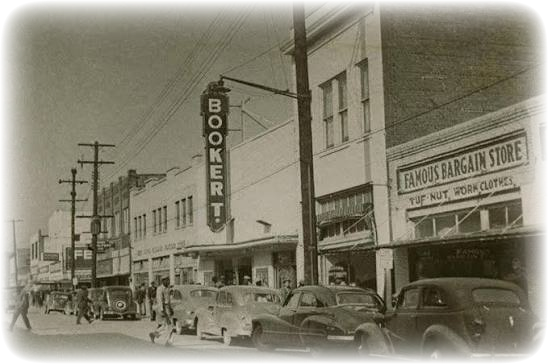
Above: Jackson, Mississippi, 1940’s.
And I’ll tell you the other side of it — it’s a long answer to the question, but bear with me. I was a teenager — in fact, I went through my early puberty years Under the Hill — and they used to have this show, the midnight show, the dances, you know. They would do a strip tease, but at the midnight show, they were totally naked. And I loved looking at those beautiful ladies dancing on the stage, and the guys playing music. Every night we would sneak under the tent to see the midnight show. That, along with everything else, made my week — made my year.
SV: You grew up moving between the legal and illegal successful people in Jackson. Of course you had the musicians, the teachers, the doctors, but also the pimps and the hustlers, and they were all sharp-dressed and respected. So my question is: did that ever blur any moral lines for you, or did you always see the distinction pretty clearly?
DG: Oh, I was right in the middle of it. In the early days, that’s what really got me into music. I started taking piano lessons when I was eleven years old. My friend Herbert Delaney was older than me, kind of a mentor — he started taking piano lessons, and we had to walk home in pairs, because we passed through a white neighborhood, and it wasn’t advisable to walk alone. So I would always wait for him. He was about four years older than me — he looked out for me, like a big brother.
So he started taking piano lessons, and at first I wasn’t prepared — I didn’t have my twenty-five cents for the lesson. But I just enjoyed listening to his lessons. That was another thing — music had such an effect on my life the moment I heard it. My mother used to play all those Ink Spots and Nat King Cole records, and she was a good dancer — she and my uncle were very good dancers. So music was all around, all the time. Eventually we both started taking lessons from Ms. Chastain in the neighborhood.
I took piano lessons for a year, starting at eleven, and then my piano teacher passed away after that year. But by then I had trained my ear — I could hear something and then play it, even though the lessons had taught me the value of counting, reading, all of that. I had gotten pretty advanced. And once I learned a little of what we called “taps” on the piano, I just took it from there, and I could play a lot of the little songs — all the elementary songs, “Mary Had a Little Lamb,” all that stuff.
But getting back to the real reason I got into music, and how it pulled me out of that underworld I was in — when I was in the seventh grade, let me roll it back. One of my dearest friends, Freddie Waits, and I were in first grade together — that’s when I met him, in the same classroom. And in that elementary school, once you entered a particular homeroom, you stayed together from first through sixth grade, and even into junior high, which was seventh grade. So we always ended up in the same homeroom, with the same teachers.
When I was fourteen, going into the seventh grade, Freddie Waits was like a brother to me — he had a mother and father, but no brothers in the house. I was raised with my mother and three sisters, so he and I counted each other as brothers. In the seventh grade, I started hanging out with the underground crowd and skipped school for ten days. My mother was raising me and my three sisters as a single parent — my stepfather had been killed in a car accident when I was seven, in second grade — while also taking care of her own mother.
So I thought I’d get the biggest punishment of my life, and I did — but not in the way I expected. She cried. She just said, “James Richard” — that’s my given name — “How could you do this to me?” That was the biggest punishment of all, because she cried, and I had never seen her cry. She was such a strong woman.
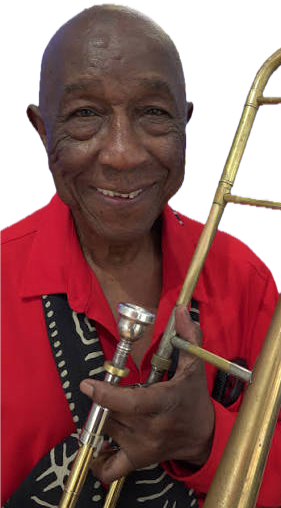
The very next day, I came to school after that, and Freddie was in the classroom with a book and his drumsticks, practicing. I said, “Freddie, you’re in the band?” He said yeah. I didn’t ask a single other question — I went straight to the band director, and said, “I want to be in the band. I want to play trumpet.” At that time the school supplied instruments, and he said, “Well, I’ve got enough trumpets, but if you want to play trombone, you can take one home today.” Oh my God — that was it. He showed me the positions, and I walked home through my neighborhood proud, because having an instrument meant something. In my neighborhood, my nickname was “Schoolboy,” because I was one of the few kids still going to school. So that was it.
SV: You’ve said that segregation had things that got lost in integration — for example, a respected Black math teacher that white teachers came to study under at night, or the interstate highway system destroying Black Wall Street-type communities. So my question for you is: what do you think gets flattened when people tell that era as only one story?
DG: Well, I can safely say that things were better in my segregated life than they turned out to be in my integrated life, which can be well established. I can give you an example — that neighborhood I was brought up in, Under the Hill, was a rough neighborhood. There were a couple of rough neighborhoods, like Holland — people had certain reputations, and you had to fight sometimes. But the thing I loved about it was that I could go days, sometimes weeks, without even seeing a white person — especially in the summer, when I’d go out to the country to my grandmother’s place. You hardly ever saw anybody white unless you went to the store, and most of the adults did that.
The thing that was so good about being Under the Hill, having our own neighborhood, was that we had everything intact. Mr. Osborne— he would let me and a guy named Alfred run his grocery store on the weekends. We had the cash register, and we had to learn to count, take inventory of his provisions, and count everything up in the morning. Alfred would be the cashier, and I would be the butcher — cutting up meat and serving customers in the butcher section. Then at noon we’d switch — he’d go be the butcher and I’d be the cashier. Mr. Osborne let us run the store, and I was under twelve years old at the time.
That kind of opportunity — with integration, whatever happened, our neighborhoods were purposely disrupted, running highways through them to break up the community. All of that was gone. I don’t think you’d find a neighbor today who’d let a twelve-year-old run a store as a cashier or a butcher.
There was a street called Farish Street, and there was a street called Capitol Street, which was basically the white main street. We all shopped on Capitol Street, but white folks hardly ever came to Farish Street, because of segregation. But I saw all of that disappear with integration.
I can tell you an inside story about integration. I taught Walter Payton and Eddie Payton when they were teenagers — Walter for two years, and Eddie — in Columbia, Mississippi. Ralph Boston’s brother, Charles Boston — Ralph Boston being the great runner who set a lot of records — Charles Boston is still alive today, and he coached Walter Payton as a football player. When they integrated the schools down there, Charles was the head coach — a winning coach, well qualified to mentor and teach Walter Payton — but they demoted him to assistant coach.
Not only that, but he told me he witnessed so much disrespect, cursing from the kids — because of the way things were, basically white supremacy and racism — that he faced all of that, going from teaching at an all-Black school where everything was respectful, into that environment. Shortly after, he retired and just stopped teaching.
Here’s the bottom line on that: in the all-Black schools at that time, we got “displeased,” we got spankings — popped on the butt with a ruler, sometimes a broomstick. But when they integrated the schools, that’s when this country, this system, started passing laws saying teachers couldn’t touch a student, couldn’t paddle a kid, all of that. And you know why? Because they didn’t want a Black teacher spanking a white kid. That’s when a lot of Black families lost control of their kids — that’s the negative side of it, and that’s why we see what we see today.
I remember, in one of the schools, a first-grader said, “Don’t put your hands on me.” I said, “Not only am I going to put my hands on you, I’m going to pick you up and throw you out.” That’s not even what I’m talking about — but that’s when they started putting laws in place that you couldn’t discipline children the way we knew how. At that time, in the South, we were taught to say “yes sir” and “no sir.” Once integration hit, you weren’t going to see a white kid say “yes sir” to a Black teacher. It was a double standard, and things just broke down. So, as a Black community, little by little, we lost that. Now we’re in the integrated situation, and you’ve seen what’s come of it.
I can go into that a little deeper. James Meredith, who integrated Ole Miss — I knew exactly what day that was, in ’62. I was his friend — he and his wife, James, they were just up there for us. He, his wife, and I were all classmates at Jackson State, a small school. I was there when the federal marshals escorted him down to the University of Mississippi, and people threatened to kill him. I heard all of that. I don’t want to go too deep into it, but I have a lot more to say if you want.
I watched Dr. King almost every day — I mean, I met him, saw him daily. When he was in Jackson, that was his headquarters, and I’d see him day to day, sit near his table in restaurants — sometimes at his table — for the three years I was in school. I used to eat lunch with him almost every day.
SV: I was reading an interview where you talked about handling white men who were policing your walk home at night, giving them nothing, wearing them out through control. So my question is: where did you learn that skill, and what did it cost you to learn it as a kid?
DG: It’s all about thinking on your feet — it’s just like rapping now, a lot of people can freestyle. Living Under the Hill, I had to walk through one block where the white neighborhood kind of separated itself from the Black neighborhood. In that block was an all-girls’ boarding house for college kids, and when you walked through, there’d be couples in the cars parked there, doing whatever, and imagine — old girls, a college boarding house, all that going on. So the police would stop me before I even got into that block — like clockwork. “Boy, where are you going?” “I’m going to 1329 Civil Street, I live there.” And then I always had a way of leading them along — “That’s really up off Monroe, and when you make that left onto Monroe, there’s another street before that” — and I’d just go into this long dialogue, never saying “yes sir.”
Then, “Boy, where are you coming from?” And I’d go into another long dialogue — “Oh, I saw this movie,” mumbling and mumbling. I had it down — I knew how to do it. I would never say “yes sir,” the way a lot of people did at that time. I had my own way. If they said, “Do you want some water?” I’d say, “Well, I am thirsty today, I could take a drink” — not “yes sir, yes sir.” Because I’d seen my uncle, my mother, all the adults, get into that submissive demeanor with white people, looking down and all that, and I didn’t want to do that. I didn’t do it.
There’s another thing — my mother’s name was Ruby, and everybody addressed adults respectfully. Some people from the Bell collectors, the H&N, would come up and say, “Hey, is Ruby there?” And I’d say, “Miss Osborne will be back at four o’clock if you’d like to come at that time.” I wouldn’t let them call my mother “Ruby.” That was a thing — and they’d look, like, “What’s going on with this kid?”
Another thing I can tell you: there was never, ever a white man in a Black neighborhood after dark. Nobody talks about that, but I want to talk about it. Because — two things: if they were down there, they were down there for no good reason, and if they went down there, they were being very brave, because there were no lights, and their car might get hit with a brick, or if they got out of the car, it might catch fire. It was an unwritten rule that nobody talks about — no white person came into a Black neighborhood, even for an emergency. Police didn’t even come down there.
As a result, when I was about thirteen, working on the wheel truck — the same system — another guy, a little older than me, named L.C., he could drive; I couldn’t yet. We’d go around to these cafes at five or six, after dark, and serve them beer, because the white beer drivers would deliver during the day but would not go into those Black neighborhoods after dark trying to sell anything, because they didn’t know where a brick might come from. So nobody talks about that, but that’s the reason I was out there selling beer.
And think about the other laws that were put in place — right after slavery, they passed laws that if you didn’t have a job, they could arrest you. It was against the law to learn to read. So most people right after slavery were eligible to be put in jail, just because they couldn’t read or couldn’t work a certain job — and if they caught you without a job, they’d put you in the penitentiary system. There were a few of those set up historically, and it kept going even after slavery ended — Angola in Louisiana, Parchman here in Mississippi, all these state penitentiaries. Everything was set up to put laws in place to funnel you into the penitentiary, where it was essentially the same as slavery — free labor, chain gangs. Parchman was supposed to be one of the worst in the system, still to this day. But I won’t go too deep into that, since nobody talks about it much.
All that said, we sold beer to those cafes at night with no problem. During the day, at the grocery stores, a guy named Fats used to drive the wheel truck, and his boss — a white guy — would just sit there while Fats showed him around. Fats knew all the R&B songs, because that’s what played on the radio, and that was his day job. But after five o’clock, before dark, Fats would clock out from driving that truck — he worked for, I think, Pabst Blue Ribbon, which had a beer warehouse there. After Fats got off around five, that’s when L.C. would go pick up the truck and drive it — and I was embarrassed because he’d come right to my high school to get me. I’d say, “L.C., don’t do that, I’m trying to be cool” — he’d have this big build, and I’d say, “back it around the corner.” But it was a lot of fun like that.
I lived it. And I know how it felt when we were segregated — we had a lot of respect, and very good control over our children and our families. Most families had two parents in the house. My mother lost her husband — my stepfather — in that car accident, but that wasn’t the common case.
SV: Emmett Till’s murder happened in your area while you were working nearby, and I wanted to ask: what did that specific proximity change in how you moved through the world afterward?
DG: That’s a good [question], too. As I told you, I wouldn’t say “yes sir,” and I was working in an all-white neighborhood at a supermarket. Some guys who lived up on the hill got me that job — they worked there too. I guess even the management knew I wasn’t saying “yes sir” to the white customers.
But when Emmett Till got killed — my friends were smart, and I didn’t even know what was happening — they got me a job in a Black neighborhood, shining shoes. I listened to music, I made more money, and I didn’t have any problem, because everybody around me was Black. The minute he got killed, this guy — I think his name was — I can’t remember his name now, but everybody called me James Richard, “This guy shines shoes, he needs somebody helping shine shoes, and you can make more money and you won’t have to be on your feet all day at the grocery store.” Because at the grocery store, I only got about fifteen minutes to sit down and eat some sardines, some potted meat, saltine crackers, a soda, and then get right back up and keep going until we both got off.
Anyway, I took the job. They knew I wasn’t acting the way they wanted — saying “yes sir” and all that — I didn’t do it, so they got me the job with this guy who could tap dance and shine shoes — he was an amazing guy. Next to the shoeshine stand was the Paradise Barber Shop, and they had the shoeshine stand out front. Next to that was a newsstand run by a guy we knew as “Eagle Eye.” He sold a newspaper that told the truth — really just two legal-sized pages typed together, called the Eagle Eye. People can look that up. Anybody who came down Farish Street, he’d read them the news — he wrote it himself, exposing a lot of stuff that white neighborhoods didn’t want exposed.
They kept trying to shut down Eagle Eye — trying to arrest him or fine him — but he always won on freedom of speech. So when they couldn’t arrest him or fine him, they declared he was insane and put him in Whitfield, the state insane asylum. He was there for five weeks — probably being driven crazy with shock treatments and medication — and then some friends helped him escape. They put him in a coffin-like casket, drove him out, and nobody questioned it, nobody opened the casket to check. They drove him to Meridian, Mississippi, put him on a train, and he went to Chicago, where he continued writing his newspaper, the Eagle Eye.
SV: You also had lunch near Medgar Evers’s office for years before he was killed. What do you wish history preserved about him as a person, beyond the tragedy?
DG: He was a very smart person. I’m not going to say he studied the law formally, but he knew the laws — he was smart. And that’s one thing you needed to survive in the segregated South: you had to be very smart, and out-think people, and use your instincts along with your knowledge of the law.
There was a place — it’s still there in Jackson — called the Masonic Temple. His office was there, and across the street was a little place called Smokler’s, kind of a cafe that served food, popular with college kids, because at that time there was no fast food around. There was one place on the corner called the Penguin that served hamburgers and things like that, but nothing like fast food is now.
Think about the time — no fast food, but everybody had to eat. Our national lunch hour was noon to one. There were no night shifts back then — people worked nine to five, or eight to four, eight to five — and everybody had to eat. A lot of people went home for lunch if they lived close by, but I lived on the east side of town, so I couldn’t go home. But there’s one common denominator for everybody, rich or poor, big or tall, whatever — you had to eat.
Medgar and I used to eat lunch together every day, Monday through Friday, at that same table, because we took a liking to each other. He was my friend.
And on that note — my youngest sister was at a meeting the night he got killed. He had organized the youth; they used to do protests downtown after school. He was smart about it — he wouldn’t let the kids break any school rules or get in trouble at school. When school let out at three o’clock, the kids would march downtown, sit at the lunch counters, and so on. They did it deliberately so the jails couldn’t hold them all — they couldn’t fit fifty kids in a jail with only ten cells. So they built tents on the same fairgrounds where the carnival used to set up — Under the Hill — to hold the kids they arrested. Sometimes it was more than fifty kids in a single protest.
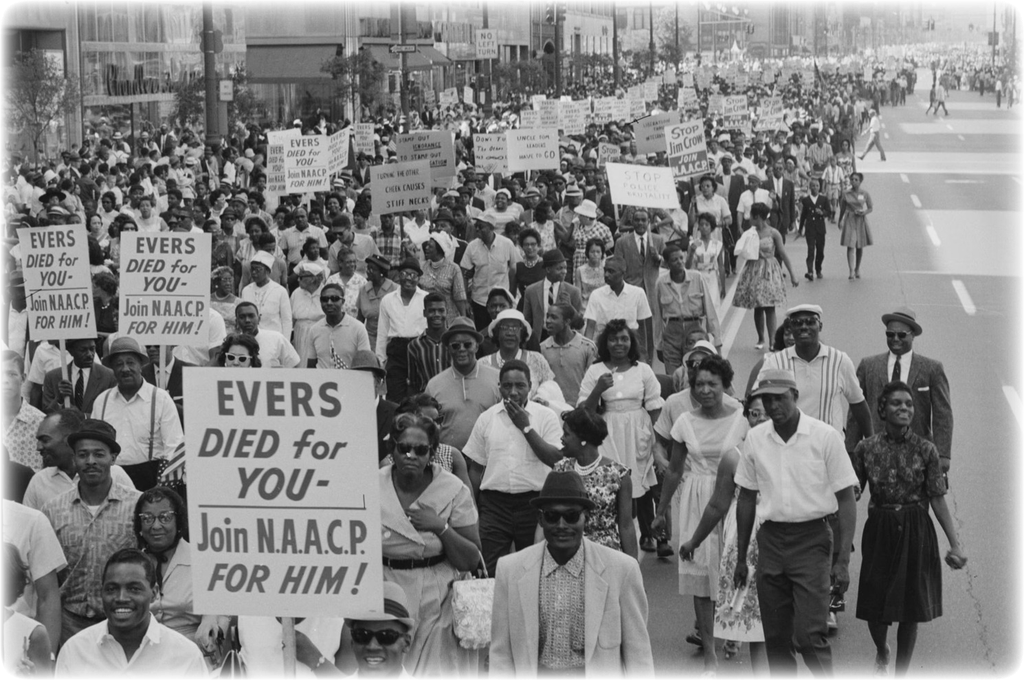
My youngest sister was at that meeting and got arrested. My middle sister wasn’t allowed to march, because she was so small — under five feet — she looked five or six years younger than she actually was. They told her she was too little. She passed away a year and a half ago, back in February. But she was probably just as conscious of it all as my oldest and youngest sisters. She wanted to march, but they wouldn’t let her, afraid she’d get hurt because she was so small and fragile.
SV: You mentioned seeing your mother cry once — do you think you were running toward music, or away from ever seeing your mother cry like that again?
DG: That day, and the day I got into the band — that was it. It turned me completely around. I never missed a day of school after that. I’d be there before it opened every single day, and they’d have to send me home — the band room closed around four o’clock, and I’d still be in there practicing. It was like night and day.
I loved music so much, and I still enjoy it to this day. I play in bands, and any opportunity I get to play, I take it — even though there’s no money in music anymore, and people don’t want to pay you, and they can be disrespectful — I still get up and practice, stir it up. If I couldn’t play, I don’t know what I’d do. I can’t think of anything else. At this age — I’m eighty-six years old — I’m falling more in love with music than I was even at twenty.
SV: That’s amazing.
DG: It really is like an addiction. I’ve never been addicted to anything else — I don’t smoke, I don’t drink, I never got into drugs, never snorted anything. I’ve stayed pretty close to sober my whole life. But music has always been my drug, in a sense. I’ll tell you — I go out and hear live music more now than I ever did in the past, because of what it does for me. I’ve been going through some things lately — people trying to rip me off, scams, several things hitting me at once — and it took a toll. I won’t say I got depressed, but I had the blues, that bluesy feeling. But then I’d go out and hear live music, and it lifted those heavy problems right off me.
I talked to a guy the other day, and I told him: music is like food. Music is food for your soul, the way food is nourishment for your body. You’ve got two things — your brain operates to keep your body running and feeling the way you do, and food fuels that. Music does the same thing for me. Going out to hear good music is like eating a delicious gourmet meal, and it nourishes you the way sitting down and eating a good meal gives you strength.
I went to hear Steve Coleman the other night, and Buster Williams’s trio too, and every time I go out to hear music, I learn something — it affects me in some way. It really is like an addiction, in the best sense.
SV: Did the divide between James Richard, your birth name, and Dick Griffin, your musician identity, ever feel like living as two distinct people?
DG: No, no, no. Let me tell you how it works. My family calls me James Richard — my mother never called me Dick, she didn’t even really know that name. It was always James Richard — my sisters, my close family, everybody. I even have friends from way back, drumline buddies from college, who still say, “Hey man, James, how you doing, James?” There’s just something about that rhythm — James Richard, James Richard. So the name Dick never had anything to do with who I really am. I’m the same person. Anybody who knows me as James Richard is somebody close to me, in a real way.
Now let me tell you how the name Dick came into play. A classmate of mine, Frank — little guy — at that time, Dick Cavett, Dick Gregory, all these “Dicks” were well-known names. Frank started calling me that because Richard is short for Dick. My name is James Richard. So Frank would wait until I got to the end of the hall and yell, “Hey, Dick!” real loud, with all the girls around, laughing. I threatened to report him to the principal for that. But he kept doing it, and I knew he was going to keep doing it — he’d wait until I got down the hall and do it again, in front of everybody.
Nobody had called me that before, but it stuck, so strongly. Everybody caught on, because it was an easy play on words — “Hey, hey, how you doing, Dick, hey Dick, come on, Dick.” That’s how it stuck, like glue. That’s how Dick Griffin came to be.
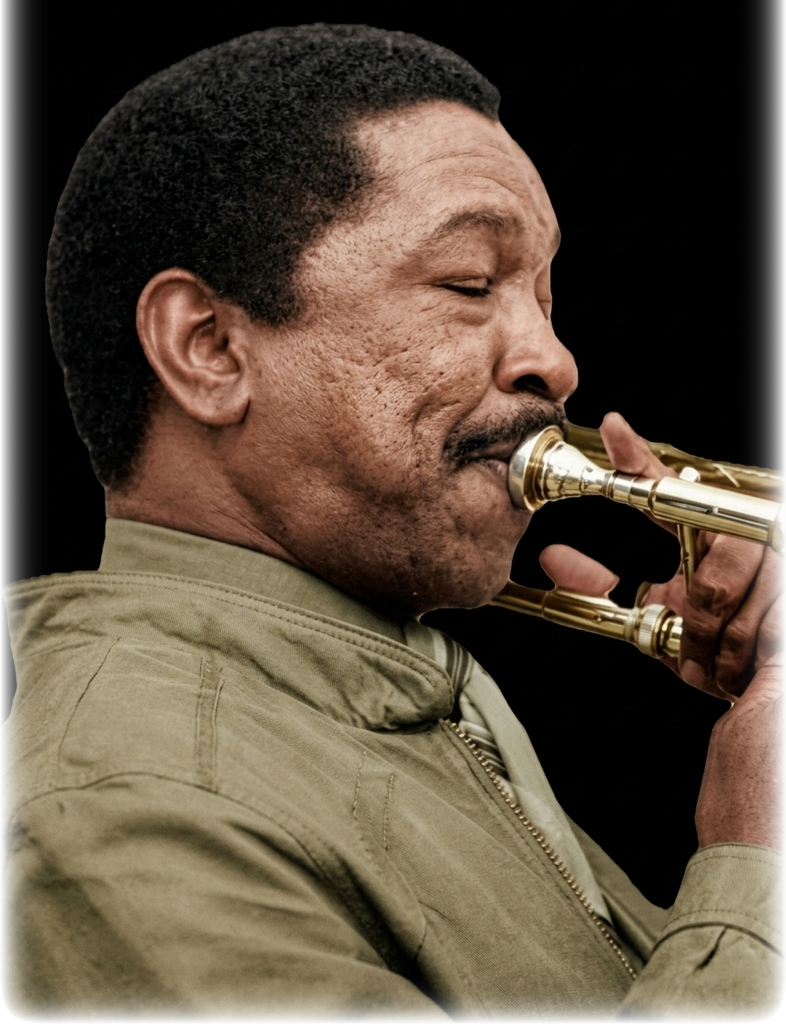
SV: I understand a teacher initially told you there was no hope for you as a trombonist, steering you toward piano and arranging instead. Did that feel like a detour at the time, and when did you realize it was actually the right path?
DG: Let me tell you this, and it’ll make a little more sense. Here’s a thing I say: it takes just as much time to do a bad job as it does to do a good job. About anything I do, I do a good job — even if I don’t get paid, I don’t even think of it any other way. I want to do a good job. I want this to be a good interview — you understand? So when I say I’m going to do an interview with you, I’m going to do it, and it’s going to be a good one. I’m going to share something with you I’ve never shared with anybody.
That’s the way I play my horn, too. I don’t care where I am, what kind of gig — a blues band, a hip big band, a hip quartet — every note I play comes from the source as if it’s the last note I’m ever going to play in my life. Curtis Fuller told me that once — he said, “Dick, people talk about how I sound, but I’ll tell you why: I play every note as if it’s the last note I’m going to play in my life.” And that’s why a lot of people play it safe — you can hear it, they’re holding back, saving their best licks for some bigger gig down the road, being conservative now to save themselves for when it “really matters.” I don’t think that way. So when I did this interview with you, I wanted it to be the best interview you’ve ever done with anybody.
Above: Title track from his Multiphonic Tribe outing—forward-looking post-bop with Griffin’s expanded trombone vocabulary front and center.
SV: I want to talk about multiphonics for a minute. You developed multiphonics after hearing about Coltrane’s two-note effects and classical trombone exercises, and you really refined it through trial and error, including losing your voice after one gig. So how did those early physical discoveries reshape what you thought a single trombone could express?
DG: Well, I’ll tell you — there was a guy in Chicago I heard do it on trumpet. I was talking to somebody who knew his name, but I don’t recall it. I also heard John Coltrane do something similar on saxophone. And Roland Kirk too — so it came from a number of different sources. I’m not sure exactly which one hit me first. But once I understood it — there was a classical book that described the technique, because cellists were doing transcriptions with double stops. That’s probably one of the earliest sources. Another was Albert Mangelsdorff, the trombonist. So it came from a lot of different places — I couldn’t say for sure which one started me on it.
But once I got into it, it was, like I said, a passion — I just loved doing it. I even warm up differently now — not the traditional way. I warm up by playing whatever I’m hearing in my head, and it works much better for me, because I grow that way. I know the theory of warming up traditionally, going slow and soft and building, stretching whatever areas need it — sure, that’s fine too.
Above: An explicit showcase of his multiphonic technique applied to the blues form.
SV: You also combined multiphonics with circular breathing, and what you called “circular phonics,” inspired by watching Kirk sustain multiple horns at once. What has that sustained practice revealed that the two techniques alone maybe couldn’t?
DG: Well, I just recently took it to another step. I’ve been working on it for a long time, but now I’m starting to do something similar to what Roland Kirk did — it’s hard to describe, because it comes from a spiritual place. I don’t plan what it’s going to be, I don’t know how it’s going to come out — I just go into it. If you’ve never been in that state, it’s hard to explain. It’s almost like being mesmerized, hypnotized — and I can do that to myself.
Here’s an example. In 2009, I was on tour with Doug Hammond, the drummer, and he was featuring me — the way Frank Foster used to feature me. I’d go up and go into this hypnotized, amazed state, and I could play for a long time — now I can go fifteen minutes without wanting to bore anybody. But when I come out of it, I’d have a written part to read — and I couldn’t do it right away. I’d just sit there, seeing the music, but it would take a while for my mind to reset — to be able to count and read and play that part again. Doug noticed that, and he’d let another player cover that part until I got myself back into a state where I could count and read normally.
That’s just how it is. I don’t share that with too many people, but I guess I have now. When I go into that state, it’s like people who go into a Holy Roller church and start to shout — I understand that completely, because you really need that kind of physical release, and you go to another spiritual place. When you come out of it, you don’t just snap back — it takes a while.
That’s why — I was raised in two churches, the Pentecostal Holy Roller church, and the Baptist church. The reason for that: I was the only male in the family after my stepfather was killed. There were six of us in the house in the mornings — my three sisters, my mother, my grandmother, and my cousin — so I’d get dressed first and be sent out of the house, since it wasn’t practical for me to be around while all the women were getting ready. So I’d go to the Holy Roller church, which was right in my backyard — my organization — and go to their service first, for the men who had to get dressed and out of the house early. Then, once the women were ready, we’d go to the Baptist church, where people would also shout — real, not performative — genuinely moved by the spirit.
Above: Griffin’s heartfelt tribute to Kirk, with strong supporting cast (Gary Bartz, Stanley Cowell, Cecil McBee); emotional and personal.
SV: You’ve spoken about the decades-long journey it took to internalize the circular breathing technique you learned from Rahsaan Roland Kirk. When it finally clicked, was it a sudden technical breakthrough, or was it a shift in how you approached your musical phrasing?
DG: Well, it was about letting go and getting into that spiritual place. Sometimes I’d rather sit down, because I feel like I might fall down — it’s a mental thing. You have to let go, really let go, and reach further and further out into that free, mental state. I can’t say it happens all at once — it grows slowly, slowly, slowly. That’s why, even now, the more I do it, the deeper I get into it. It’s a growth, and it’s hard work too, because at this stage I take more chances. I play every note like Curtis said — as if it’s the last note. I live my life trying to stay in the moment. One of the things I’ve recently had to do is let go of the past, because you can’t correct it — you can only be upset about it, or learn from it, but keep moving.
You never know — right now, we’re talking, but ten minutes from now, I might not be on this planet. Once you get that into your head, that’s why, with the music, I can play safely, or I can go into that thing I’m describing — there’s more to it, you can just go out there. But now I’ve gotten the courage to do it. If I don’t play it now, I might not have much time left to think about when I’m going to play it.
SV: Curtis Fuller reportedly told you flatly that you didn’t play in the J.J. Johnson tradition, and you agreed with him. How did you make peace with not competing on their terms, and trusting your own sound instead?
DG: Two things — this is kind of funny. Benny Powell, the trombonist, told me, “Man, you might as well stop playing trombone, because you’ll never be a J.J. Johnson.” And, honestly, I was — and still am, in a sense — a sad trombone player, technically. I never developed the technique. My technique is different — I can’t play like some of the guys with great technique. I don’t have to name them — J.J. Johnson, Slide Hampton, guys I looked up to and still do. I never had that technique, but I had a sound, something coming through me that wasn’t that. I was almost ashamed of it, because of what the standard was, what the “correct” way was supposed to be, according to bandleaders and everybody else. But my sound isn’t like that.
But I can say this: what I do, they can’t do. J.J. Johnson — great as he was — couldn’t play the multiphonics, the circular breathing, all the stuff I’ve worked on.
Above: Abdullah Ibrahim’s “Mandela” from Water from An Ancient Well, 1986; Griffin’s trombone adds warm, earthy color and solos in this essential South African-jazz fusion statement.
Griffin first connected with Thelonious Monk in late 1967 during a six-week run at New York’s Village Vanguard. Griffin was performing alongside Rahsaan Roland Kirk on a shared bill with the Thelonious Monk Quartet, who were promoting their Underground album at the time.
A non-smoker and non-drinker, Griffin spent his set breaks in the club’s kitchen, where he frequently ran into Monk pacing and practicing his stage dance steps. Their bond cemented during a set when Monk heard Griffin playing multiphonics—producing two notes simultaneously on the trombone—prompting the jazz legend to pause, start up a conversation, and take the young musician under his wing.
SV: When Monk asked you to repeat your multiphonics, what do you think he was actually hearing — fascination with the technique, or something musically useful to him?
DG: He was hearing something — I think he’d never heard a trombone do that before. What I do on trombone, nobody else can do it quite like me. Other people can do their own version of it, and a lot of people have almost mastered it, but it’s still not quite the same as what comes through me. It’s like — Dr. King’s voice. Nobody sounds exactly like Dr. King. Some people get close, have a nice, similar voice, in that direction — but nobody’s really going to sound like Dr. King. I’m not saying I’m so great, but even though I’m not polished by the standards — I don’t have the “correct” technique, I play out of a couple of flaws, whatever you want to call them — nobody sounds on that trombone the way I sound. Once I really recognized that, it gave me the freedom and the courage to play what I hear.
SV: Monk also told you that making a record is like writing a book — that it would be here longer than you. Did that land as a statement about mortality at the time, or only later?
DG: At the time, it told me how carefully and cautiously he did good work. Every time he touched that piano, you could tell — he practiced a lot, from what I understand. Most of the truly great players practiced constantly. Slide Hampton, notorious for it. Coltrane, notorious. Lee Morgan, notorious. Sonny Rollins — notorious, and so dedicated that he took two years off in the middle of his career just to practice, without playing a single gig. Think about how serious and dedicated that is — it’s like someone going to med school.
In the mid-1960s, Griffin performed with the Sun Ra Arkestra and began a longtime collaboration with saxophonist Rahsaan Roland Kirk.
SV: I read that Sun Ra told you never to repeat a lick twice in one night, and that he once made you solo alone until the crowd gave you a standing ovation. Can you talk about that a little, and is that still a practical rule for you, or has it become more of a philosophy against creative autopilot?
DG: Well, that was always a challenge — every Monday night. John Gilmore could play changes really well, on standards too. Sun Ra told me, “Griffin, when you play a lick one time, I don’t want you to play it again.” He wouldn’t let you rest on that solo — you had to play something different. That got you thinking in different ways, like turning a phrase upside down, taking what goes down and making it go up, all these different ways of thinking.
One night, we were in Aix-en-Provence, in France — we’d been there for two weeks, and every night he’d send somebody out to open the show, usually a percussionist, or one of the dancers, or one of the saxophone players. I didn’t expect it, but he said, “Griffin, I want you to open tonight, and I don’t want you to come off the stage until you get a standing ovation.” And I didn’t come off until I got that standing ovation. I was out there playing my multiphonics, playing solo, and whatever I played, I went right into the circular breathing technique that Roland Kirk had shown me. It was magic. Sun Ra would never say something like, “Hey, that was crazy” — he’d just look at me and nod, and sit down, as if he already knew I could do something I didn’t even know I could do. That was Sun Ra’s way — he’d always push you, in a positive way. I’m still using those techniques every time I perform — I make sure I pick up my horn and try something new, something I didn’t just write fifty years ago that I could play with my eyes closed.
SV: Sun Ra and the band rehearsed all day, every day, with the band pooling their money together to survive. So my question is: what did that communal discipline make possible musically that a conventional band structure couldn’t?
DG: The tightness and the commitment. They were all committed to making music together — how many bands actually achieve that level of commitment? They didn’t just wake up whenever, practice a little, and go to bed — when they moved to Philadelphia, they had a house where they could practice anytime, as long as they wanted. Sorry, my phone was on mute for a second there.
He had a way of getting things straight — even how to deal with “the system.” He got a guy out of prison once, and nobody ever really figured out how he pulled that off.
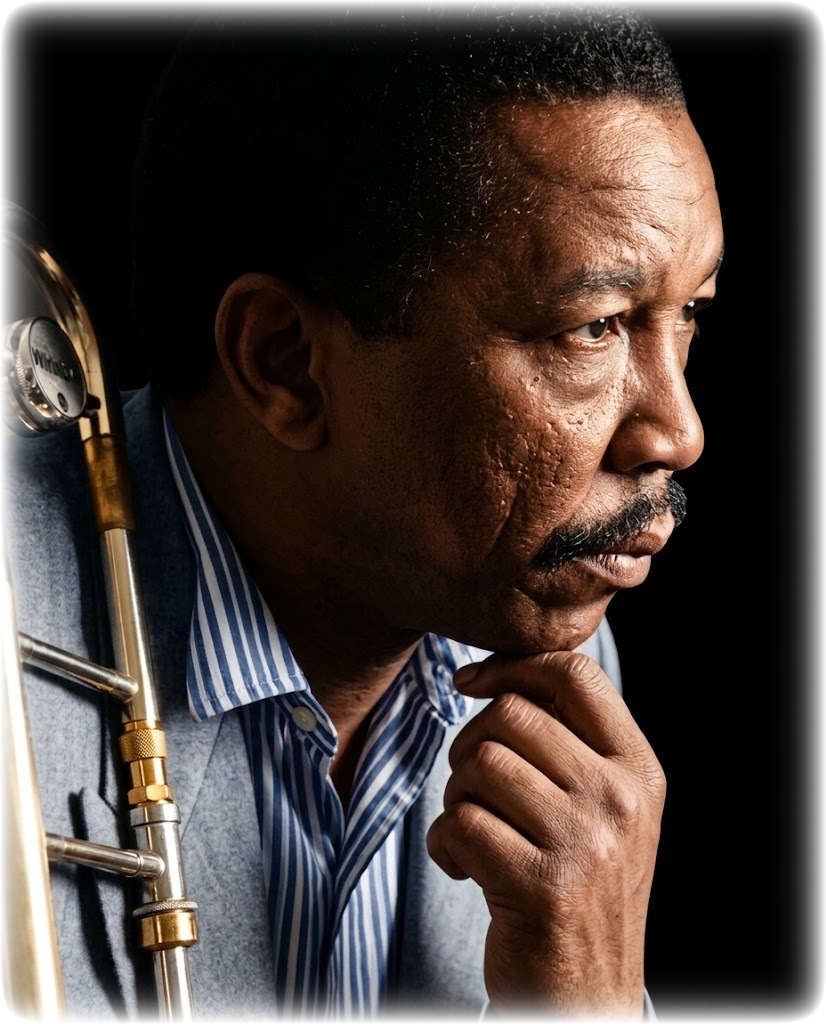
SV: You’ve described Sun Ra–and I think a lot of people would describe him–as “out of the box” — but he never lost the underlying pulse in his music. How do you think he held freedom and groove together?
DG: Well, everything was based on his own foundation. He could really play — he’d played with Fletcher Henderson and in his early band, and I know he played at Club De Lisa. That was like a dance club — when my mother would go to Chicago, she’d go dance at Club De Lisa. Sun Ra played in the house band there, and that gave him a strong stride foundation — he could really play stride piano. The area he came up in, that’s what the musicians were playing, and everybody played for dances. So most of Sun Ra’s music has that dance feeling underneath it, that dance tempo, even when it sounds “out.”
SV: Sun Ra was constantly reading and thinking about space and the unknown. Do you think, since you knew him, that curiosity was about escaping the world he was born into, or expanding past it?
DG: I couldn’t really say what he was thinking — honestly, I wasn’t thinking about that when I knew him. He was reading a lot — always had been, probably very academically inclined in school. He was a reader and a writer. I couldn’t say exactly what I felt he was thinking, but everything he did was kind of counter to convention — always changing.
Even the way he dressed — if we were walking somewhere, on a break from a gig, and passed a shop with some interesting-looking fabric, he’d go in and buy it, and we’d be wearing it that night on the bandstand. He was constantly creating, constantly changing. The band eventually got set uniforms, but if he saw something interesting, he’d say, “Try that on, try that on.” If it worked, great. Some people got to keep their own uniforms; it kind of depended on how long you’d been in the band — if you’d just joined, you started from the ground up.
In the early 1970s, Griffin spent a year playing in a big band led by legendary bassist and composer Charles Mingus, who provided invaluable encouragement for the young trombonist’s composition efforts. Around that same time, Griffin spent three years performing in the house band at Harlem’s famous Apollo Theater. During his tenure, he backed up a slate of music icons and Motown greats, including James Brown, The Temptations, and Nancy Wilson.
SV:.What was it like to witness Monk sitting silent and still, almost like the hum of a refrigerator, while Mingus tried to coax him out? Did that change how you understood his music afterward?
DG: Well, Mingus and Monk were two strong individuals. I got a chance to be around Monk for five years, and to play opposite him at the Village Vanguard, when they were booking two bands — they’d always have two bands on the bill, maybe Monk’s quartet and Miles Davis, or whoever.
My stepfather got killed when I was in second grade, seven years old. It just so happened that my biological father and Thelonious Monk were born in the same year — I think 1917, somewhere around there. I never really knew my biological father, so I gravitated toward Monk in a way — I don’t know if he felt that too. One thing I know about him: he had a sense where we didn’t talk much, but he seemed to know what we were thinking. He’d come into the room, look around, start pacing back and forth, and then say something like, “Well, if so-and-so did this, then that.” It was almost like he was already thinking the same thing I was.
The same thing happened with the idea of “writing a book.” He was recording the “Underground” record around that time — 1968, I think — and he came out and said, “You’ll remember this.” He had a way of almost whispering it to you, even if nobody else was in the room, making sure you really heard what he was saying. He said, “Making a record is like writing a book. You have to make a good record, because it’s going to outlive you. Each track on the record should be like a chapter in a book — you’re telling a story, just like you’d write in a book, except you write it in sound instead of words.”
Mingus had the same philosophy, as it turns out. I don’t know anything about any tension between Monk and Mingus personally, but later on I started working with Mingus — it was almost a two-year project. He got a Guggenheim grant to put together a big band, and the Village Vanguard was our home base — we played there so many times. The band had three trumpets, two trombones, five saxophones. On trumpet was Lonnie Hillyer, Virgil Jones, and Richard Williams. Eddie Preston played first trumpet, and I played second — I never played first trumpet, for reasons I won’t get into. On saxophones we had Howard Johnson, Clifford Jordan, and Charles McPherson, plus another tenor player, and an alto player named Ricky, I believe. On piano was John Foster, and on drums, either Roy Brooks or Joe Chambers. Dannie Richmond wasn’t in that band at the time — he was off playing in a rock band in England, though he’d occasionally come through and sit in when he had the opportunity. A few different drummers passed through, but it was mostly Roy Brooks and Joe Chambers holding down that chair.
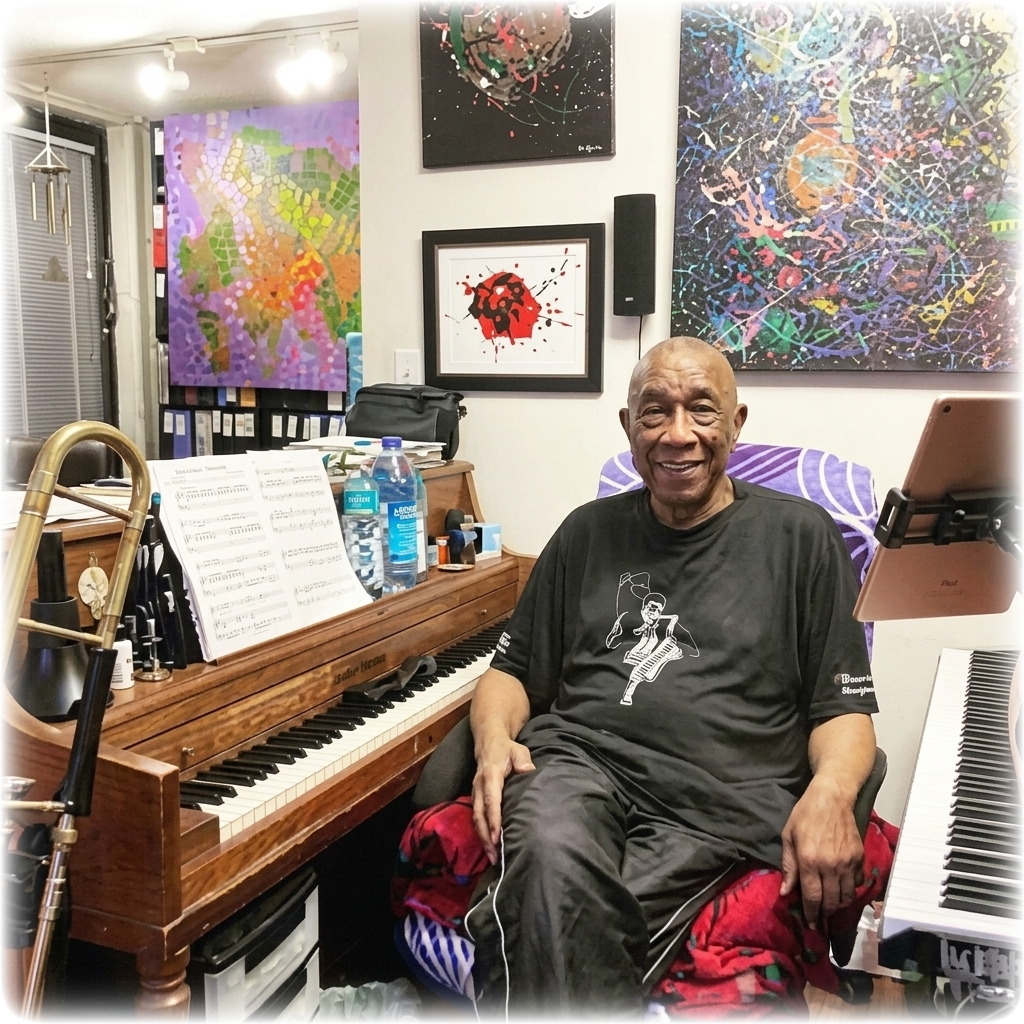
SV: Mingus once tested you mid-solo by changing keys underneath you, and then called later to apologize by phone, at two in the morning. How did you learn to tell his intimidation apart from real danger, and did that lesson carry into how you handled other difficult bandleaders?
DG: That’s a good question, and I like the way you put it — but I was never really intimidated by him, and I’ll tell you why. I knew him, and he knew me. We didn’t bump heads. I respected him, and it was similar to the relationship I had with Abdullah Ibrahim and a lot of my other bandleaders — they could feel something from me, and they liked me. Hank Jones was like that too.
Here’s what it is, and I know exactly what it is: when I come into a band, I come in to be a good bandman. I don’t just work hard, I dedicate myself to the band like a marriage, like a real commitment. A lot of young musicians today don’t even understand that. Back in the day, I didn’t always get called back to play with certain bands, because I got branded as a “rolling, crashing” trombone player — I’m not naming names, but that’s the reputation I had, because that’s how I played.
But my intentions were always good, even if I messed up sometimes, showed up late. With Mingus, though, we already had that understanding. Here’s how it started. The first time I came into the band, we were playing “Black Saint and the Sinner Lady,” and I played it my way — I don’t play traditionally, like J.J. or Curtis would. I know the changes, but I’m always chasing something else — I follow my ear a lot, I hit and miss when I play, because that’s what’s exciting to me about playing. You’re never going to get the exact same thing from me twice — I might play inside, I might play outside, I might play soft and correct — I don’t know until I get up there and play.
Anyway, one night I had to send a sub to cover for me, and the sub wasn’t quite on my level. That happened, and then, that same night at the Vanguard, we were playing a blues in F. Everybody in the band went around, and I guess the guy was looking at his instrument like, “What key is this?” — got a little shook. When it came to me, playing in F didn’t faze me at all — it didn’t shake me one bit.
So that night, when I got home, early the next morning, Mingus called — a real, deep, gripping voice, “This is Charles.” You never called him “Charlie” — never — he’d get mad if you did, it had to be “Charles Mingus.” He called to apologize. I said, “For what?” He said, “I was mad at you, and I was going to fire you. But you’re the only person who impressed me tonight.” I said, “Huh?” He asked, “Do you need a draw?” — meaning an advance on pay, which meant he trusted me. I said no, I was fine.
Then he said, “I’m going to tell you why I was mad at you. When you first came in and played ‘Black Saint and the Sinner Lady,’ I didn’t think you knew what you were doing.” I said, “Okay.” He said, “But then, when your sub didn’t play as well as you, that told me something. Don’t ever do that again — you should always send a sub who plays better than you. A lot of people are scared to do that, because they think somebody will come in and take their job — don’t be like that.”
And I never made that mistake again — I always got a sub better than me after that, on my own time, no problem. After that, he started calling me almost every night around that same time, and we’d just talk — about music, how he wrote his songs, how he approached composing. My former wife, may she rest in peace — she passed away three years ago — had a piano lab in one of the bedrooms, ten different pianos in there, and I could go put my headphones on and play any of them at any hour. We talked about music all the time. He shared things with me he told me never to repeat, and I never did — that was just how it was with Mingus, and I learned something from that too. If Mingus liked you — and there were really two of us he was closest to, me and Charles McPherson — he was on your side. Charles wouldn’t abuse that friendship either — he wouldn’t say much bad about you at all. But if you crossed him, he’d let you have it.
SV: You’ve said that every Mingus song was like a chapter in a book, with a real story behind it. Has that idea — that music should carry a narrative — shaped your own writing?
DG: Oh yeah, that’s one thing we had in common. I’d write songs and be able to tell you the story behind them, try to describe the feeling in the music. There’s one song I wrote called “Madrid,” about one of my first trips there — I had the romantic part, and then the bullfight, the chanting, the castanets — I tried to put all those little details in there, telling the story of a man and a woman who meet, go out to dinner, and he takes her to a bullfight, where the bull’s fate plays out in different ways. That’s all in the music.
And Mingus told me the real story behind “Slippers” — the piece everybody thinks is just some jive title, but the real story is about a guy who liked to go fishing on the weekends, and while he was gone, his wife would let her lover into the house wearing a pair of slippers. That’s the true story, but if you listen to the piece itself, it’s a very classical, well-constructed composition — it doesn’t sound like the story at all. He also told me the story behind “Peggy’s Blue Skylight,” and the relationship that inspired it.
That was Mingus — Charles Mingus, never “Charlie.” A lot of people called him Charlie, but not to his face — he’d correct you right away.
V: Let’s move on to Roland Kirk. Writing charts for Kirk over the phone at two or three in the morning, transcribing what he was describing to you — how did that change your sense of what a score actually needs to communicate for someone who couldn’t see it?
DG: I guess it’s about the sound being unique — a way of writing for a particular musician that fit his own style of playing. Some players who came into the band didn’t have the reading facility that guys like Marshall, John Gilmore, and Pat Patrick had — those guys could read anything you put in front of them, and knew everything about a certain period of jazz.
But that was Sun Ra’s gift, too — he’d take someone who’d never even played an instrument, get them one, and teach them from scratch. It might take a year of dedicated teaching before that person was ready for the bandstand, because it takes a long time for the muscles and the ear to develop.
Above: The title track from Kirk’s “Volunteered Slavery,” 1969; Dick Griffin, trombone. Griffin’s trombone is integral to the energetic, politically charged ensemble sound.
SV: Kirk also never really told you what to play — he trusted you to know where you belonged in a piece of music. What did that teach you about the difference between being a great accompanist and just being a good musician?
DG: It’s really both. People who accompany well spend real time developing that skill. Even though I played a lot of quintet gigs with Kirk, we never really talked about his personal life or his lifestyle — but all human beings fall into the same basic traps. A trap is a trap — it catches mice, and a mouse might fall into it simply because it’s never seen that particular trap before. That’s real life — there’s always something out there, always a trap.
Above: Griffin’s “Blues for Sun Ra,” 2014.
SV: You found out after the fact that the proper union pay for your arranging work for Kirk came out of his own royalties. So my question is: what did that teach you about the tension between friendship, authorship, and being paid fairly?
DG: I found out that a lot of musicians I knew were underpaid, in a sense — I don’t need to name names, but I knew there were two systems. The union system was set up for people playing on Broadway, doing studio recordings — those musicians got the benefits, got treated fairly, got paid the standard rate, like people in symphony orchestras or Broadway pit bands. Sometimes people compared what they were getting to those rates, and it just didn’t match up fairly.
But guys like Sun Ra — he was smart. He was one of the highest-IQ people I’ve ever been around; there wasn’t a crossword puzzle he couldn’t finish. I witnessed it — people tried to stump him, and he’d just breeze through it. He was a generous person, in his own way. He kept his musicians working, even if he wasn’t always able to pay full scale, and he’d pay them unemployment when they were off the road. A lot of bandleaders take real care of their musicians that way — some pay retainers, so that even when a band member is off the road, they still get something, so they’ll be ready and willing to come back whenever called.
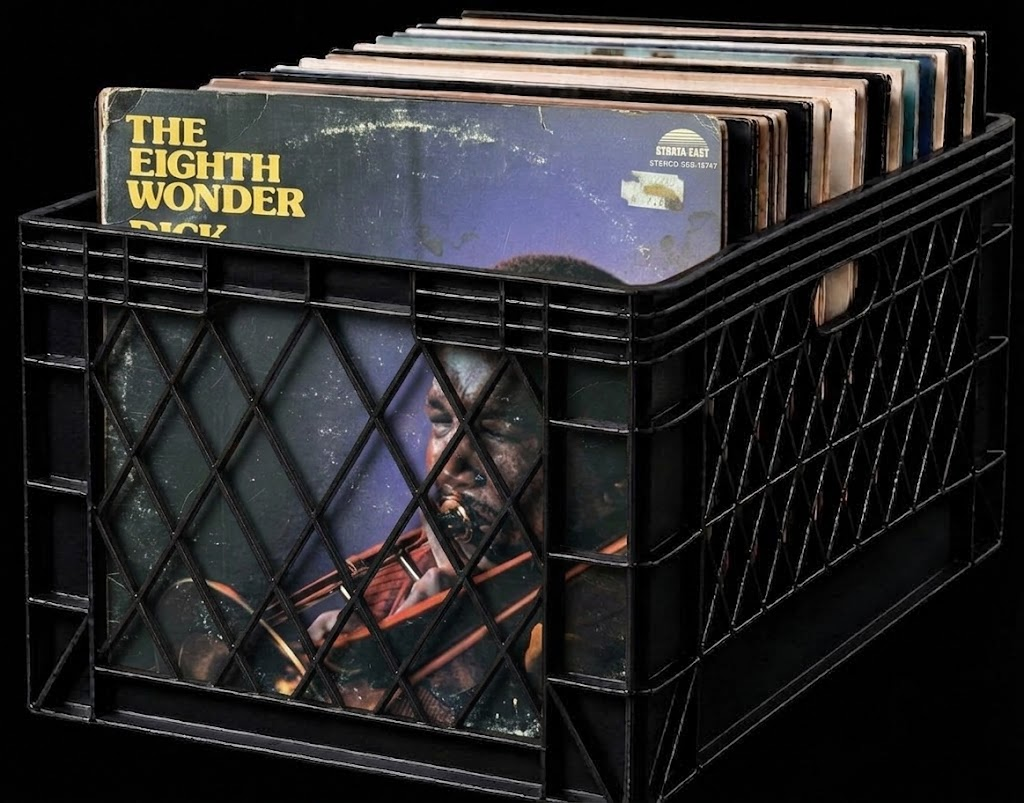
SV: Your 1974 Strata-East debut The Eighth Wonder is still talked about as an overlooked gem of the era. Looking back, what were you trying to capture on that record, and how do you hear it now?
DG: I have to clarify something a lot of people misunderstood, about the “Eighth Wonder” recording. It wasn’t about me being “the eighth wonder” — I was saying that music should be the eighth wonder of the world. All the seven wonders of the world — music should be the eighth, that’s what I meant. Not “I’m the eighth wonder,” like some people took it.
Above: The title track of Griffin’s 1974 Strata-East LP; it opens with unaccompanied multiphonic trombone in perfect harmony—Griffin’s signature technique on full display in a boozy, blues-rooted spiritual jazz statement.
That record was, and still is, one of the first records to really explore that idea in this country, that I can recall — using circular breathing and different extended techniques the way it did. Other people were doing pieces of it, but Kirk took it to another level. His inspiration partly came from Harry Carney, holding that last note out so evenly and long — and before Carney, other people were doing versions of it too, without getting much recognition, like a tuba player named Terry, who used it constantly, very wildly — and Mingus was doing it too, though nobody talks about that. But that’s the story behind that particular record, “The Eighth Wonder” — I was referring to music as the eighth wonder of the world, and the power that it holds.
Above: Another track from Griffin’s LP, “The Eighth Wonder”, a dark modal exploration balancing free-form elements with Griffin’s stately horn against Ssam Rivers’ flute.
SV: There is a story that you were once scheduled to sit in with John and Alice Coltrane, but a scheduling conflict kept you from making the date—and he passed away just a few weeks later. Is that account accurate?
DG: That’s true. Here’s what happened. Pharoah Sanders and I were very close friends, and Pharoah told Coltrane about me — Alice too — about my strict, disciplined training. They wanted to hear me, because they were open to all kinds of different sounds. I was scheduled to receive my master’s degree in June — I figured I’d graduate, get my master’s, and head to New York to really start making music seriously. But when I went to graduate, they told me, “Mr. Griffin, you haven’t completed your English proficiency requirement, you need that before you can graduate.” So instead of graduating in June, I finished in August. Coltrane passed away around July 17th — close to that date. So I never got the chance to play for him or with him directly.
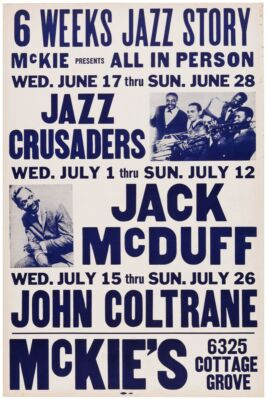
But I did get to be around him on several occasions. In Chicago, I went every night for a week to hear him play at McKie’s. And when I came to New York in ’64, I went every night to hear him play at Birdland. I even got to help him carry his tenor saxophone to his station wagon one night. He wasn’t a very talkative guy — quiet, soft-spoken — but we talked a little, about me being from Mississippi and all of that. He was always kind, and he was very aware of what was going on politically, especially knowing I was from Mississippi.
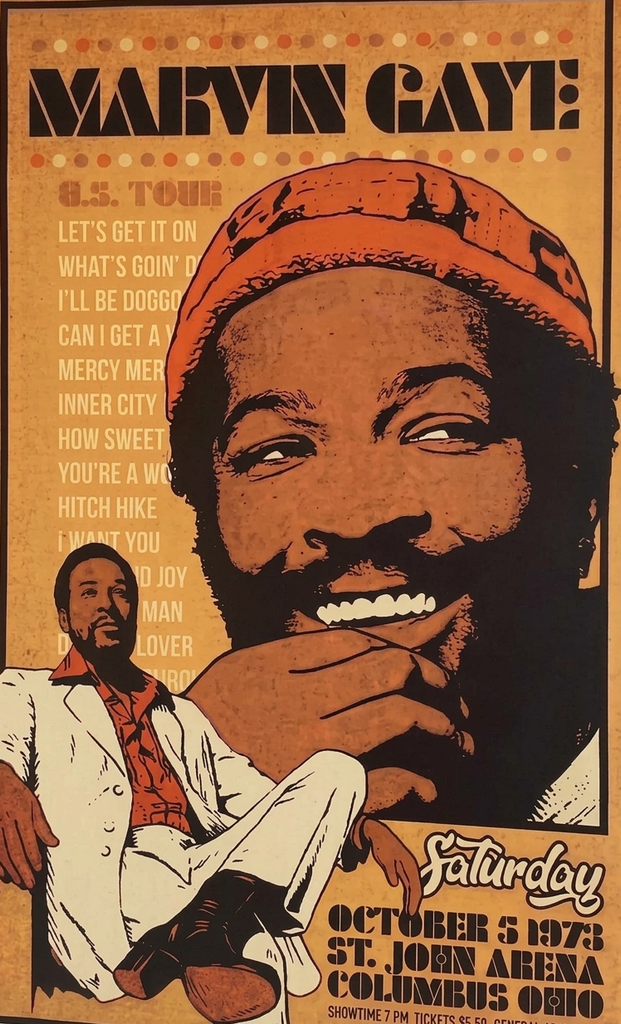
Griffin also joined Marvin Gaye’s horn section for a period.
SV: Marvin Gaye is a legend for his music, but you’ve highlighted something rarer: his absolute humanity. From five-star accommodations to a total lack of ego or separation, he treated his band with deep respect. Looking back at the music business at that time, why did that kind of foundational decency stand out so sharply?
DG: Marvin Gaye was very, very respectful. But people like Marvin Gaye, like Charlie Parker — some people carrying real demons inside them don’t show that side to everybody. He’d been through some things, cleaned himself up in some ways, but what I saw was somebody sweet, respectful, down to earth. A lot of people never saw that side of him — every coin has a head and a tail, every person has both sides, and you might only see the best of somebody, never the worst, or vice versa. That’s why people are so shocked sometimes — “this guy did that? He seemed so normal.” You just never see the hidden side.
But I saw the sweet side of Marvin Gaye. I always say he was the best bandleader I worked for, because a lot of bandleaders travel first class themselves and stick the band in economy, put themselves on a nicer floor of the hotel than the band. He wasn’t like that — he made sure everybody traveled and stayed at the same level he did.
We had a bus for that tour. John Stubblefield was in the band, and a lot of other musicians came through that scene — Bill Davis was in the band too; he’s not with us anymore. There was also a great trumpet player whose name I’m blanking on. My connection to Marvin actually came through session work — I was doing horn arrangements on a lot of Motown/Platinum recordings, Smokey Robinson and others — the Hunter brothers, Johnny Griffith, Ed Perry, roughly three of us — I did trombone, along with a guy named Harris — every Saturday or Sunday, we’d go in and lay horn parts on whatever tracks were being recorded that week. That’s how I got connected, and eventually Marvin called me directly for trombone work.
There was also a trumpet player from Washington, D.C. — I think he’s still out there — and a trumpet player and conductor named Leslie Drayton, who’s in Houston now; I’ve been trying to track him down, find old photos from that tour. We hit Chicago, Pittsburgh, all down the East Coast.
SV: And you also played alongside James Brown?
DG: I was playing house band at the Apollo. So every group that came through — the Temptations, the Four Tops, James Brown, Eddie Kendricks — we got to be pretty good friends, because a lot of the Temptations were around my age, and when a group came through, they’d be there a whole week, so we’d hang out. I knew all the original Temptations — and Otis Williams is the only one from the original lineup still alive today. Eddie Kendricks was from Alabama, and I’m from Mississippi, so we bonded over that whole regional connection. My son actually did some shows with Otis Williams and Gladys Knight later on, and we’ve stayed in touch through all of that.
I must have done about five years as part of the house band at the Apollo, so that meant playing behind pretty much every act that came through. One that really stands out — Isaac Hayes. We went on tour together, and he had this spoken intro, “By the Time I Get to Phoenix” — a long monologue every single night, and it never got old, always sounded fresh, kept the crowd hanging on every word.
Another that stands out is Marvin Gaye — the singing, the whole tour. And I got to play with all the Jacksons — I played with Janet when she was ten years old, Michael was seventeen, and I played with the Jackson Five when they became the Jacksons, the whole family. We did a week at Radio City Music Hall in 1975 — around February, I believe — you can find an article about it in Billboard.
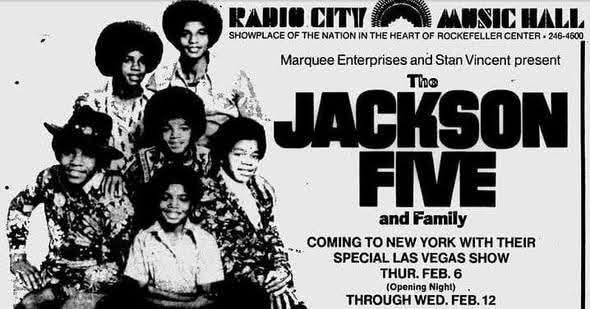
I got to be around Michael for that whole week — we rehearsed for maybe four days. I’d go up and talk to him during breaks; his brothers would run across the street to get sandwiches, but Michael would usually stay behind in the theater, practicing. He was very soft-spoken — I’d ask how he was doing, and he’d be working on his spins, all those little details, while his brothers were out having fun. He was like Coltrane in that way — always practicing.
SV: Let me ask you about Hank Jones for a minute. He never touched drugs or alcohol, and you’re the same way — both of you citing something about extreme or addictive personalities. What do you think led you to recognize that about yourself, when so many others didn’t?
DG: Well, coming up in Jackson, Mississippi, there were no hard drugs really available — just bad, homemade alcohol, white lightning, we called it — moonshine, corn whiskey. And people who got strung out on that corn whiskey, it would do terrible things to them.
I got drunk once, badly. I was working on the beer truck, like I told you, and the employers would give us a whole case of draft beer — not cold, but real beer. Under the Hill, we’d just sit around drinking it like water or soda, and I didn’t feel too bad at the time. So one time I jumped down off a porch — those porches were pretty high — and by the time I got to the ground, everything started spinning. I made it home, but I couldn’t even climb the front steps. My neighbor, Miss Katie, recognized what was going on and went to get my mother, because I didn’t want to go inside while my mom was still awake, trying to sneak in.
When I finally got to bed, the room was spinning like a Ferris wheel, and I started throwing up. The next day I was so sick — that’s when I learned what a hangover really was. And right then, I decided that wasn’t for me. I didn’t like the whole cycle of feeling good and then feeling terrible for a day, sometimes two. My body just didn’t like being out of control like that.
That kind of set the tone. Later, in high school, we’d occasionally drink some Mogen David wine. One time I was on a band trip, in Greenville, and my friend Herbert Delaney and I had some of that Mogen David wine, and I remember saying, “Herbert, let’s go find this guy” — I was acting like a different person entirely, and I’d only had a little, just gotten tipsy. That was it — I said, I never want to be out of control like that with myself again. I was still in high school when I decided I didn’t want to drink like that.
I’ll admit, once I started traveling, I smoked a little marijuana here and there, wanting to relax and sleep. But I stopped, because one night I played at the Village Vanguard, or somewhere, after smoking, and I played horribly — I thought I sounded great in the moment, but afterward I was mortified. I told myself, never again. I never snorted anything, but I just didn’t like being out of control.
Above: Ellington’s standard given Griffin’s rich, multiphonic-inflected treatment.
SV: You’re also an accomplished painter, and I want to ask: how did the visual and the musical feed each other in your creative life? Do certain colors, shapes, or moods from the canvas find their way into your solos or compositions, or vice versa?
DG: I can’t say there’s a direct crossover in that sense. I was always a good drawer — I could draw well in high school, and I liked expressing myself that way. There were three pretty good artists in my high school; two of them majored in art, and I went on to major in music. One, Walter Jackson, is a very fine sculptor who majored in fine arts and taught art — he knows art deeply. Another, Carl Cameron, who’s no longer with us, was very good at drawing portraits. I could do pretty good drawings myself, but I chose music, and back then it wasn’t really feasible to pursue both seriously at the same time. So I set the drawing and painting aside for years.
Then I had a show in Paris — a gallery called Le Blanc. While I was there, I had the same dream two nights in a row, around three in the morning — I always seem to wake up creative around 3 a.m. — I saw this red ball spinning, with beautiful colors coming out of it. That was the beginning of my real venture into painting.

Above: One of Griffin’s pieces, “Moving Out,” 71 x 64, acrylic on canvas
One of the major influences that pushed me toward painting and drawing was the death of my friend Freddie Waits— he died in November of ’89, or possibly ’90, I’m not sure of the exact year. We’d been in first grade together. Freddie was, in a lot of ways, one step ahead of me, and I was one step ahead of him in other ways — never a negative competition, just how things worked out. He got married before I did, had a son before I did — our sons were born about six months apart, his in June, mine in November.
Losing him was such a hard thing. I’d had that dream, bought a canvas, and started working on it, and then he passed, and I remember thinking, “He’ll never know I’m a painter, that I can paint” — and nobody would know unless I got started, so that’s when I really began. In a way, I poured my grief over losing him into painting.
I went to an art supply store, bought a 9-by-12 sketch pad and an 18-by-24 pad, and started doing pastels on paper — ten large ones and ten small ones. I asked Alex Weiss, who’s no longer with us, to come take a look. I laid them all out on the floor, and he looked at them and said — he used a lot of profanity, I won’t repeat exactly what he said — but essentially, “You’ve got something here.” I asked what he meant, and he said, “You’ve got imagination.”
So I wanted to study properly. I went to a place — I think it was a real art school — for about three months, just studying, because I know myself well enough to know that if I haven’t taken formal classes, and I have friends with master’s degrees in art, there’s something worth learning. So I studied there, and one day a teacher told me, “I’ve been watching you. I think what you should do is just go home and paint, because being here is just going to confuse you.” He gave me his personal phone number and told me to go home and think about it.
I still felt like I needed more, so I went to the Art Students League, a great, historic art school — people have studied there for over a hundred years. I said, “I want to enroll,” and he said, “Don’t waste your money. I want you to come to my class at seven p.m., bring some of your paintings, some of your art, just come sit in.” So I did — I brought my work in, laid it out, and people looked at it and said, essentially, “What did I tell you? Go home and paint.” I was really just looking for fundamentals — how to mix colors properly, things like that.
Here’s something funny — I’d go to the art supply store, and the clerks there loved talking about color and technique, and I’d just ask them, “What happens if I do this?” and they’d hand me a color wheel and explain how mixing worked, and we’d sit and talk. That’s really where I got my lessons — that’s all I needed to know.
SV: What do you most want younger musicians to understand about the tradition, about technique, and about finding their own voice on an instrument that isn’t always front and center in modern jazz?
DG: Just have courage. I hear a lot of people who take the safe route. It’s very difficult to try something different, given all the beautiful things that have already been done in this music — but if you think in a certain way, you’ll come up with something of your own. It just takes courage to step out of line — the same courage it takes to step out of a checkout line and ask somebody to open another register.
Try to find your own voice — it doesn’t take some magic formula. Just listen to what’s in your own head, and don’t be afraid to go for it. A lot of schools just teach you how to duplicate what’s already been done, because most of the people teaching jazz in schools have never actually made a living playing jazz. They’ve learned the technique of it, but they haven’t lived it, out on the road, since they left college. That’s what I’d say.
Above: Griffin is part of the powerful trombone section in Tolliver’s big band. Essential Strata-East large-ensemble energy—bold, post-bop/spiritual writing with Griffin contributing to the brass weight.
SV: You’ve been at this for over sixty years, and you’re still leading bands, still releasing music. What’s one moment or performance that still stands out as a personal highlight — maybe something that isn’t on the official resume?
DG: Too many to choose just one. There’s playing with James Brown — he used one of my arrangements to open his show for a whole weekend, at one point, and offered to buy it outright — I felt like the number he offered was actually too much, so many stories like that. Just too many.
SV: You’ve been changing fundamentals even at this age, eighty-five, eighty-six — your embouchure, your breathing, even which side of the bed you sleep on. So what made you willing to unlearn something that basic, this late?
DG: It’s not hard to learn — it’s the courage to change. Most people get to a point where they think, “Okay, I’ve got this figured out.” But you got it figured out for what it was supposed to be back then — now you have to figure out what it’s supposed to be now. That’s the whole difference.
Everything — even something as simple as, people used to ask, “Where’s your cell phone?” or, “You don’t have a cell phone or a Visa card?” Back in the day, if you didn’t carry those things, people assumed you were associated with the underground, hustling somehow. Now people look at you like you’re the strange one if you don’t have those things. So that’s what I mean about the mind — that’s why I am who I am now.
Everything you do in life is like a coin — it has a head and a tail. Have you tried the tail? It has a left and a right. Have you tried the right? That’s what’s exciting about life now — I’m not sitting back thinking, “I’ve got this figured out, I worked hard for this.” I wake up every day thinking, how can I change today? What can I fix today? And a lot of times, that means walking away from something. I’m a competitor — I love to compete, I want to win — but sometimes you have to say, that’s not realistic. Lose, and keep moving. Let them have it, and go get what you’re supposed to get.
That’s just reasonable. There were four things bothering me, and I sat down and asked myself, what are you even fighting for? What would happen if you just let them have it, let them win, and let it go?
The most important commodity that every single person has — the only one everyone shares — is time. How you spend your time, how you waste it, how you use it, how you respect it. Everything you commit to, ask yourself: what is this going to do for my time? How much time am I willing to spend to win, or to lose? One way to do it — you do it easy, or you do it good. I don’t do it at all otherwise.
Above: Griffin on McCoy Tyner’s 1973 LP; “Little Brother” showcases his contribution to Tyner’s ambitious orchestral writing.
SV: You’ve talked about the idea that you have to be willing to give up who you are in order to become who you want to be — that staying “green” keeps you growing. At this point in your life, having already been a trombonist, a painter, a teacher, an associate to all these giants of music — what do you think you’re still actively becoming?
DG: Oh, wow — that’s a good one, because I just finished rehearsal today. I’ve been rehearsing my own big band for about four years now, and I still learn things — sometimes such simple things that I ask myself, why didn’t I start doing this four years ago, when I first put the band together? Every day I learn something, and I feel like a kid again, because I’m excited. I run into a technical problem, and I say, let me just try this — I’m excited about changing, because the world is changing, and if you stay where you are and refuse to change, you get left behind.
I’ll give you a good example: remember back when nobody had cell phones, and it seemed like only people doing something illegitimate carried pagers or had numbers to reach people on the go? Now it’s hard to find someone who doesn’t carry a phone, and we take that completely for granted. You pull out your phone to take a picture of something without a second thought. I did a concert recently, and I had someone in the audience take a picture of a small flyer with their phone so they could remember it — some people who came to this country recently think about that kind of thing differently than we do.
Receipts, too — people hand you a receipt now, and it practically evaporates two minutes later, all digital. I had someone recently bring me some receipts, and I said, “Is this for my taxes?” and they looked at me like I was speaking a foreign language — like, people just don’t think about it that way anymore, keeping paper for their taxes. Even buying something for my car, they ask, “Do you want a receipt?” and I say no, because it’s already on my phone from the transaction. Paper, as a whole, is basically disappearing.
So all of this comes back to — you’ve got to be willing to give up who you are in order to become who you want to be. Stay green, and you keep growing — because once you think you’re fully “ripe,” you fall off the tree and that’s the end.
That connects to what one of my major mentors told me — work on your weakness, which means facing your fears. I’m slow to change sometimes — I tolerate things too long before I make a move. Lately I’ve had to tell myself, tighten it up, speed it up. My sister — God rest her soul — used to say, “Go where you’re celebrated, not where you’re tolerated.” If you’ve been tolerating something instead of being celebrated, forget it — let it go, get out of it.
I recently did something I’m really proud of myself for, along those lines. And that’s the exciting part now — how much stuff do I still need to get rid of? How many situations do I need to leave behind? Because you have to have faith that there’s something better out there. That’s how you create space for it — when you’re stuck in a situation that isn’t good for you, where people aren’t treating you right, you have to act, and trust that something better is waiting. I’m learning that this world is so big, so vast, that whatever you want is out there somewhere — you just have to go where you can find it.
SV: You’ve shared advice from two jazz giants who gave you diametrically opposed directions: Coltrane told you to practice what you already do well, while Rahsaan Roland Kirk urged you to attack your weaknesses. Is there a weakness you’re most focused on now, not just as a player, but as a composer or a person?
DG: Yes — how I manage my time, and facing my fears. I can analyze why I haven’t done certain things, and it comes down to fear — telling myself, “I’ve got to do this, and this, and this before I can do that,” instead of just plugging in and doing it. Lately I’ve realized a lot of that reasoning wasn’t even necessary.
Like I said, the four issues I mentioned — I resolved them, even though they didn’t go the way I wanted, or the way I thought they legally should have gone. One thing I walked away from, and I’m mad at myself for not walking away two or three years earlier — it was a simple solution once I got my head around it. You can’t stand on being “right” in this corrupted world, because nobody’s really right these days — not everybody, but a lot of people are lying, stealing, taking. So the rules you used to live by don’t always work anymore. It’s like a key that’s fit the same lock for fifty years, and then one day, it just doesn’t turn. So what do you do?
SV: Dick, it’s been so great talking to you–I can’t thank you enough for your time.
DG: Alright, thank you. You take care, man, I’ll talk to you soon.
Further listening:
As leader
The Eighth Wonder (Strata-East, 1974)
Now Is the Time (Trident, 1979)
A Dream for Rahsaan (Ruby, 1985)
All Blues (Ruby, 2002)
Time Will Tell (Ruby, 2011)
Homage to Sun Ra (Ruby, 2014)
As sideman
Rahsaan Roland Kirk The Inflated Tear (Atlantic, 1968), Volunteered Slavery (Atlantic, 1969), Prepare Thyself to Deal with a Miracle (Atlantic, 1973)
McCoy Tyner Song of the New World (Milestone, 1973), Inner Voices (Milestone, 1978)
Billy Harper Capra Black (Strata-East, 1973)
Abdullah Ibrahim Ekaya (Ekapa, 1983), Water from an Ancient Well (BlackHawk, 1986)
Muhal Richard Abrams The Hearinga Suite (Black Saint, 1989)
Leave a Reply
You must be logged in to post a comment.