
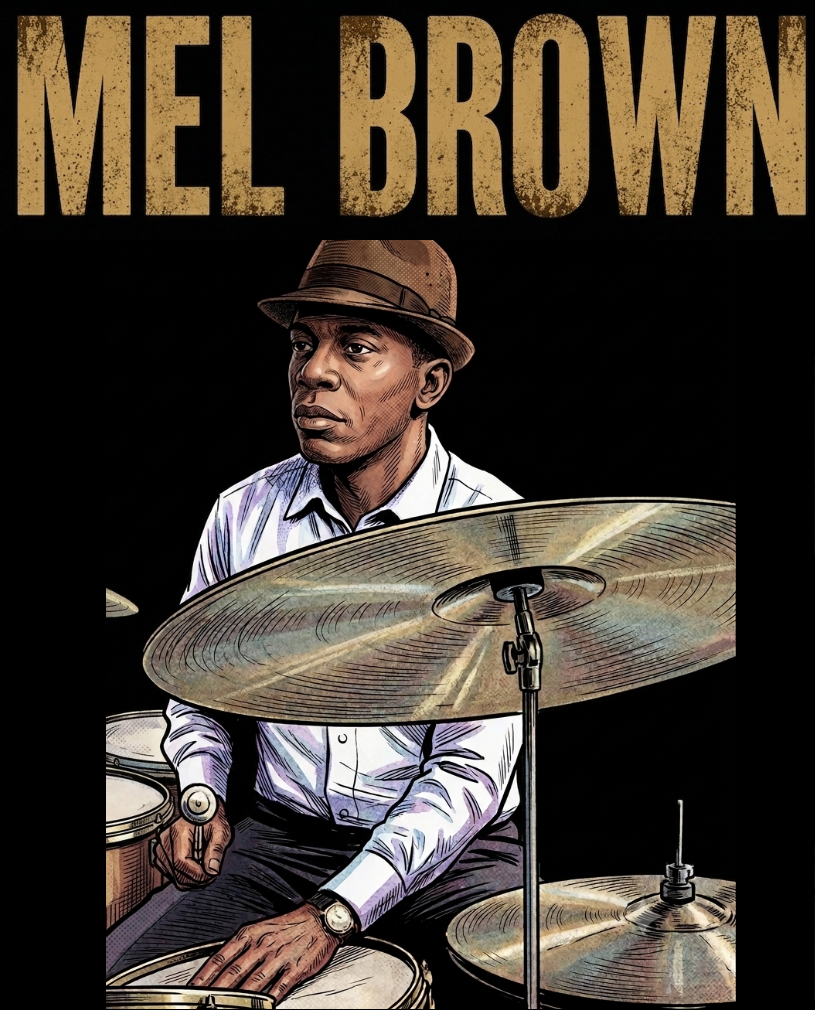
Drummer Mel Brown chronicles his journey—spanning from childhood efforts with makeshift sticks to his iconic Motown tenure and a lifelong commitment to mentoring Portland’s jazz community—while detailing the philosophy that defines his signature rhythm.
___
Born in Portland, Oregon, in 1944, Mel Brown’s early life was marked by his connection to the city’s vibrant culture. As a youth, he worked a paper route that took him through Portland’s historic jazz district. During his high school years, he became deeply involved with the Portland Junior Symphony. He continued his musical pursuits while attending Portland State University, where he balanced his studies with performing at local jazz clubs. During this time, he also recorded and toured with the group Billy Larkin & The Delegates, with releases appearing on the Aura, World Pacific, and Liberty labels.
Sounds Visual: I want to start at the beginning—the formative years and the roots of your rhythm. I read that you started with rolled-up newspapers because you couldn’t afford sticks…
Mel Brown: Well, I had to be resourceful. I didn’t have the money, but I saw other drummers in the neighborhood who might have had a broken stick or something I could use. Once I could afford a pair, that was it. I collected money from my newspaper route—my customers would pay a little bit here and there—and I could finally buy a pair of sticks for a buck.
SV: You often handed out free sticks to kids. Was that a deliberate attempt to act as the mentor you wish you had, or was it just a way of keeping the family of music growing?
MB: No, I’ve just done it trying to be nice because I know what it’s like not to have any sticks. If I had something in my bag, I’d just do that for the kids who came down to my drum shop.
SV: You’ve spoken about the intense ear training you did with Philly Joe Jones’ records—that level of detail where you could identify every rudiment and hand-start. Is that auditory visualization something you still use, or when you hear a young drummer sitting in with your band, is your brain automatically breaking down the technique like that?
MB: No, I don’t use it as a drill anymore. That was for a different time in my life. Right now, when I’m in a mentor role, I use more of a “brain concept.” I give the student a prompt and see what they come up with. I encourage them to use their ears; if you’re walking down the street or you’re in a car and you hear a melody on the radio, go home and write that rhythm out. A lot of people just want to hit the drum, but they aren’t really thinking rhythmically. If you play something and then write it down on a chalkboard, you start to see the visual pattern as well as the audible one.
SV: Let’s talk about some of the big influences on you as you were coming up. Obviously, Philly Joe is one of them, but you also loved Max Roach and Art Blakey. Can you just talk a little bit about some of those influences?
MB: When I first really started getting into the jazz thing, I was listening to records and reading the names on the back of the album covers. I couldn’t see them in person, so I had to have my own sound. I would pick a drummer—say, Max Roach—and for a whole month, I’d listen to everything I could find by him to figure out what he was doing. The next month, it was Art Blakey. The next, Billy Higgins. I was getting it from three different sources.
Each drummer played the drum set differently, which made me listen harder. I spent a lot of time in front of that record player, really reading those minor notes. It helped me out, and it allowed me to pick up different things from John Coltrane records or Count Basie records.
And back then, you could go by certain clubs in the neighborhood, and if the door was open, you might get a glimpse of someone on the bandstand. You’d think it sounded one way on the record, but seeing it in person changed everything. Interestingly, back when I was a kid, it seemed like all the drummers I ran across were left-handed. You had to really watch how they were hitting the drum—it was like, “Whoa, I never thought to start with my left hand.”
SV: TheWilliams Avenue legacy in Portland seems so vital. You were mentored by elders like Bobby Bradford and Cleve Williams who waited for students after school to pass on knowledge. How much of the, for lack of a better word, Portland Sound is directly linked to that specific 1950s and 60s culture of community mentorship?
MB: It was a real community. There were other drummers around town who did things—like Bobby Bradford and Cleve Williams—who could actually play other instruments, too. They helped me out immensely. I really looked up to people like Chuck Moore and Dale Smith. We didn’t have a lot of space to play, so the mentorship was direct and hands-on.
SV: When you look at the city today, is there a part of the historic Williams Avenue spirit that you feel is still alive in the way that Portland Jazz musicians interact?
MB: I think so, like with the jam sessions at Ronnie Steen’s. That’s a real drawing point. When people come to town, they want to know where the jam sessions are, and we don’t have enough of them. The Albina Arts committee is doing a great job trying to bring things back, but we need those consistent spaces. The only drag right now is that you go downtown, you park your car, and you’ve got to pay quite a bit of money to do it.
Following his graduation from Portland State University, Brown relocated to Vancouver, where he secured a steady engagement performing with guitarist named Tommy Chong., who later became half of the comedic duo Cheech & Chong. His career took a major turn when Martha Reeves attended one of his performances and subsequently recruited him to join her band in 1967. Brown performed with Martha and the Vandellas for two years—earning a personal shout-out on her unreleased Live at the Copa album—before he was hired by Motown. As a Motown artist, he transitioned into the role of a studio musician and began touring with various acts on the label’s roster.
SV: Let’s talk about the Motown years.
MB: I was in Vancouver, Canada, playing at a club from 12:00 to 5:00 in the morning. It became an after-hours spot for musicians. The manager came down to the club and saw me play. She knew me from my previous work with Earl Grant, so she called out to L.A. and told the folks there, “You need to see this drummer.” I met her in L.A. a few weeks later, and they brought me out to Detroit. They liked my sound and the way I read music, and that was it—I was working.
SV: You’ve described the Motown sound as a big family affair. How much do you think of that spontaneous collaborative environment influenced the way that you assemble your own bands?
MB: I was trying to learn how they got that specific sound. I was still thinking in terms of jazz, but Motown had its own groove—that rhythm and blues foundation. When I finally started leading my own bands, I wanted to combine that. I wanted the groove of Motown, but with the sound of Art Blakey or Miles. So when I came back to Portland, I put together a band with horns—not just a guitar—and it worked out pretty well.
SV: The Motown era is famous for its anonymity. You worked on legendary records, but sidemen weren’t always credited. Can you clarify some of the records that you did play on just so I can attribute those properly? And because the sidemen weren’t listed, does that era feel like a lost chapter of identity or does the satisfaction of just having a job with those stars make you feel fulfilled?
MB: It was an identity thing, but you have to understand, you didn’t necessarily record a whole album. You’d be called in to put down one or two tracks, and you’d leave. By the time the record came out, you’d listen and think, “Oh yeah, that’s me on track three.” But it was all about the work. James Jamerson was on everything, and he was the foundation. You just showed up, did the work, and got paid. You never knew who you were going to be playing for when you walked through the door.
SV: Are there any records from that era that stand out to you that you played on that you still hear nowadays, or that you still have in your collection?
MB: I don’t really think about that. But I just know that I was there. You go to the studio and maybe Smokey would come in and say, “Okay, this track over here is for Stevie Wonder.” You’d go in and do something, and then they’d say, “Oh yeah, this one over here was for The Four Tops.” You know, so you never really knew. You got the names of the records while you were recording, but you never knew if they actually kept that track or not.
SV: Let’s talk about meeting Marvin Gaye, and then performing with hin,
MB: Yeah, Marvin was just a fun dude to be around. He was a joker, and he was also an athlete. We used to have those Motown parties during the summer, and Marvin was always playing sports—softball, football, whatever. He had a dream to be a professional football player; he even got on a Detroit Lions summer league team for a hot minute until the season started, and then they cut him because they didn’t want him to get hurt. And with that record, What’s Going On, we enjoyed those sessions a lot.
SV: Did you also do a session with George Harrison?
MB: I did. I was in London in 1970 with The Temptations, recording Live at the Talk of the Town. One night after the show, the guys said, “Mel, some guys are looking for you.” I went down to the restaurant, and there were George, Ringo, and Paul. My buddy Billy Preston was there, too. They said, “Hey, we’re going to do some recording, and we’d like you to play with us.”
We went to the studio, and I used a drum set I’d never played before—it felt like I was playing on toys. In the middle of the track, there was a little two-bar drum break. I hit the cymbal and then did a fill on the bass drum, and I basically stumbled over the pedals. I thought, “That was a total screw-up.” But George said, “Man, that was great! Do it again.” That ended up being [part of] the drum track for “My Sweet Lord.”
SV: Wow–and other acts like Diana Ross, Martha and the Vandellas, and the Main Ingredient—you did a lot of recording for all three of those?
MB: That’s right. Though the Main Ingredient, that really wasn’t Motown. You’re correct on the others.
During his tenure with Motown, Brown recorded with some of the biggest names in the industry, including Stevie Wonder, The Temptations, and Marvin Gaye. Despite these high-profile collaborations, he and other session drummers of the 1970s and 80s often remained unrecognized, as industry policy rarely credited session musicians for their work. Their role was strictly limited to supporting the artist in the studio or on stage, rather than serving as official members of the touring bands.
In 1973, Brown returned to Portland, which became his permanent home. Six years later, he formed a trio with pianist George Mitchell and bassist Phil Baker, and from 1978 to 1980, he toured with Diana Ross alongside that group. Beyond his performance career, Brown established himself as an entrepreneur, operating The Mel Brown Drum Shop until 1984 before transitioning into the financial sector with his bookkeeping firm, Metropolitan Accounting and Tax.
Despite his business ventures, Brown remained a cornerstone of the Portland jazz scene, frequently performing with his own sextet at The Hobbit and collaborating with bassist Leroy Vinnegar to form a Hammond B-3 organ quintet. His commitment to the community and music education grew throughout the 1990s as he served on the board of directors for the Mt. Hood Jazz Festival and founded the Mel Brown Jazz Summer Camp at Western Oregon University. Over the course of his distinguished career, he also performed with the Oregon Symphony and was ultimately inducted into the Jazz Society of Oregon Hall of Fame in 1999.
SV: You formed a trio in ’79 and were actively installing a “passing it on” clause in their contracts. Can you talk about the George Mitchell and Phil Baker era?
MB: I had the trio at a club here called the Hobbit. When my piano player left to go with Tom Jones, I had George Mitchell come in, and after George, we had Phil Baker on bass. That was the Mel Brown Trio, but we were also the rhythm section for Diana Ross. We were the rhythm section when we did that concert in Central Park back in 1983. George and Phil, they were on that gig.
SV: What’s the one technical or philosophical blind spot that you find yourself correcting most often in young players?
MB: I don’t really correct them because everybody plays so differently. I have big hands and long fingers, and someone else might have small hands; they’re going to play a different style. But my drum shop gave me a chance to see a lot of drummers. If you’ve got a drum set and you live in an apartment, you can’t really play whenever you want. So they’d come down to the shop and use the practice room. They’d learn from each other—it was like a family of drummers asking, “How do you do that?” It was like being in a Boy Scout troop.
SV: Do you feel that your greatest contribution to jazz is the music you recorded or the generations of drummers who are carrying on your legacy and philosophy?
MB: It’s a mixture of both. Everybody just has a way of doing something. I don’t know if I really had that much of an influence, but guys knew me and they looked up to me because of the Motown thing. I’m just grateful that they thank me for helping them correct whatever they were doing wrong.
SV: You’re known for a great swing feel and a hard-bop fire in your playing. When you’re improvising, do you find yourself leaning into those classic techniques or is there a modernist in you that takes over?
MB: Hopefully, I learned how to get a certain sound from my teachers. I remember telling Philly Joe Jones, “You’re the greatest teacher I’ve ever had because you weren’t afraid to show me your tricks.” He told me he had three reasons why. First, if he showed me how to do it technically, I’d never play it exactly like him anyway because we’re different people. Second, I wouldn’t play that figure in the same spot in the music that he would. And third, he said, “If you play it and someone says it sounds like me, they’re just giving me credit, and I was there first.” That stuck with me. You have to develop your own sound. Don’t spend your time trying to be a carbon copy of your teacher.
SV: How much of that analytical mindset do you have to turn off to stay in the moment and let the music breathe on stage?
MB: You try not to be totally analytical; you just do what the music dictates. If you’re playing behind a singer, you play differently than you would behind a saxophone player. Behind a singer, if you’re too busy, you’re getting in the way. You have to think of your left hand like a piano player comping behind someone. You should be adding to the music, not just playing things you practiced for eight hours. It may not fit the music, and if it doesn’t fit, you should get out of the way.
SV: If you could sit in a room with 13-year-old Mel and his newspapers, what’s the one thing you would tell him about the business of being a musician that would have saved him the most stress?
MB: Just think about the future. Ask yourself: Are you going to make this a career? If you are, what kind of music are you going to play, and where do you fit in? Are you playing because you love the music, or are you just thinking about the money? You have to decide who you’re going to be and what your contribution is going to be. Never step on anybody to get your own sound. Just be the best person you can be.
SV: Jazz is really celebrated for its improvisational nature. As a fellow drummer, I was curious, how do you balance the meticulous planning that goes into creating a piece with the spontaneity required for effective improvisation?
MB: That’s a hard one to really answer. It sounds like I would tell someone, “Don’t play that way, you should play it this way,” but I wasn’t on the record date. Guys can just say, “I went down to the alley and sat in at such and such club.” It’s about the moment, not the plan.
SV: Jazz is also a genre that embraces individuality and personal expression. How do you approach finding your unique voice as a musician and what advice do you have for emerging musicians trying to carve out their own path in the industry?
MB: I really can’t give them advice except to just experience playing as much as you can, because something will come out. Something will feel good to you. The main thing is, if you play something, play what feels good to you as opposed to playing a lick that you’ve copied. We’re all copying licks, but they’re coming from different angles. You play them, and people say, “Boy, that sure was good.” But that’s what I played when I played with the trio, and that’s what I played when I played with the quintet—two horns and me. So listening to as much music as possible back then, but then deciding: “Do I really feel comfortable playing that?” Plus, if I played it, would I play that thing with brushes, or would I play with sticks?
SV: Mel, before I let you you go, let the readers know where they can come see you play.
MB: I’m at Salty’s every Friday, and then there’s a place out in the Clackamas area called Conway’s House of Jazz. And then there’s a place called the Jack London Revue, and I’m also reguarly at the 1905 Jazz Club. And then on the second Saturday of every month, I play at a place called the Alberta Street Pub.
SV: Thanks so much Mel!
MB: Thank you. I am very honored that you were interested in all the stuff that I’m doing.
Leave a Reply
You must be logged in to post a comment.