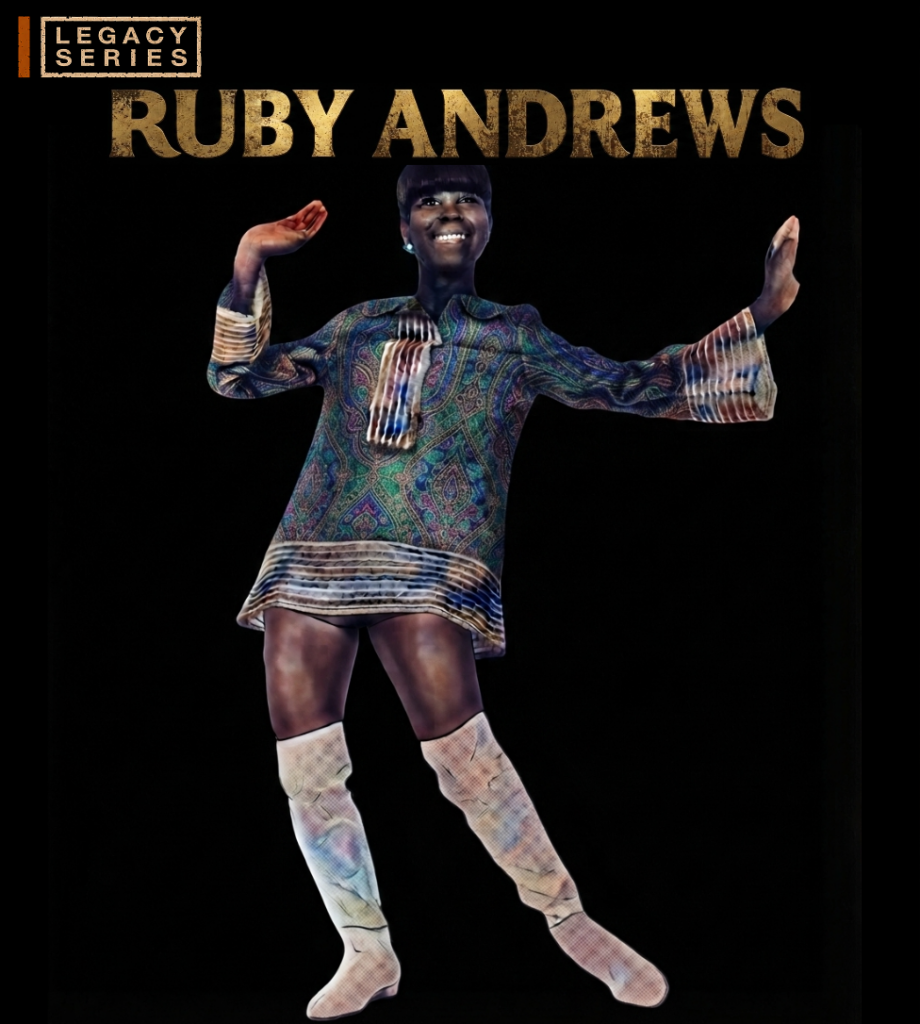
The Legacy Series cuts through the static to pay dues to the departed masters. In this installment, Chicago soul powerhouse Ruby Andrews reflects on her storied career, detailing how her chart-topping hits like “Casanova, Your Playing Days Are Over” were born out of personal life experiences and brought to life with legendary Detroit musicians like the Funk Brothers.
___
A prominent voice of the Chicago soul scene, Ruby Andrews (born Ruby Mae Stackhouse) rose to fame in the late 1960s with crossover R&B hits like her signature anthem, “Casanova (Your Playing Days Are Over).” Beyond her performing career, the Mississippi-born singer later established her own independence as the CEO of Genuine Ruby Records, solidifying her long-standing influence on the industry.
Sounds Visual: Ruby, when did you start singing?
Ruby Andrews: Actually, I started in church at three years old, leading the senior choir. And after that, I just stopped going to church because I didn’t like it anymore.
SV: And were you also singing in high school at Hyde Park Academy in Chicago?
RA: Hyde Park had music, and that was the main thing that I was into. I went to music school in Hyde Park with Minnie Riperton—we were in the same music class. I would lead the choir, and that scared the heck out of me!
Every year we had a program in Hyde Park called social studies. I did extra in social studies, but we also had a show in the auditorium every year. Some of my friends said, “Well, you can sing. Why don’t you do that?” So I went on stage, got a standing ovation, and I said, “This is what I want to do.”
My first recording in a studio was doing background vocals on the song “Michael the Lover” by the C.O.D.s.
I did a couple of songs on that label, but nothing really came of it. Then, in 1965, Kellmac Records released the song “Wishing,” credited to Ruby Stackhouse—my birth name.
SV: Ruby, when did you change your name from Stackhouse to Andrews?
RA: My favorite actress is Julie Andrews, so I said that’s closest to mine. I liked it, and it’s simple to remember. That’s how I changed my name.
Above: “Wishing,” relased in 1965.
Andrews soon came into contact with Rick Williams, a local recording artist, producer, and label owner who quickly recognized her talent. Ruby’s next single, 1967’s “Let’s Get a Groove Going On,” showcased a funkier sound and became the first release under her new label with Rick Williams, Zodiac Records.
RA: I am the one who created the label Zodiac. I named it that because I was really into astrology back then, and the design around the label features all 12 astrological signs.
Andrews’ third release for the Zodiac label, 1967’s “Casanova, Your Playing Days Are Over,” became her biggest seller, hitting number nine on the R&B charts and crossing over to number 51 on the pop charts. Casanova proved that Ruby’s liquid alto voice was incredibly effective when matched with the right material.
RA: That was an overnight hit, so to speak. Jo Armstead wrote that record in about five minutes. She came out of Ashford and Simpson’s camp and married a friend of mine. We all got together because we needed a song, and we felt the sound we wanted wasn’t in Chicago. So we went to Detroit, got everybody together, and hired local musicians, producers, and writers.
Mike Terry was the arranger, coming straight out of Motown. We also had the Funk Brothers on all of my tracks, along with the Chicago Symphony Orchestra. I guess the rest is history!
SV: Do you remember the first time you heard it on the radio?
RA: Oh, God. I was at my manager’s house, waiting for him to pick me up and take me to the studio, and the radio was on. Let me say this first: the program director, Rodney Jones, was my manager. He programmed everything from Motown to Capitol, so he was a big man at WVON. I felt so honored to have him as my manager, and having his protection is really what propelled everything else forward. That’s how my records took off.
SV: And then you had another hit in 1969 with “You Made A Beliver Out of Me.”
RA: I was watching television one day, and a commercial came on with a lady saying, “Use Palmolive, it’s good to your hands… Palmolive, you made a believer out of me.” That’s how that song came about!
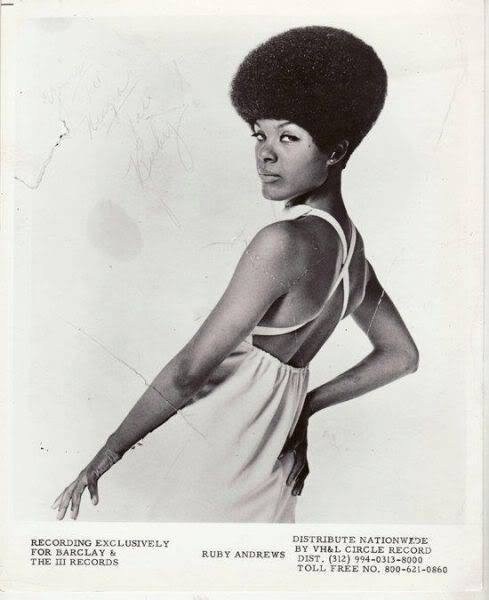
We used the exact same musicians and orchestration out of Detroit. A group called the Brothers of Soul—Richard Knight, Robert Eaton, and Fred Bridges—wrote all of those songs for me. Mike Terry was the arranger, and, of course, the Funk Brothers played on all of my tracks. But we couldn’t put their names on my label because Berry Gordy didn’t want them doing outside work; he wanted to keep that signature Motown sound exclusive.
That song, “You Made a Believer Out of Me,” was also a testimony to the fact that I loved this man who was my producer. The songs were genuinely written about my life and my personal relationships.
Andrews’ work with Motown’s top-shelf musicians eventually earned her a slot on the legendary Motown Revue tours. Ruby, that must have been an incredible experience.
RA: The highlight of my career was working with the Motown Revue. I had three booking agencies, and the Black booking agency would always put me on the Motown Revue. Working with Marvin Gaye, knowing the Four Tops, Stevie Wonder, Martha Reeves—those were the highlights of my life.
I also did a lot of television and worked with the Miracles. When “Casanova” first came out, we played major theaters here in Chicago like the Regal, as well as the Apollo in New York. I opened shows for Jackie Wilson, Moms Mabley, Pigmeat Markham, the Four Tops—just everybody.
With the release of her 1970 debut Everybody Saw You, Chicago soul powerhouse Ruby Andrews solidified her place in the R&B pantheon, delivering a definitive collection of deep soul.
SV: Ruby, tell me about the title track.
RA: That song was written about my boyfriend at the time, because, well, he was a “player.” All the songs they wrote for me were really about my personal life—hurt, pain, and all of that. “Everybody Saw You” was a major track; I think it went to number one in a few cities.
SV: From that same album was “Casanova ’70,” a reimagined, funkier version of your 1967 hit. Tell me how that came about.
RA: They wanted me to cover “Casanova,” but I originally wanted to keep the original in its own lane and felt nobody needed to re-record it. But we wanted to bring something really funky out, and that’s how we ended up doing “Casanova ’70.”
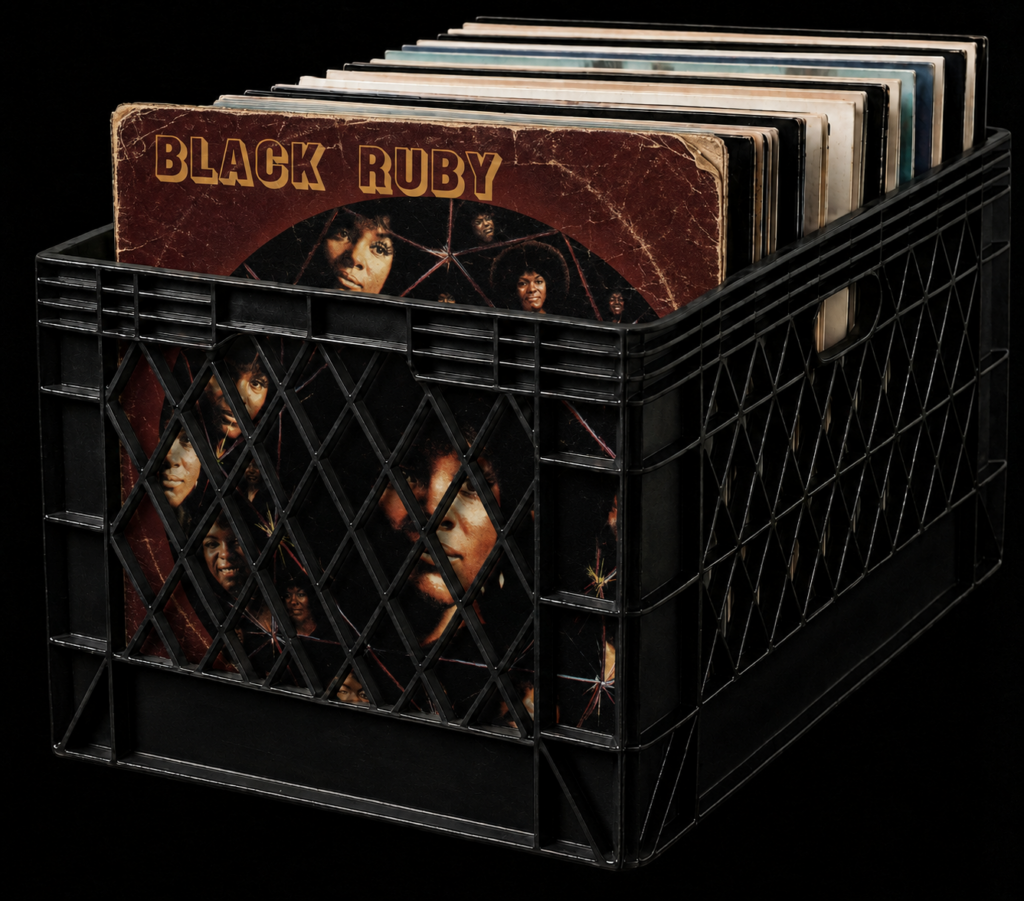
Released on Zodiac Records in 1972, Ruby Andrews’ sophomore album Black Ruby successfully paired charted R&B singles like “You Made a Believer (Out of Me)” with rich, Memphis-recorded arrangements. Over the decades, the release has achieved revered cult status among crate-diggers, largely anchored by the enduring legacy of its coveted Northern Soul centerpiece, “Just Lovin’ You”.
RA: We recorded the second album in Detroit, and the artwork was done by a young woman from Milwaukee, Wisconsin. Today, that album is sold out over in England, so I guess they like it!
“Just Lovin’ You” is my most popular song in England—it’s been number one over there since 1967. People constantly tell me how much they love it, sending me pictures of babies being born, weddings, and anniversaries to that song. Between “Just Lovin’ You,” “Casanova,” and “You Made a Believer Out of Me,” those tracks completely overshadow everything else the public wants me to do live.
We recorded [my version of “Hound Dog”] in Memphis under Jerry Butler, I believe on the Universal label. They brought me the song and wanted me to do this heavy, growling delivery. After I got through doing that song, my throat was so sore. I said, “No more doing that!”
Sometime around 1971, I had to have surgery on my vocal cords. I got on stage one night, sang a single verse, and completely lost my voice. It scared me to death. We went to the doctor, and he said, “You have polyps on your vocal cords; we have to remove them if you want to continue to sing.”
Your voice is delicate, but it can also take some hard knocks—just not consistently. I had to do that song three or four times, and pushing it like that really killed my throat.
SV: Ruby, since we’re talking about your voice, you have an incredible ability to shift effortlessly from soft and seductive on one track to powerfully raw and dramatic on another. How do you balance both sides of your vocal range?
RA: I balance it because certain songs shouldn’t be belted out. For instance, if you’re sitting on the couch with your partner and you want to tell them something important, you don’t scream—you say it softly and with feeling. That’s where I got the notion to style my songs that way.
On the other hand, a belting song is when you’re screaming at your man because he’s doing you wrong and walking out the door. That’s the difference.
SV: Ruby, another great one is “A Love Feeling” from your third album, 1977’s Genuine Ruby, released on ABC Records.
RA: That was written by Ron Dunbar from Detroit, who wrote for all the Detroit girl groups. It was very easy working with him; he understood my vocals, and that’s the song we chose to release. It didn’t go mainstream, but people love it, and I like it too. We recorded it at Sound Pit Recording Studios—Don Davis’s studio in Detroit—and mixed it at Holland-Dozier-Holland Studios.
SV: Ruby, like so many artists I’ve spoken with on this podcast, your music has been heavily sampled in the hip-hop world by artists including Q-Tip, De La Soul, and the Wu-Tang Clan. There’s a clear duality here: the positive is that sampling introduces you to a brand-new audience, but the negative is the lack of compensation. Where do you stand on the issue of sampling?
RA: I don’t feel good about it, because nobody ever asked for permission and I never got paid for my personal music. Through my corporation and record company, I am going to go after them at some point.
That’s one reason why I think the industry shifted so much—because rap artists were sampling everything, and record companies often failed to properly compensate us. You have to go after the record companies when you want your money for sampling.
Before all of that happened, I saw it coming, but I couldn’t do much about it then. Now, though, Seal Johnson’s people pulled up every single song that was sampled and gave me all the stats, lawyers, and company information. Once I fully establish my corporation, I’m going to go after them, because I think they’ll respect it more coming from a formal business entity.
Above: Andrews’ “You Made a Believer (Out of Me)”, later sampled by Q-Tip in 2008’s “Won’t Trade.”
SV: You’ve secured the rights to the Zodiac Records catalog and your music is starting to get re-released–I’m thrilled you’re finally getting the recognition you’ve earned.
RA: I just got Zodiac Records fully up, running, and copyrighted. I want to take the personal songs my fans love most and put them into a brand-new compilation. I just signed with a record company over in England that is going to help me with distribution and promotion, since there isn’t as much infrastructure for that here right now.
I’m also finally receiving awards! Back in the day, I wasn’t invited to award shows, and people in Chicago were getting recognized while I was overlooked. Now they’re giving them to me, and I’m just like, “Well, okay.” I would have been thrilled back then, but now that I’m older, it’s just, “Okay, all right.”
When “Casanova” first came out, parents bought the records, then their children listened to them, and now their grandchildren are listening to them. It spans generations. I’m still “in the numbers,” if you understand what I’m saying, because young people still genuinely love those records. That’s why I want to put together this fan-favorite compilation and potentially re-release Black Ruby as well.
SV: Ruby, thank you so much for joining me today, and I wish you all the best!
RA: You’re very welcome. Thanks for talking to me!
Ruby Andews passed away on August 13, 2026.
Leave a Reply
You must be logged in to post a comment.