
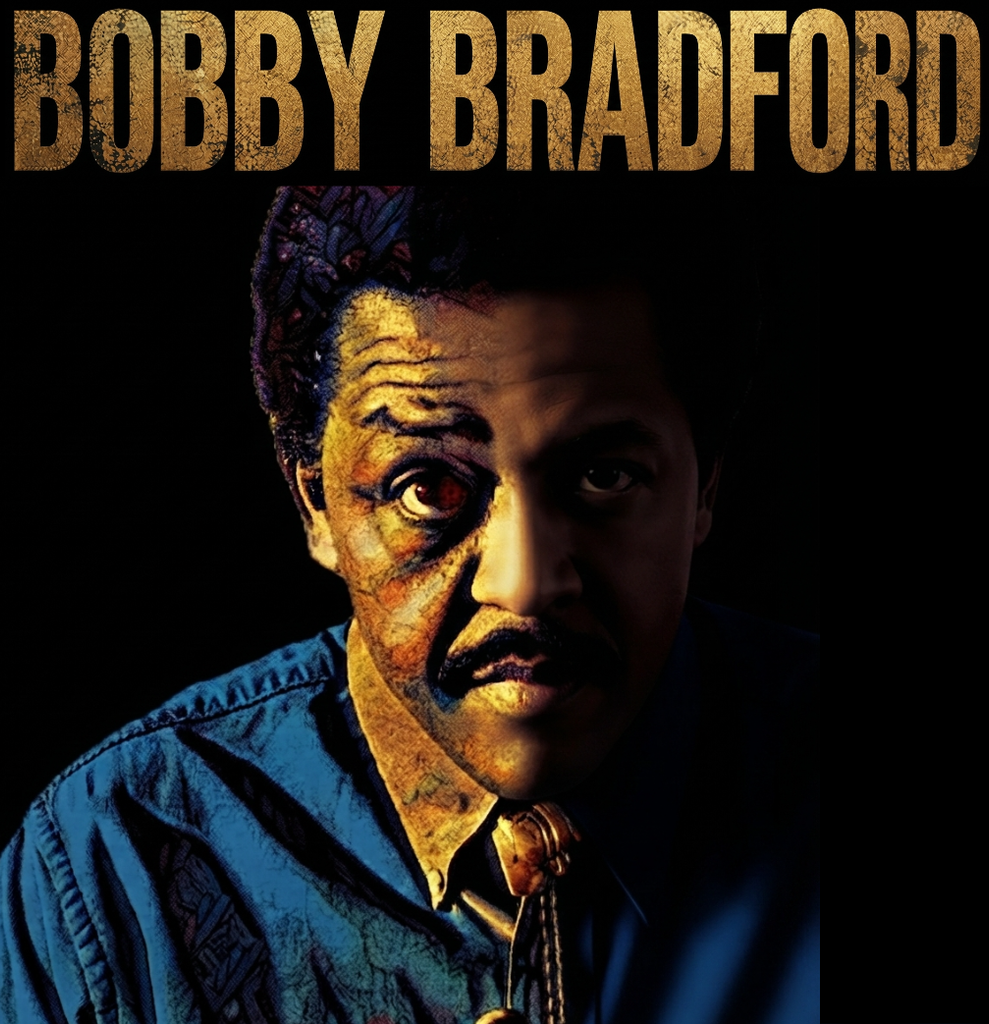
Forged in the Mississippi Delta’s blues and gospel fire and tempered alongside Ornette Coleman’s revolutionary harmolodic vision, Bobby Bradford’s trumpet became a fearless instrument of pure sonic invention — unshackled from chords, unbound by convention.
___
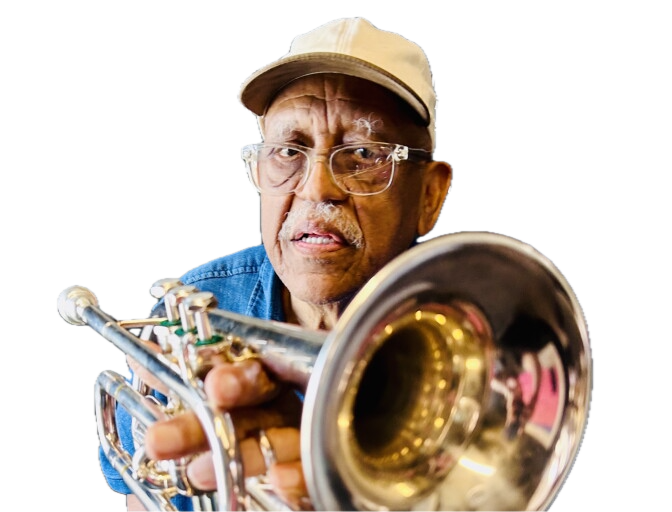
Bobby Bradford is an acclaimed jazz trumpeter, composer, and bandleader renowned for his influential collaborations with jazz icons like Ornette Coleman and John Carter. In addition to his expansive recording and performance career, he shaped generations of musicians through a 44-year tenure teaching jazz history and ensembles.
___
Sounds Visual: Growing up in Mississippi during the Jim Crow era, you once noted that you absorbed church music and the blues as essentially the same music with different words. How did that early insight shaped the way you hear and shape melodic lines, even in the freest, most improvisational settings decades later?
Bobby Bradford: Well, you know how old I am, right?
SV: I do. [Bradford is 92 years old as of this interview.]
BB: So, Mississippi. I grew up in Cleveland, which is right at the center of the Delta blues, but we were on the edge of town, like a lot of Black families were. There were Chinese merchants nearby — grocery stores, general stores where you could buy feed, bib overalls, small tools, whatever you needed. That was a gathering place when people had leisure time. You’d go up there and there’d be a long front porch with a banister running along each side. Farmers sitting up there whittling wood, some guy playing guitar.
You know the figure — the man who sits on a long plank, playing guitar with a harmonica rigged around his neck so he can go back and forth between them, singing, playing. And every so often he’d hit the plank and make this little wooden doll dance — the pieces held together at the joints with leather. He’d have a cup out, people would drop in a dime or a nickel. I just took all that for granted as a kid.
And I grew up in the Baptist church — serious Negro spiritual and gospel, though there’s a distinction between the two. Very rhythmic music, with what we think of as the essential properties of Black music — the bent notes, all of that. Inside the church, outside the church, it was the same aesthetic. That was totally a judgment Black people made as they assimilated Western music. They had no history of harmony the way Europeans did — tenor, alto, soprano — they didn’t bring that with them. They embraced it from white people. They loved it. But they tweaked it. They tweaked the melody too.
Church songs came in as enslaved people were pushed toward Christianity by the slaveholders, who wanted them speaking English — not because he cared about their souls, but because he wanted to be able to talk to them, and he didn’t want any religious practice happening that he couldn’t understand. So the enslaved man moved into the white man’s culture — the language, the religion — but in the process he carried a lot of African inheritance along with him.
Growing up, it was clear to me — not in any scholarly way, just clear — that the music in my church was different from the music in the white church across town. I never even set foot in theirs, but from what little I heard, I could tell the tone was different. Black and white, plainly. I grew up inside that music without ever thinking of it as a choice I was making. So the same men on the porch of the store might sing a church song, then a blues, then an old work song they remembered from the fields — all with the same guitar.
SV: That connects to my next question. You’ve talked about the “university of jazz” that existed in your Dallas neighborhood [Bradford and his family moved to Dallas in 1946] — just from hearing T-Bone Walker’s father, or Freddie Jenkins, walking down the block. How much of your musical education happened simply by absorbing the ambient sound of your community? And is there one lesson from those street corners you wish you could still pass on to students in a classroom?
BB: I think about that often. My high school friend James Clay, the saxophone player, was asked something similar once, and he said he couldn’t remember a point in his life when he didn’t know what jazz was. Same with me. I don’t remember the first record I heard, but the reaction was: these are guys who are much better musicians than the fellow on the porch, and they make up their own stuff. That’s it, I understood.
There were local musicians too — not as famous as Freddie Jenkins, but there was a professional band led by a man named Red Calhoun that played weddings and parties. And then there were guys who just played the beer joints on weekends — mostly R&B, but they knew some jazz tunes too.
In my neighborhood in Texas, unless it was winter, every front door was open, just the screen door shut to keep the flies out. Walking down the street you could hear what people were playing on their record players. Some houses had serious R&B going, some had big-band jazz — Basie, Ellington. It was in those same houses that I first heard Charlie Parker and Fats Navarro.
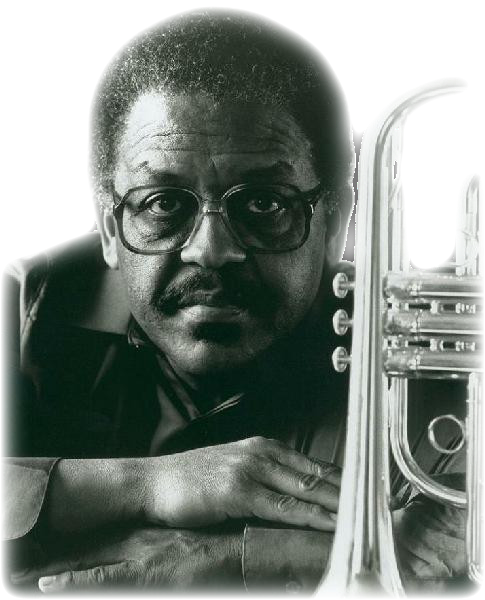
SV: Aside from Bird and Fats Navarro, you’ve also described hearing Dexter Gordon as a teenager and being knocked out of your socks. What qualities from those players still show up in your sound today, and which ones have you consciously moved away from?
BB: I don’t think I consciously moved away from any of them so much as I expanded past them — though maybe that’s the same thing. I loved Fats Navarro’s trumpet playing. I loved Miles Davis, and Dizzy too. It’d be hard for me to say which of the three I loved most, but I probably copied the most from whichever one was easiest to reach. Dizzy’s playing was a nightmare to try to transcribe. Miles was more direct — not as technically demanding as Dizzy — and I loved that vibrato-less sound.
I loved Roy Eldridge too, but I didn’t want his vibrato as part of what I was doing. It’s not that I disliked it — I just didn’t want it. Dizzy, Miles, Fats, they’d all moved away from that vibrato you hear in Roy’s playing, or in the trumpet sections of Duke’s band and Basie’s band. Beautiful, but the boppers were moving in a different direction, and their whole social posture was exciting to me too. I was at the age where I was looking for a Black role model — not consciously, but I was — and here was Dizzy in an Oxford shirt, paisley tie, striped suit, horn-rimmed glasses, dropping big words about mythology. You see what I mean?
SV: I do. What drew you to the cornet specifically, rather than the trumpet most of your peers played? What can you express on it that you couldn’t on trumpet?
BB: People have always made a bigger deal out of my playing cornet than I ever did. Same as they do with Don Cherry and the pocket trumpet — people invent stories. “He was wandering some part of town and saw an old pocket trumpet in a window.” Garbage. People love to make things up.
Here’s what actually happened. We had a little mom-and-pop store on one corner in East Dallas, and across from it was an Italian grocery, run by a family named Erso. On another corner was a Black-owned grocery, and on the fourth corner was our church, Greater Bethlehem Baptist. Next to each of these places was a shoe repair shop and a little dry cleaner. The man who ran the shoe shop, when he wasn’t fixing shoes, sat on his porch — it was almost like a Western town, with a long wooden sidewalk running past all the storefronts — playing an old beat-up cornet.
He wasn’t playing jazz. Just Tin Pan Alley tunes he liked — “Stardust,” Cole Porter songs. He had a lovely sound but never improvised. Whenever a customer came in he’d set the horn down and go fix their shoes.
One day I was watching him finger the horn, and I told him I could do that. He laughed and asked if I knew what it took. I said I could do it right then. He had a customer waiting, so he told me to hold on, and while he was gone I got my mouth in the right spot on my own — found the embouchure, figured out the fingering was just moving up from the open position through the first two buttons. When he came back I played something for him — messy, but he said, “Damn, boy, that’s pretty good.”
He let me keep fooling with it. A few days later — I had a job throwing papers for the Dallas Morning News, up at five in the morning — I’d saved enough to buy myself a Bulova watch on installment, two dollars down and a dollar a month. Those watches came with different colored crystals, orange, green, blue, real showy, and cost around eighteen dollars.
I went back to the shoe shop with my watch and asked if he’d trade me the cornet for it. He said go ask your father. I knew my father would say no, so I walked around the block instead, came back, and told the man my father said it was fine. I gave him the watch, he gave me the cornet in its beat-up case, and then I had to figure out how to explain the horn’s sudden appearance at home. I told my family the man had lent it to me to see if I could learn to play. That was the beginning of me being a pretty accomplished liar, and it never gave me much trouble.
School had already started the band-class semester, so I couldn’t enroll right away. The band teacher gave me a method book — something like the Goldman method, still used today — and I taught myself the fingering at home so I’d be ready to join band class in January. I made a lot of noise on that horn. My brother used to beg me to go play it outside, which I didn’t mind at all — I was in love with the thing. Up in the morning trying to play it, home from school trying to play it. My brother and I took turns working the family store, and I kept the horn under the counter so I could sneak in practice on my embouchure between customers.
I got into the training section of the high school band that January, and by the next semester I’d moved up to the full marching band. Some of the players a year ahead of me were remarkably gifted — David “Fathead” Newman was one of them.
SV: Amazing.
BB: He played xylophone in the band, and clarinet, though not particularly well — funny, considering what he became known for as a saxophonist and pianist. He had a metal C clarinet, and he was low on the totem pole among the clarinets, where some of the other players were killers. He wasn’t especially interested in that chair — on the marching field he’d rather have been playing clarinet than lugging the glockenspiel around.
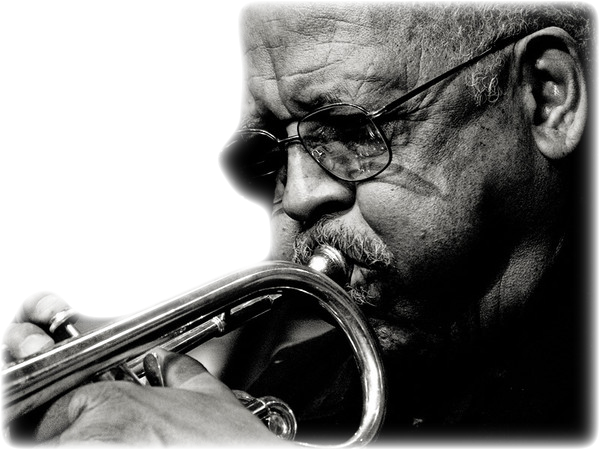
SV: Back then, jazz was fundamentally dance music, even when musicians were sneaking in complex bebop lines. How did playing for dancers shape your sense of time and audience engagement, before the listening-room era took over?
BB: As a player, you have to remember that everything in that era was governed by the length of a 78 — two and a half to three minutes. That was a form in itself. When composers of the day wrote a tune, they were thinking, “I’ve got to say what I need to say in three minutes.” Nothing developed slowly over time the way it might later.
And right after one song ended, people were standing on the floor waiting for the next one, so you had to open with something that caught their attention immediately — you couldn’t leave them standing there. It had to be rhythmic above all. Even a slow drag — the “belly rub” dance — had to carry that underlying triplet pulse. You could dance close and slow, but there was always that propulsion underneath. And it was a forbidden dance in some rooms — if you danced too close with someone’s girlfriend, her man might come out and hit you over the head for it. But no matter how slow the tempo got, it still had to carry that rhythmic drive.
SV: I want to talk more about self-taught Texas players — someone like Red Connor, who had enormous technique and sound without ever taking a lesson.What do you think made Texas such fertile ground for players like that, and why do you think so many of them never found national recognition?
BB: Part of it comes down to where Black communities concentrated after the Civil War — Texas, Louisiana, Mississippi, Alabama. As slaveholders in Georgia and the Carolinas saw the war turning against the South, many of them sold their land and moved to Texas, thinking slavery would survive there a few years longer and they could squeeze in a few more cotton harvests before it ended. That’s my explanation for the concentration of Black people in parts of Texas — and where you get that concentration, you keep more of the African tradition alive in the music than you would in areas with fewer Black residents.
That might explain why so many great players came out of Dallas, Fort Worth, Waco, Waxahachie — that stretch of Texas. Maybe it holds true for parts of Arkansas too, though the only major player I can think of from there off the top of my head is Teddy Edwards, and Pharoah Sanders. I only heard Red Connor play once, but it was enough.
All those tenor players from that part of Texas seemed to reach for the same kind of sound — big, with a wide vibrato. I’m thinking of players who never made a national name, like Joe Houston, a terrific tenor player I worked with in his R&B band. Or John Hardee — does that name ring a bell? And Buster Smith. All of them approached the horn the same way, I think because once you’re a young player and you hear the crowd respond to that sound, you chase it too. Illinois Jacquet was born in Louisiana but moved to Texas early, and you hear the same thing in his playing. Dewey Redman came along later, more of a modernist, but you can still hear the Texas in it.
Leo Wright, the alto player — and Louis Jordan, from Arkansas — Leo was actually my college roommate.
SV: That’s wild! You’ve talked about Louis Armstrong’s “mask” in front of white audiences, and the double consciousness required of Black artists of his generation. How has that awareness shaped choices you’ve made, musically and otherwise, as a bandleader and teacher? Can you speak on that?
BB: People resist the idea that Armstrong had to do that. I was talking a few years back with a woman here at UCLA who told me she’d never seen anything like it in his behavior. I said, “Ma’am, Louis Armstrong was dead before you were born — you don’t understand what it meant to be born in New Orleans in 1901 and make your way through the world as a Black man, whether you were a musician or not.” There was a certain behavior you had to display for white people just so you could keep doing what you were doing, because at any moment they could shut it down. And you knew that. All it took was one person saying, “I don’t want that Louis Armstrong coming around here anymore,” and someone else saying, “Yes sir, boss, I won’t book him again.” That’s a crude example, but it’s realistic.
Think about someone with Armstrong’s talent — white people didn’t want to engage with a twelve-year-old who had that kind of mind. Any time he said or played anything unusual, people would wonder where he’d gotten it from. I’ve known countless musicians from the South who did extraordinary things and had to hide how extraordinary they were.
I think of my children’s grandfather, a singer who came to New York with a band out of Oklahoma. He had a wonderful natural voice, and when he sang for white audiences as a boy, they’d ask him, amazed, how a kid like him knew all those songs. And the safe answer — the answer that let him survive — was to stay humble: “I just listen to the radio, I go to the picture show.” Never let it seem like you were too smart. You look at a kid with a gift like that, straight from heaven, and you understand what it is, but you can’t let it show that you understand.
Growing up, it was clear to me that Black performers had to do this. I can’t say I was ever in the room with Armstrong, but even with Duke Ellington — I never personally saw him do anything like that, but I’m sure on some level he had to as well, to get what he wanted done. Going all the way back, the Black man had to figure out how to stay at peace with the slave master, which meant being deceitful on many levels, just to keep him smiling. There’s a line in Show Boat about not wanting to make the big boss frown — you do whatever it takes.
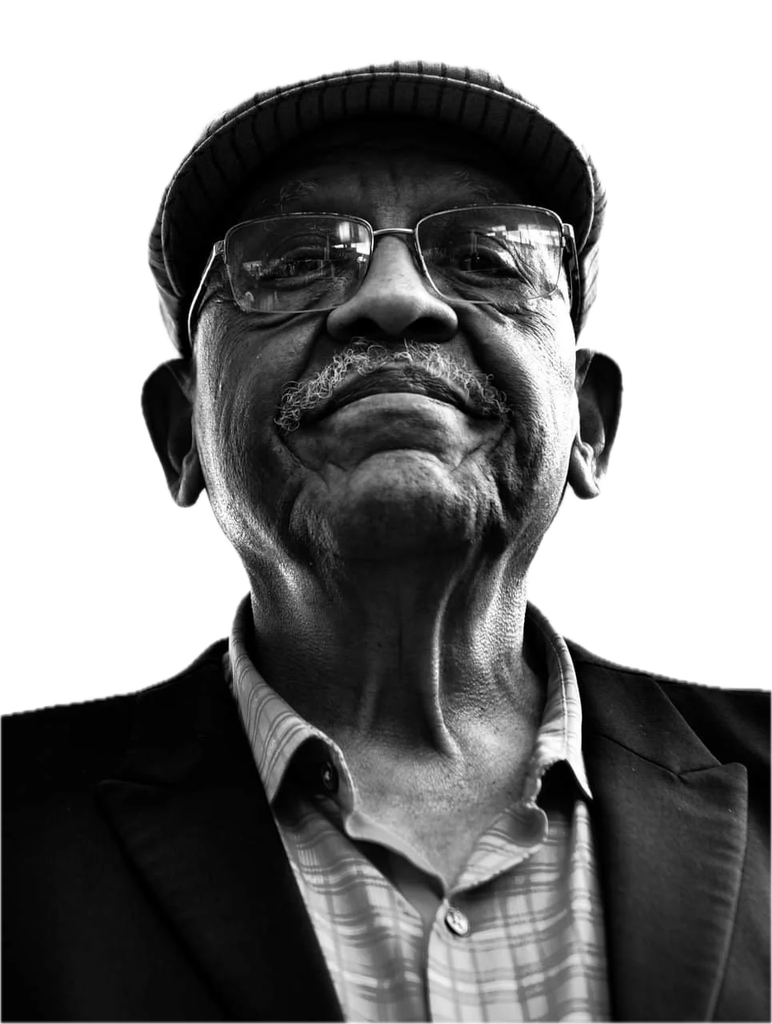
SV: Let’s move into Los Angeles, starting around 1953. Long before instructional books existed, you and musicians like Eric Dolphy and Ornette Coleman learned largely by tracking down records and transcribing them by ear. I also read that your father once challenged you to transpose difficult material into keys like A-flat.
BB: That’s true. Here I am in Dallas in 1949, already playing cornet, listening to whatever music I could find, but you weren’t going to hear the boppers live in Dallas in 1949 — they didn’t come through Texas. What you had were the Black newspapers, the Chicago Defender and the Pittsburgh Courier, which went back to Reconstruction. They came out weekly, and we’d go straight to the entertainment section — pictures of Dizzy in his horn-rims, Charlie Parker, Cab Calloway, Duke Ellington, notes on what they were doing in New York.
But to actually hear the music, you went to the record store, where they had little booths you could stand in and listen before buying. A 78 ran maybe eighty-eight cents or a dollar. If the clerk wasn’t busy he’d let you listen even if you didn’t buy. Somehow we scraped together the money and played those records over and over, trying to capture what these guys were doing. Some of it was accessible. A lot of what Charlie Parker played was brutally hard to work out, so we’d put something heavy on the turntable to slow the 78 down enough to catch all those sixteenth notes. You could get every note that way — but it would come out in some impossible key.
My father played clarinet, not particularly well, but he had a good ear and sang in the church choir. When he’d hear me practicing some bebop lick, he’d say, “Now let me hear you play that a half-step up.” I’d usually put him off — “not right now” — but he made it clear that if I was serious about this, I couldn’t just keep playing my favorite little clichés forever. I had to break out of my comfort zone.
SV: How did learning that way — no formal notation, no pedagogy, just transcribing by ear — shape your understanding of melody and harmony compared to how students learn today?
BB: The best way to learn music is to hear it and access it that way. There’s nothing wrong with notation, but you don’t want to lean too heavily on it — you want to actively sense the music. One of the pieces that scared everyone was Charlie Parker’s “Donna Lee.” A lot of people know it, but only intellectually — they learned it out of the Real Book, they see the changes on the page, and their fingers hit the right buttons, but they don’t actually hear what they’re playing. If you ask someone like that to sing it back, they can’t.
Walter Benton, Fathead, all of us used to talk about that — can you actually sing the right notes? Because that means you truly hear it. A lot of people can read something off a page and have it come out of the horn without ever really hearing it internally. You want a mix of both. You can absorb a much wider range of repertoire now with all the recordings and textbooks available — you can play Charlie Parker in the morning and Herbie Hancock in the afternoon — but if you only ever learned things off recordings the old way, that would slow you down considerably. Still, you can’t dismiss the fact that this music is, at its root, an oral tradition.
SV: Let me ask you this–you once said that West Coast “cool jazz” — Chet Baker, Gerry Mulligan — was really just a softer, more restrained dialect of bebop rather than a separate movement. Do you think jazz history wrongly split those scenes apart?
BB: That’s been a subject of controversy going back a long way, and part of it is people playing the race card — white boys play like this, Black boys play like that. That’s not the real issue, even though when people say “West Coast” they’re usually picturing white players. There were plenty of Black players in Los Angeles who liked what Chet Baker was doing, which to my mind was really a splinter of Miles Davis — that vibrato-less, warm tone. Miles was the first to approach the horn that way, and a lot of people, Black and white, loved it. Somehow when Gerry Mulligan and those guys did it in New York it didn’t quite take, but when Mulligan came out to Los Angeles, that sound found a home. Mulligan wasn’t inspired by LA — he was already playing that way, as part of the broader modern-jazz movement, before he arrived.
Then you had guys on the coast who were straight boppers. Art Pepper could stand on a bandstand with Sonny Stitt and hold his own — you couldn’t call him a cool-jazz player. Paul Desmond is a different case. But there wouldn’t have been a West Coast movement at all without bebop, just as there wouldn’t have been a cool-jazz movement without Miles and Gil Evans. It sprang directly out of bebop.
Think about tenor players like Richie Kamuca, or an alto player like Herb Geller — you’d call them West Coast players. At the same time you had Joe Maini in LA. And there was a Black tenor player — one of the first Black musicians to break into the studios, he played on the Groucho Marx television band —
SV: Buddy Collette.
BB: That’s him. He’s a good example — a Black player who knew the blues deeply, but when he played tenor you could call him a West Coast player too.
Ornette had a great line about Mulligan once. Someone asked him about Mulligan’s playing, and he said, “I love Gerry Mulligan, wonderful musician — but he’s basically a two-beat player.” That’s a perfect description. It doesn’t mean he couldn’t stand up and play with the boppers, but the body of his original music still carries that two-beat feel underneath, even when it moves into four.
A lot of people, instead of engaging with the music, wanted to make it about white versus Black, and they’ve never stopped doing that. Part of it was people being unable to reckon with a Black man like Charlie Parker, from Kansas City, arriving at that level of musicianship without formal training — just pure gift. That terrified people. You’d hear him play and think, my God.
SV: You and Ornette both worked at Bullock’s department store. What was it like, moving between selling–
BB: We weren’t salesmen — the salespeople were all white. We were stock boys. We wore little aprons, like machinists. If Mr. Higginbotham liked a lamp on the furniture floor, he’d say, “Bradford, go down to the basement, bring one up, and put it in the customer’s car.” That was the job.
While we both worked there I got drafted into the military, and Ornette got promoted to run the elevator after I left.
SV: Got it. My question was going to be: what was it like, moving between that daytime work and pioneering avant-garde music in clubs at night?
BB: I never had a problem with it, because both of us grew up in environments where work was simply expected. We had a mom-and-pop store, and I worked in it two or three hours a day — that wasn’t a joke. Ornette was married with a family; I wasn’t, but I still had to work. Getting together to practice and play this new music was, like anything else worth doing, a serious passion. There’s no question he was a genius — no formal training, entirely self-taught, but unmistakably a musical genius.
SV: When you went into the military, did Don Cherry take your chair?
BB: It wasn’t that structured — Ornette didn’t have a steady working band around town. He’d call me when he had a gig that paid enough to justify a trumpet player, maybe eight dollars, which was fine by me. But he was getting a lot of resistance to what he was doing wherever we played.
Ornette could play conventional jazz — he knew the Charlie Parker repertoire, the bebop vocabulary — but before he ever left Texas he was already working toward the thing he really wanted to do. The first time I heard him, I knew he had something, even if I couldn’t say what.
You may have heard this story: Ornette came to Austin to be best man at Charles Moffett’s wedding — they were childhood friends, and Moffett was a senior at the college where Leo Wright was my roommate; I was a freshman. After the wedding there was a small reception at what’s now the Victory Grill — still standing on East 11th Street, actually a historic landmark now, with a bronze plaque out front. Moffett played drums, there was a bass player from the school jazz band, Leo Wright got up, along with a tenor player from San Antonio, a really precocious kid. Ornette got up and started off playing Charlie Parker and Dizzy Gillespie tunes like everyone else, but then he moved into his own material. It was abrasive — it stopped following the chord changes the way you’d expect.
That night back in the dorm, Leo asked me what I thought. He said he didn’t think Ornette knew the changes — that he’d been playing strange stuff. I said it seemed like he started inside the harmony and then moved out of it. What I remember verbatim — Leo said, “I refuse to believe that motherfucker out-blew me.” He didn’t mean it as an insult; that’s just how we talked.
I told him I didn’t know exactly what Ornette was doing, but I liked it — he’d reached a point of pure improvisation, developing an idea and taking it apart and reshaping it in ways I couldn’t follow, and I thought, this is insane, and also: this is what jazz is supposed to be about.
SV: That’s the very definition, really.
BB: In my mind, jazz at its purest was those early New Orleans street bands, guys who barely knew their instruments, just beating their way through a forest of impulse. As musicians learned more, they lost some of that pure, spontaneous response. So what you’re always trying to do is learn all the vocabulary — chords, scale patterns, structure — without ever sounding like you’re playing something you rehearsed the night before.
We played a gig Saturday night here in Pasadena, at a place called the Healing Force of the Universe, named after one of Albert Ayler’s records — it’s closing in November. Just four of us: me, Vinny Golia on woodwinds, William Roper on tuba, and a young bass player, David Tranquada. I told them beforehand, “I’ll meet you at the end. I want to push us somewhere we didn’t go in rehearsal. I’m going to throw you curveballs all night — throw them back at me.” Some nights work better than others, but the idea is always that after you play the written theme, you use it as fuel to launch into open space.
SV: Right. That’s one of the things I love about jazz–the fact that it’s a conversation between those musicians on stage, or in the studio.
BB: Exactly. What Ornette was doing– I loved it, whatever it was. I didn’t see him again for about a year, until we ran into each other on a streetcar — he’d come to Los Angeles to marry Jayne Cortez, and I’d come out to join my mother and stepfather after dropping out of college. We reconnected, and he invited me over to practice — he was writing new material, trying to land a record deal.
He’d hire me sometimes, and he’d hire Don Cherry sometimes, whoever he needed when he didn’t have a full band. People have romanticized it as though it were a steady working band with a clean handoff from me to Don, but it wasn’t quite like that — I actually played with him more often than Don did in that stretch, because Don was still in high school.
SV: Right, that’s remarkable.
BB: Don gravitated to what Ornette was doing right away, but like me, he came up as a hardcore bopper first.
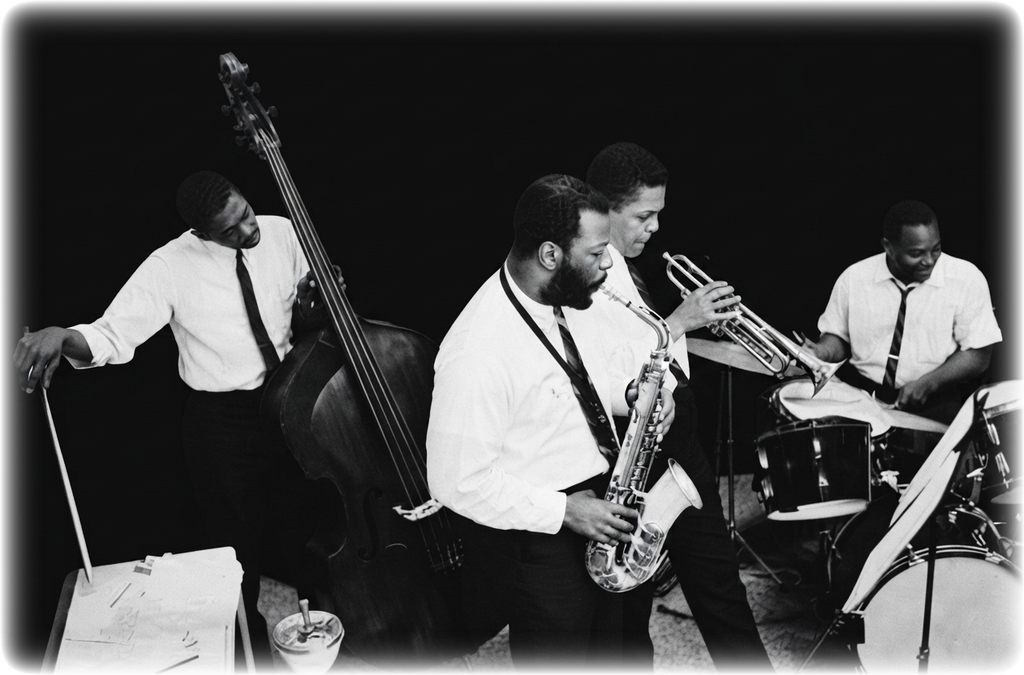
Above: Ornette Coleman rehearsing with Bobby Bradford, Jimmy Garrison, and Charles Moffett, Atlantic Studios, 1962.
SV: When you were playing music untethered from chord changes for the first time, did it feel like chaos, or could you hear a structural logic underneath that others were missing?
BB: I never experienced it as chaos. What I came to understand was that Ornette’s guiding principle was the thematic material itself. He’d say, all I have to give you is this song — you have to embrace it, digest it, know it as well as you know your own name. Then when you solo, instead of chords, you carry that piece with you and find every way to twist and tweak it.
What I learned from him came from listening to how he improvised over his own tunes. He told me the reason he liked playing with me was what I did with his material — he said it never occurred to him where I’d take a piece, but he loved it, and he never wanted me trying to play like him.
His pieces are unbelievably rhythmic, even the ballads, and full of these wonderful intervallic relationships that go beyond anything the boppers were doing. He had his own private language — he’d talk about the major third and the minor third as if they were characters in a play. He’d say, “I like the sound of a minor ninth, and I use it where it says what I want to say — those are my tools.” If you’re thinking in terms of chords, the first thing in your head when you see a C-minor-seventh is the note C. Ornette didn’t think that way — every interval was a character to him, and he used them like a playwright uses people.
We never had theoretical conversations about it — he never said, “I never follow a major seventh with anything but an augmented fourth.” But I practiced his tunes until I had them memorized, because we didn’t play with music stands then — that came much later. And he was always writing new material; he rarely played the old pieces unless someone specifically requested “Lonely Woman” or another favorite.
We’d spend all day together in New York working through his tunes, then go play a piece that night that he’d written that same afternoon.
SV: That’s amazing!
BB: We were young. I’m ninety-two now, and not long ago I watched my son from my first marriage doing yard work in a hundred-degree heat, full of energy, and I thought, I can barely remember what it felt like to be in that kind of physical condition. We used to start practicing at eleven or noon and go until three or four in the afternoon, taking breaks, but all day, every day.
SV: I want to ask about the sessions that became Science Fiction — any memories from that date, or how Ornette’s writing had changed by then? And was there was a moment in rehearsal where the “feeling over theory” approach revealed something unexpected about the group?
BB: Ornette booked us into Slugs’ for three or four nights before the recording date, just to get the material under our fingers in front of a live audience. By the time we walked into the studio we weren’t reading off music stands — we had the tunes down. But Ornette knew we’d go places in the studio we hadn’t gone at Slugs’ or in rehearsal.
Above: A high-energy Coleman piece featuring Bradford alongside Dewey Redman, Charlie Haden, and Ed Blackwell.
Often a new tune would emerge in rehearsal itself — he’d have the melody written but hadn’t decided how he wanted the rhythm section to sit underneath it. There are very few Ornette recordings where Charlie Haden isn’t keeping some form of time, unlike some of the drummers who came later and never kept time at all. Ornette generally had some idea of how he wanted a tune approached, but sometimes it changed on the spot — he’d hear it and say a tempo was wrong, that it needed to move slower or faster, because at double time it might not work. He made those calls in rehearsal.
Above: Bradford’s trumpet on this classic Coleman track is often singled out for its strong, melodic soloing within the free ensemble.
SV: To me there’s a real distinction between Ornette’s music and Coltrane’s late period — Coltrane’s drummers eventually abandoned time altogether, while Ornette always insisted on a steady pulse underneath. Did playing free over a steady pulse change the psychological demands on you as a horn player, compared to playing free with no pulse at all?
BB: I remember teaching a jazz history class once, playing something from Coltrane’s Interstellar Space, and a student challenged me — “You said this music swings. That doesn’t swing.” I told him it does swing, except Coltrane redefined swing into these little cells — each phrase self-contained, and each cell swings on its own, then he strings them together, like train cars, into one larger swing, rather than a straight one-two-three-four. Trane always swung — he just wasn’t running it in a conventional meter.
I’m sure he never told Rashied Ali exactly what to play. He just played what he played, and Rashied heard it and responded — the same way, once the drummers around Charlie Parker heard what he was playing in New York, they understood, without him ever explaining it, what wasn’t going to work anymore, and adjusted. Guys like Kenny Clarke could hear immediately what playing with Parker was going to require.
It’s the same with Ornette — he opened that door too. I can’t think of anything we ever played with Billy Higgins or Ed Blackwell where they played the way Rashied Ali did — not because they couldn’t. I did play some things with Billy, later in his career, that were completely out of time. But those two, Blackwell and Higgins, were so talented they could step onto a bandstand with Muddy Waters and adapt instantly. You could just say, “Here’s what I’m playing — join me,” and that was enough. You could watch them, or you could join them. Either way was a pleasure.
SV: I want to ask about Ornette later developing “harmolodics” as a formal theory to explain what had originally been pure intuition. Do you think putting language to it helped or hindered how younger musicians approached his music? And where do you personally draw the line between continuity with the jazz tradition and genuine rupture from it?
BB: I think harmolodics, with all due respect to Ornette, came about because critics and other musicians pressured him for an explanation. At first, a lot of people in New York were trying to dismiss his music entirely — if you could write it off, you didn’t have to reckon with it, didn’t have to learn it. Most of the jazz establishment was looking for a way to call him a fake and hope he’d go away. He didn’t go away.
But critics kept asking him, what’s the theory behind what you’re doing? And honestly, I don’t think he had a verbal answer for it. It came out of him as a gift — you could ask him to explain a passage and he simply couldn’t give you words for it. Eventually, because people wanted something, he coined the term “harmolodic.” I never got a real explanation out of Dewey Redman, Don Cherry, Billy Higgins, or Blackwell either — none of us could tell you exactly what he meant by it. He clearly had a philosophy, but he couldn’t articulate it the way, say, twelve-tone composers can explain their systems. Having that kind of explanation doesn’t necessarily improve the music, but it gives an outsider some access to the thought process. Ornette couldn’t offer that, even though the thinking was clearly there.
As a composer, the man was frightening. People used to tell me, if you play his music and still don’t get it, that’s your problem. I never had any trouble with it — he’d hand me the trumpet part and say, “Play it, man.” That’s all I needed.
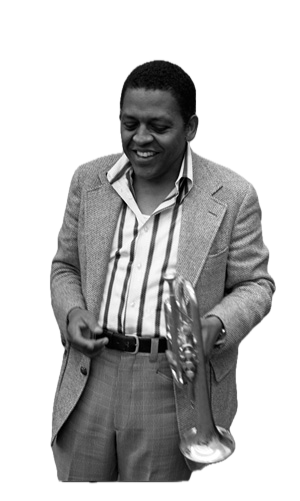
SV: You’ve also made the case that free jazz couldn’t have succeeded ten years earlier — that American society and the racial dynamics of the 1950s had to shift first. Do you see free jazz as an inevitable musical evolution, or something that depended entirely on the social upheaval of the 1960s?
BB: I think it was inevitable, because jazz moves forward no matter what — whatever Black people are experiencing socially comes out in the music, whether anyone controls it or not. Every major forward step in jazz originated in the Black community and then moved outward. The field songs came directly out of the experience of working ten hours a day in the cotton fields under the sun — the music helped a man sustain the physical endurance the work demanded, and it gave him some emotional release.
Jazz moved as the Black man’s experience in America changed — from Reconstruction forward, the music reflected whatever he was living through. By the time Charlie Parker arrived, that experience included things like Kansas City’s twenty-four-hour clubs, far more interaction with white audiences who either loved or hated what they heard. Whatever the Black man was living, accepted or not, it surfaced in the music — the same way the shift from Negro spiritual to gospel reflected a shift from sorrow toward rejoicing, even as both remained rooted in the same experience.
As LeRoi Jones put it, the Black man’s movement — slow as some might argue it was — toward seeing daylight in white America. Ornette Coleman emerging out of what he’d heard in bebop was, to my mind, no bigger a leap than Charlie Parker emerging out of the swing era. It wasn’t only a musical statement, it was a social one — the way Black writers were making bold statements in the late fifties and early sixties was part of that same current.
Some people hear Ornette’s music and think it’s just chaos. It isn’t. At its very best it’s doing exactly what jazz has always tried to do — get up there and respond honestly to the world you’re living in at that moment: what you’re feeling, what you’re anticipating, what you’re looking back on. That’s frightening, on some level, even to attempt.
SV: I want to move to your partnership with John Carter. Ornette is the one who suggested you two get together. Beyond your shared Texas roots, what made that partnership last nearly twenty-five years and produce such a distinct musical language?
BB: John and I didn’t actually know each other back in Texas — I knew of him. He was remarkably precocious; he finished high school credits by sixteen and went straight to college. By around twenty he was already teaching music in the Texas public schools before he moved to California. He was extremely well trained — a master’s degree from the University of Colorado at Boulder — and, I can say now, a monster clarinet player. Not one of these saxophonists who casually doubles on clarinet — he’d been playing clarinet since the fourth grade. It was his primary instrument; the saxophone came later.
He called me once when I was living in Pomona. He said Ornette had given him my number, mentioned that I’d played with him, and that John was writing new material in that same territory but had no one to play it with. We spent an afternoon at my place — his wife and kids came along, the kids played in the backyard, our wives talked in the house, and John and I sat and talked through the possibilities. It was clear right away we could do something together.
Above: Bradford’s own composition and one of his signature ballads. A poignant, lyrical showcase that became a recurring staple in his repertoire (later versions appear on Love’s Dream and elsewhere).
At first it was just the two of us, playing some of his material and some of mine. I could hear a real difference between his approach and mine, but I liked what he was doing. Eventually we went looking for a bass player and drummer — John had tried before and struggled to find musicians willing to commit to what he was doing; a lot of players dismissed it as classical music dressed up with a little jazz seasoning, which offended him. But I heard exactly what he was reaching for, and I liked it.
We auditioned several players before settling on Bruz Freeman and Tom Williamson, and started rehearsing as a quartet. Everyone loved what we were building. We played mostly John’s material, which never bothered me — I told him, let’s do whatever keeps this band together. On our earliest recording, about eighty percent of the material was his. He worried that bothered me, but I told him, we’re married now — nobody else in this town wants to do what we’re doing, and if we don’t have each other, we don’t have anything. Bruz and Tom weren’t interested in writing themselves, but they loved playing the music, and we simply stuck together.
Above: Bradford composition from their early quartet classic; strong, personal statement in the free-bop vein.
SV: Looking back at records like Flight for Four, Self Determination Music, or Secrets — is there a period of the partnership, or a specific risk you took together, that you’re proudest of, or that you feel is underappreciated?
BB: The very first record, Seeking — that was on Revelation Records — I was so happy we made that. Nobody else in LA was doing anything quite like it. It was a big step for both of us. People kept comparing it to Ornette, which bothered John a great deal. Philosophically, sure, I can see the comparison, but in the nuts and bolts of what we were actually doing — a lot of it was completely time-free — we’d moved beyond even what the quartet with Ornette had been doing. That was a real step forward.
Our next record for that label was Secrets, though that was interrupted by the two records we made with Bob Thiele.
SV: I was going to ask about that…
BB: Flight for Four was a real breakthrough for all of us — even the European response to it was strong. But John and I were both still working full-time as teachers, five days a week, and neither of us was willing to just pack up for New York without a safety net. I had three kids, he had three kids.
Above: Opening track from their debut; open, painterly free-bop with excellent collective interplay and Bradford’s clear, melodic lines.
SV: Do you think staying out of New York protected the distinct identity of your music, in hindsight?
BB: No — if we’d gone to New York and found a way to make it work, I think we’d have been far more productive with recordings and opportunities. But neither of us was willing to take that risk with our families. John talked seriously about it once, and I told him, I’ve already been to New York with Ornette, and the economic reality of it was rough — that’s part of what sent me back to Texas at one point to finish a degree and teach in the vocal schools there in 1963 and ’64, before I came back to LA.
Packing up a wife and three kids to move to New York on a maybe was a much bigger risk than John was willing to take too. Had we managed to establish ourselves there, we’d probably have toured Europe more — that’s where the festival bookers and the record companies were. We’d almost certainly have produced more work.
SV: What do you think John understood about your playing that maybe other people didn’t?
BB: In the same way Ornette did — he told me he liked what I played after we finished the head of a tune, that it was always a surprise. He said I had enough command of the horn to handle what he was writing, because other trumpet players he’d approached had dismissed his music outright, calling it classical music with a couple of blue notes thrown in. He couldn’t find anyone else who loved his music enough to actually put in the work with him, the way I did. You could always hear the academic rigor in his writing, but he never lost track of what he loved doing — he had his own clear vision for what he wanted. Like Sun Ra, in a way.
SV: [laughs] That’s a fair comparison. After Carter passed, you formed the Mo’tet. How did leading that group change the way you approached composition and group interplay, compared to the more dialogic relationship you had with John?
BB: Actually, John was still alive when I started the Motet. If you listen to that music, there’s a clear mix — some of it traditional, some of it entirely free, some starting free and resolving into something more conventional. John used to say he never wanted to play anything conventional, never wanted to play changes. I told him, that’s fine, man. When I made the record Lost in L.A., I invited him to be part of it, and he said he wasn’t interested — no problem. All original material, though some of it is pretty stretched — basically an extension of bebop, or hard bop, whatever you want to call it.
I never wanted to reach a point where I only played one way. I told the guys in the band, some nights I want to play a straight-ahead swing tune around midnight, and I want to be among people who know the tune. I loved that too much to give it up, and I never felt I owed anyone an explanation for it.
SV: Between Pasadena City College and Pomona College, across these decades, what’s changed most for you about teaching jazz history and performance?
BB: The main difference was the student population. Pasadena City College had open enrollment — no entry requirements — while Pomona was highly selective, mostly middle- and upper-middle-class students with strong test scores and a lot of reading behind them. That shaped how I could teach.
At Pasadena, the course was African American music broadly, and jazz was only one part of it, so I had to spend real time on the Negro spiritual, the field hollers, the roots of gospel. At Pomona, I gave that history a much quicker overview and went straight into New Orleans jazz — I could go much deeper into the jazz material itself, and ask more of the students, partly because they came in with stronger reading skills. At Pasadena I had students entering at an eighth-grade reading level — no disrespect intended, just the reality — so I couldn’t always go as deep into something like an analysis of Thelonious Monk’s writing as I could at Pomona.
SV: You once said, “I can’t teach you how to play the blues, but I can teach you the form.” When a student finally moves past the mechanics into the feeling — the connection to the church — how do you recognize that shift happening?
BB: I try to help students understand that the blues developed slowly before it settled into a form. Something like “St. Louis Blues” is already a fairly sophisticated evolution of what people were doing fifty years earlier — it’s got ragtime running through it, and it’s standardized: twelve bars, the change on bar five, the one-four-five chord pattern.
But in the earliest material that preceded that structure, a man in the field might repeat a line as long as he wanted. “Oh Lord, I wish the sun would go down” — repeated, stretched out, however long the feeling demanded. That’s the germ of the blues. The next day he might sing it differently — “Thank you Lord, it’s not so hot” — improvising in the moment.
Eventually you reach the point where audiences expect that twelve-bar form. It limits the music in one sense, but it also makes it more accessible — people get used to that three-line verse, the first line repeated, then the resolution, that one-four-five pattern. But then you have someone like Bukka White — whose songs often aren’t twelve bars at all. Wonderfully percussive, full of the tonal qualities of the blues, but not locked into that repeating structure. [There might be a song] where he drifts into five and then back into four, following the feeling rather than counting bars.
He’s just responding to how he feels in the moment. Everything that belongs in the blues is present in what he’s doing, he’s just not counting bars while he does it. That’s the artist. Once musicians became entertainers making a living, the music became more of a craft made for sale — there’s good in that and there’s a cost to it too. When you’re cutting a record, you have to plan ahead, because you’ve only got two and a half minutes to say what you need to say.
What I want students to see is that the feeling comes from lived experience — sweating through cotton-field work, and singing to make that tedious labor bearable. We used to joke about it. I actually had a job as a water boy in the cotton fields as a kid, carrying a bucket and dipper up and down the rows so the workers could drink — everyone shared the same dipper, dipped and shaken out, which in hindsight is ridiculous, but that was the job. You’d hear someone a hundred yards off, singing out for the water boy — not calling flatly, but singing it, because the man was exhausted and the song carried what plain speech couldn’t.
There’s a Lead Belly song that captures this — “Me and my wife can pick a bale of cotton, me and my wife can pick a bale a day.” I heard that as a kid and didn’t understand it until much later. Overseers would sometimes offer extra pay — an extra side of bacon — to whichever couple could pick the most cotton in a day, pitting families against each other, and Lead Belly’s song responds to exactly that history, then slides into “Jump down, turn around” almost as a game song. The whole story of that labor is inside the song, and it gradually evolved into the twelve-bar blues, and eventually into something like W.C. Handy’s “St. Louis Blues” — except Handy was a city man who never worked a cotton field. He heard someone singing that way, recognized the structure, and shaped it into something the blues business could sell. You can hear the ragtime in that early recording — it’s a long way from the cotton field, but it’s still twelve bars. It’s the city version, made saleable.
Above: One of Bradford’s signature free-bop themes — energetic, swinging, and a real showcase for his cornet alongside Carter’s clarinet.
SV: What’s the difference, in your mind, between teaching someone to play jazz and teaching someone to think musically?
BB: I don’t really approach it as “teaching someone to play jazz.” I can teach you the nuts and bolts, but I can’t teach you to think sequentially, to think musically, the way you’d need to. It’s like riding a bicycle — I can’t teach you how to find your balance. I can pick you up when you fall and push you again, and again, until one day you find it yourself. Nobody can hand you that balance; it has to become a neuromuscular reality in your own body. So if someone asks, can you teach me to play jazz, my honest answer is: I can tell you what the tools are, but I can’t teach you to think that way. That part, you have to do yourself.
SV: I want to ask about Stealing Home — you focused on specific moments in Jackie Robinson’s life: his military service, his debut, the sacrifice bunt. What parallel do you see between Robinson’s quiet, strategic intelligence on the field and the choices a free improviser makes in real time?
BB: That’s a tough one. On the field, when the base coach gives you the green light to steal, you still have to make the actual decision the moment you take that first step — reading the distance, the ball, your own speed. The coach can’t make that call for you; he can only say, that’s yours if you want it. It’s your decision how far to lead off first, how much risk you’re willing to take before the pitcher can turn and pick you off. Nobody else can make that call.
I don’t know whether that celebrated bunt in his first game was entirely his own decision or something the coach signaled, but Robinson had the ability to lay down a perfectly placed bunt down the first-base line — and the beauty of it was that the ball that got him out actually hit his shoulder as he ran.
He had every physical skill he needed out there, but what amazed me beyond that was what he endured — players throwing dead cats onto the field, threatening to kill his wife, and after his baby was born, threatening the baby too. Local police weren’t going to do anything about any of it. It’s hard enough to play baseball at that level without carrying that weight. And he wasn’t even necessarily the best baseball player in the league — there were better hitters, better fielders. What set him apart was what it took to endure everything else and still perform.
SV: What’s the single most important thing you hope former students still carry with them? And when you hear a former student’s voice develop into something completely different from your own, what makes you proud of that?
BB: I’ll answer that against the example of David Murray, who’s actually who I was thinking of from PCC as well. The beauty of it is that people of his talent came to me knowing very little technically, but loving music enough to drop everything else for it. I recognized that in him right away.
David grew up in Oakland, no particular academic background — this was during a period when Pomona College was reaching out to inner-city kids, some of them performing well below their potential, not because they lacked ability but because nothing around them had developed it. That opened a whole world for him socially and musically. He found himself bouncing between studying with me and with Stanley Crouch, and by his second year he decided to go to New York.
I told him I wasn’t surprised — what he wanted right now, he wasn’t going to get from any one college. If he’d stayed the course he’d have picked up a lot of tools to help him develop what he wanted, but he wanted to jump straight into the furnace, and I told him, God bless you. I knew he’d survive, because he had the talent, the love, and the courage — and he had courage, real courage. Whatever people think of his career, the man had nerve.
Above: From the album of Bradford compositions dedicated to John Carter; one of Bradford’s greatest recorded moments as both composer and player.
Others like him — James Newton, a tenor player at Pomona named Tim Marcus, an alto player named Chris Fagan — never got the national recognition David did, but they’re still active players, still supporting families. David himself had a family — several, actually — but in spite of all that he had something to say, he wanted to break the rules, and he knew exactly what he wanted to do. He didn’t go to New York to get rich or famous. He went for love.
SV: When you improvise, Bobby, what are you actually listening for that an audience might not hear?
BB: Honestly, in that moment I’m not thinking about the audience at all. I’m thinking about the act itself — I’m not looking around gauging their reaction. I’m completely oblivious to them in that sense. I hope, of course, that they get it and love it, but regardless, I’m going to do what I’m going to do.
SV: Do you think of improvisation as making decisions, discovering things, or remembering things?
BB: All three. Once you start moving, if you’re playing with a really good rhythm section, they might take a left turn just when you expected a right. It depends on what they’re doing underneath you. Ideally you’re always peripherally listening to the bass, the drums, maybe another horn supporting you. Sometimes you deliberately ignore all of that and treat it as a kind of cross-current to what you’re doing, and just push forward anyway. But sometimes it’s a wonderful intrusion, and you weave it into what you’re playing.
That matters even more if you’re working five nights a week, three sets a night — you can’t survive on some private internal world alone; you need that kind of support, which is why you choose the musicians you choose. Sometimes there are personality clashes, but you try to keep that out of the performance.
SV: What do you think a musician learns from silence that they can’t learn from playing?
BB: When you say silence, do you mean literally on the bandstand, or in a daily contemplative sense?
SV: Either — I think it could apply both ways.
BB: I wouldn’t frame it as silence so much as space. That’s part of the organic rhythmic structure — silence interrupted by space, or space interrupted by sound. It’s really the same idea from two directions.
SV: When you hear a younger improviser take a risk in performance, are you able to tell whether it’s coming from genuine curiosity or just a desire to sound different?
BB: I think I can usually tell. It’s like watching someone at the end of a diving board, trying to decide whether to jump. And right away you can tell — this kid has real promise, he’s not afraid to be out on the edge. He’s cautious, but he’s not afraid of it.
SV: How have you protected your own musical voice while staying open to other people’s ideas? And at what point did you stop worrying about sounding like your influences and start worrying about sounding like yourself?
BB: “Worry” probably isn’t quite the right word, but I understand what you’re asking. I think of something Ornette used to tell me — I may have mentioned this before — he’d say, “I hired you because I like what you do. I hope you’re not trying to do what I do. I can’t wait to hear what you play after the thematic section, and I don’t want you imitating what you hear me doing.” Beyond the philosophical level — developing your ideas out of the thematic material rather than a chord progression, or some invented scale system — he wanted my own response.
So even as a young bopper, trying to absorb my heroes musically, socially, in every way — trying to learn their language off 78 recordings…I never worried that I wouldn’t find my own voice, because I found it very early, at least in terms of my sound. What I was struggling with was the harmonic vocabulary — what the boppers were doing, Thelonious Monk’s chord sequences — because there were no fake books, nobody to teach you that. When name players came through town, sometimes you’d meet them at the hotel and run errands for them. I remember taking dirty laundry for players like Sonny Stitt and Gene Ammons.
When those guys came through, we’d hang around the hotel waiting to be useful — go get some soul food, take this shirt to the cleaners, be back in two hours — and every chance you got you’d ask a question. What are the changes on the bridge of this tune? That kind of information wasn’t easily accessible. But my sound, I already had a sense of what I wanted — I loved Dizzy, Miles, Fats Navarro, but I could hear something distinct that I wanted coming out of my own horn.
So “worry” isn’t quite right — the sound itself came from sitting with the horn, working the embouchure and the airstream over and over until I found what I wanted. But learning all those altered chords without any literature to guide you — that was hard work. You had to dig it all out yourself, by the seat of your pants.
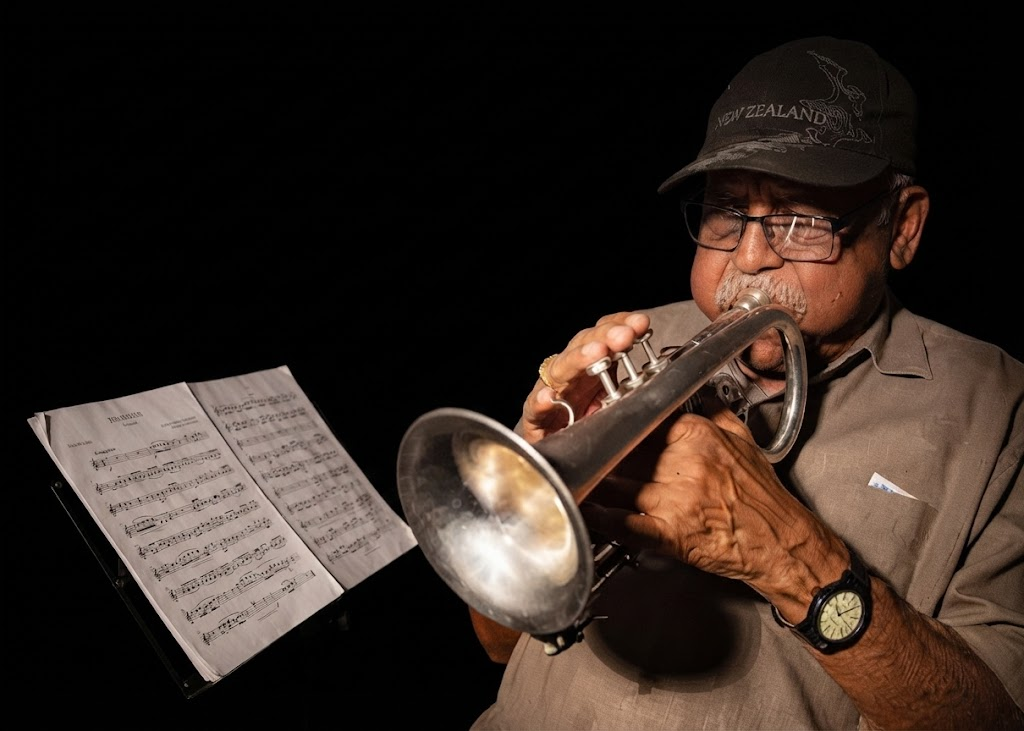
SV: Do you think people who know jazz history mainly through New York get the wrong idea about what was actually happening in Los Angeles?
BB: Definitely. That goes back to people badmouthing Chet Baker and Gerry Mulligan, calling it “cool jazz” like it meant soft and fluffy — which wasn’t accurate. But I don’t think they understood the connection to bebop at all. Harmonically, the so-called West Coast style was every bit as complex as bebop, because it grew directly out of bebop — it just wasn’t as abrasive, not as emotionally intense in performance. That’s not a flaw. Mulligan and Baker were playing their own honest reaction to that language, and they couldn’t bring into their music anything they hadn’t personally lived.
Whatever you grew up listening to becomes part of your music, whether you like it or not. Chet Baker isn’t going to get up there and play something that echoes the Negro spiritual or gospel tradition if he never grew up in a Black church hearing that every Sunday morning for the first fifteen years of his life. There’s nothing wrong with that — the idea, same as with European musicians, is that you bring your own lived experience into the music. Jazz is simply a forum for telling your own story. It struck European audiences because it was so unlike anything they knew, and they loved it for that. Some people try to twist that into some larger social argument, but I never went along with that.
SV: What’s gotten easier about making music as you’ve aged, Bobby, and what’s gotten harder?
BB: The hard part is simply continuing to play the trumpet physically. I’m actually more adventurous as a player now than I’ve ever been, but I don’t have the stamina anymore to get up and play three sixty-minute sets. Still love it just as much.
SV: Has anything gotten easier?
BB: Aside from the physical limitations — no. My thought process has actually become more sophisticated. I handle the oral tradition of the music with more control than ever, and I can think further down the road while improvising, even when I get interrupted mid-idea. Now I actually take advantage of the disruption.
SV: If you could sit beside yourself at your very first professional recording session, what would you tell that young musician?
BB: I’d say: listen. Don’t think too much. Just listen.
SV: When you listen back to your old recordings — as a sideman or as a leader — are you hearing them as a historian, a critic, or simply as the person who made them?
BB: Honestly, I don’t listen to a lot of my old recordings, because sometimes it’s genuinely painful. I can keep a clear enough head to judge whether it was a decent performance, but it hurts to hear choices I made and think, looking back, I should have turned left right there instead. So I suppose that makes me a critic, in the end.
Above: A great example of Bradford’s mature cornet work — inventive, detailed, swinging, and full of the sequential, blues-rooted architecture that critics consistently praise as uniquely his.
SV: Is there a question about your music nobody’s ever asked you that you wish someone would?
BB: Nobody’s ever asked me whether I’m consciously drawing on what I learned in college harmony classes — breaking chords apart and inventing my own rules — or whether I never think in terms of chords at all, or whether I’m working from some secret Sun Ra scale unearthed in an Egyptian pyramid. I’m joking, but you follow me. The truth is, I’m an American, born and raised right here, same as you. I like a Big Mac, fries, and a Coke. I don’t know the first thing about Egyptian scales, and I don’t know a great deal about African music either, in the sense a genuine student of that music would.
I’ve taken formal classes on African music, but that’s not the same as having been born into that culture and truly understanding what it means. Does that make sense?
SV: It does.
BB: I had some students from Japan once — two from Tokyo, one from a city known for its gardens — and I couldn’t get them to understand this. They kept asking me questions about African music as though I’d simply know the answers because of my ancestry. I told them, I know no more about Africa than you know about the people of northern Japan. You can’t assume that because I carry African blood, I understand cultures I was never raised in. That’s not something you get from a textbook or a lecture.
SV: How has the meaning and purpose of jazz changed over time?
BB: When you say purpose, do you mean that interchangeably with function?
SV: Yes.
BB: All right. Jazz, first and foremost, is a human expression born out of a specific social and historical situation. Let me put it this way — suppose the people brought here in bondage in 1619 hadn’t been African, but Chinese instead. Picture them in the cotton fields. Would they be singing to ease the misery of that repetitive, backbreaking labor in the heat? Neither of us can really answer that. It’s like asking why Paul Newman and the other actors in those old prison films never break into song while picking cotton on screen — it just doesn’t occur to us, because that’s not where that particular tradition came from.
So this music is a direct product of the African experience in white America — as LeRoi Jones puts it in his writing — the assimilation and the retention of African tradition both at once. Work songs, field hollers, the Negro spiritual, then ragtime, then early jazz — all of it tracking the Black man’s changing view of the world, bit by bit, as he assimilated into white culture while carrying along as much of his African inheritance as he could, simply to survive.
So this particular music, as a whole, was an unusual, specific phenomenon — it might have looked entirely different if those same people had been sent to Russia instead of here.
My answer, then, is that the meaning of jazz shifts as the Black man’s view of the world and of himself within it shifts. As for its function — I’d trace that back to the 1920s, when the music became so popular that it very nearly became “white people’s music” in terms of mainstream acceptance. I’m not criticizing anyone specifically, but during the swing era, white artists built a great deal of their success on an adaptation of Black musicians’ music, and swing became treated as their property, while Black musicians kept right on.
SV: Bobby, I know you have to run–thanks so much and it was such a pleasure to speak with you.
BB: Thank you for loving the music, and for wanting to help people understand how much a part of American life [jazz musi] really is. You know what Ornette used to say — white people don’t realize how Black they are. When I meet someone like you who’s actually interested in giving accurate, truthful answers to these questions, I feel like I’m talking to someone who isn’t going to let this turn into some kind of mess. Some people are never able to repeat back what you tell them, because they want to put their own spin on it. But I get the feeling you wanted an accurate account. I hear all these bogus stories about what supposedly happened when I was in Ornette’s band. People just invent things, man.
SV: All the best, Bobby.
BB: Thanks.
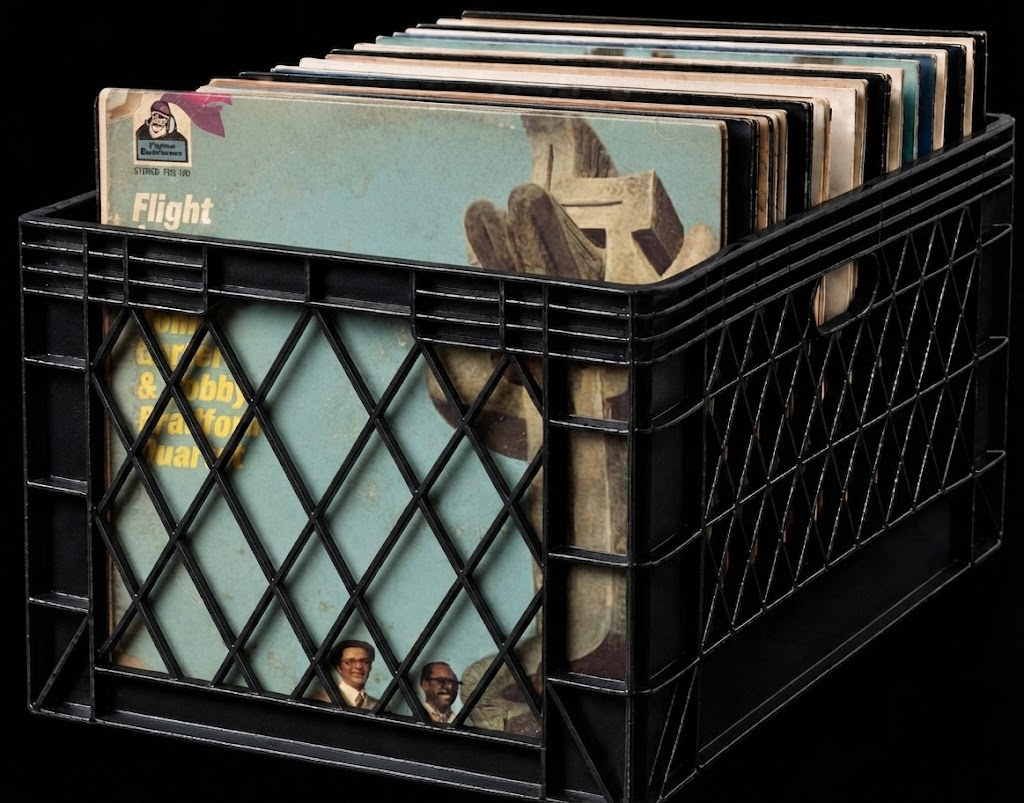
Further listening:
As leader
Flight for Four (Flying Dutchman, 1969)
Seeking [with New Art Jazz Ensemble] (Revelation, 1969)
Self Determination Music (Flying Dutchman, 1970)
Secrets (Revelation, 1973)
Love’s Dream (Emanem, 1974)
Lost in L.A. (Soul Note, 1984)
One Night Stand (Soul Note, 1988)
Comin’ On [with John Carter] (hat ART, 1989)
Tandem 1 & 2 [with John Carter] (Emanem, 1996)
Midnight Pacific Airwaves (Entropy Stereo, 2009)
Live in LA [with Mark Dresser & Glenn Ferris] (Clean Feed, 2011)
No U-Turn: Live in Pasadena 1975 [with John Carter] (Dark Tree, 2015)
As sideman
Ornette Coleman Science Fiction (Columbia, 1972), Broken Shadows (Columbia, 1982)
David Murray Death of a Sideman (DIW, 1992), Murray’s Steps (Black Saint, 1983)
John Carter Night Fire (Black Saint, 1981), Dauwhe (Black Saint, 1982), Castles of Ghana (Gramavision, 1986), Dance of the Love Ghosts (Gramavision, 1987)
Vinny Golia Sfumato (Clean Feed, 2005), Take Your Time (Relative Pitch, 2011)
Frode Gjerstad Reknes (Circulasione Totale, 2009), Dragon (PNL, 2012)
Leave a Reply
You must be logged in to post a comment.