
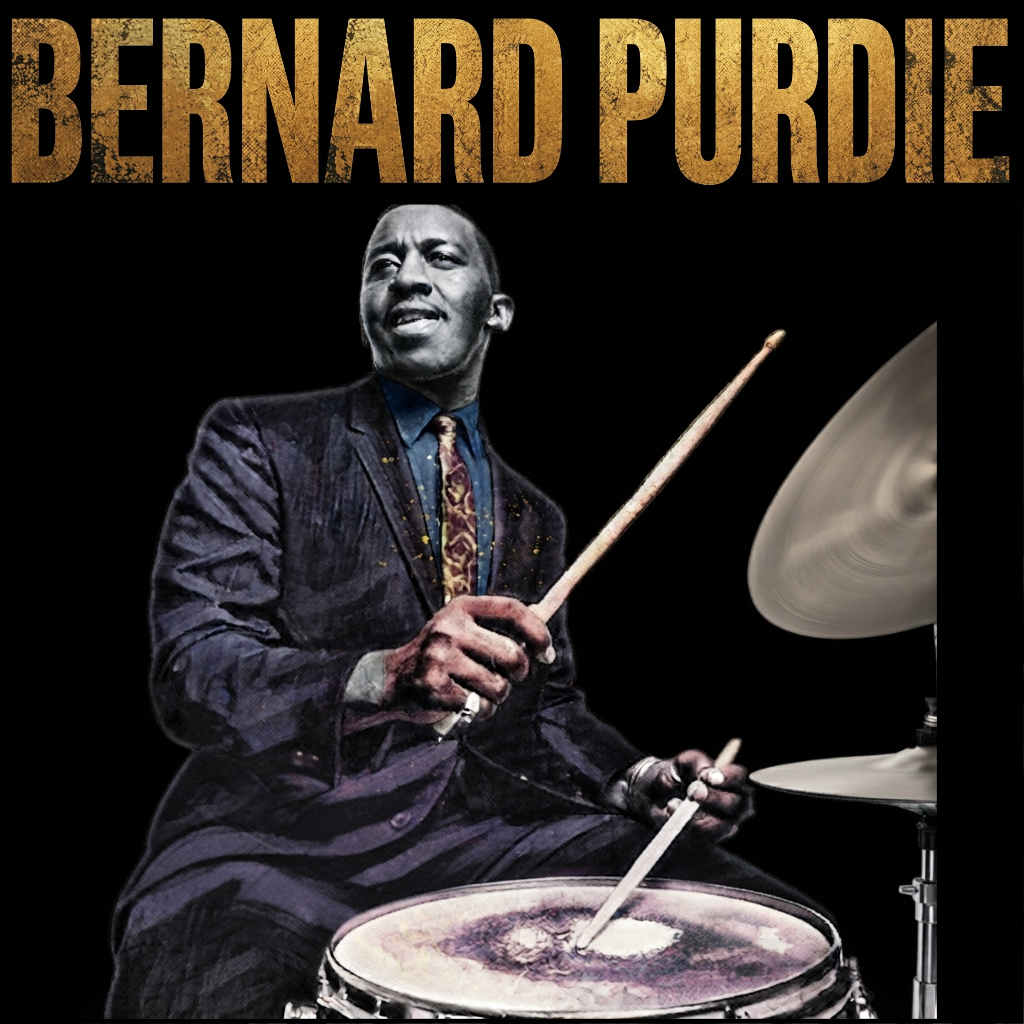
In this 2012 interview, legendary drummer Bernard “Pretty” Purdie discusses a relentless career, revealing how he unknowingly engineered the soul of modern music—from accidentally producing Gil Scott-Heron to anchoring hits for Aretha Franklin and Steely Dan—all while letting his immortal groove and notorious “Hit Maker” signs do the talking.
___
Back in 2012, I had the absolute privilege of sitting down with undisputed royalty: the legendary drummer Bernard “Pretty” Purdie. As co-host of ASTRAL TRAVELING on KBOO Radio, I watched him roll into the studio—swagger intact, carrying the heavy crown of the being one of the most recorded drummers in history.
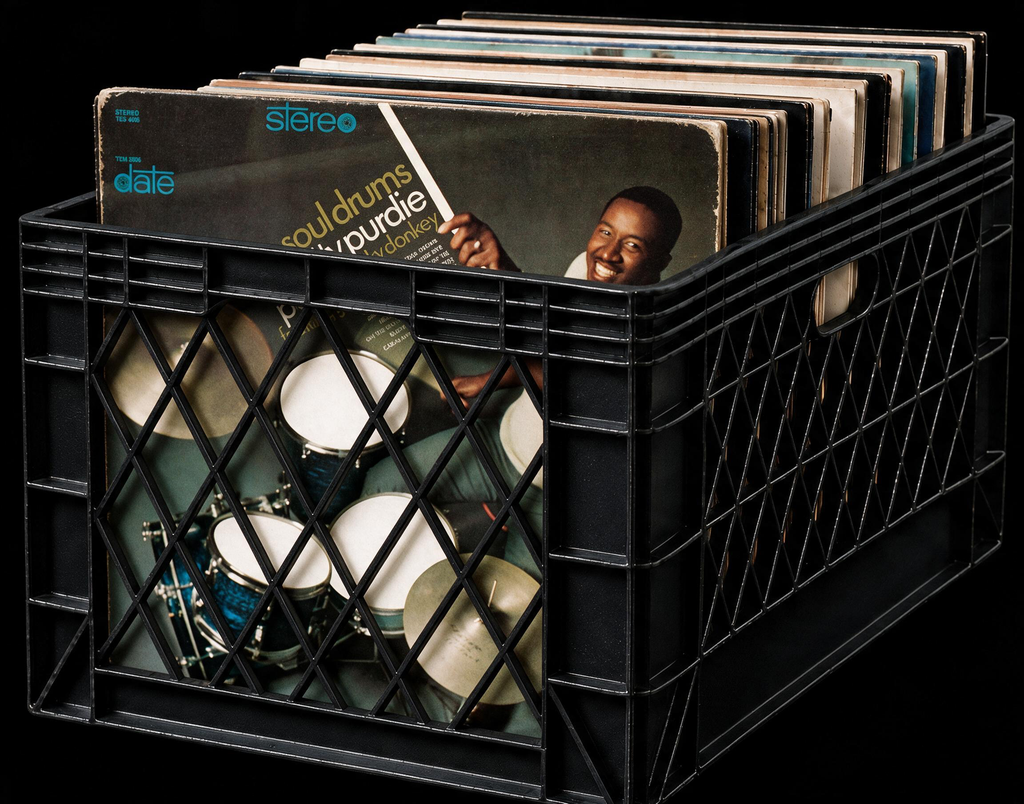
We didn’t want this conversation to fade away, so I’m resurrecting it over here as part of the Sounds Visual series. Huge thanks to Sounds Visual contributors DJ SESQUI for having me on Astral Traveling, and to STANDING 8 for bringing an incredible stack of Purdie records. to the studio (He was even smart enough to get Bernard Purdie to sign them—something I completely spaced on doing. )
___
DJ SESQUI: [We’re currently] lstening to “The Revolution Will Not Be Televised,”—tell me a little bit about this session. You were just mentioning something about actually helping to produce this record.
BERNARD PURDIE: Well, I worked for Bob Thiele at Flying Dutchman Records. At the time, even I didn’t fully realize I was producing because Bob Thiele wouldn’t be in the studio. He’d just tell me, “Okay, we got this artist, we have this material,” and I’d go do it. But that was part of my gift. My gift was doing the job.
In my naïveté of not really knowing what I was doing, I just got the best out of everybody because that’s what the situation called for. You go do a job. I never thought about getting formal producer credit; I got paid, and as far as I was concerned, that was the credit. I was doing the job, I loved what I was doing, so I’d just go in, make the record, know when we had a good take, know when something special was happening, and get the feel right. Then we’d fix whatever needed enhancing afterward. I was just good at what I did.
SESQUI: At what point in your career did you finally realize, “Hey, wait a minute, I’m producing; I should get a credit on this”? Or did you just prefer to take the reins and keep making your own records?
BP: Well, actually, I did do my own productions and made my own records. But I didn’t ask for extra credit because I was already getting paid for doing the job. It wasn’t that I didn’t realize nobody was giving me credit on paper—I had the ultimate credit because all the other record labels kept calling me to do the exact same thing. So it wasn’t about having my name printed on things. I never even thought about that. I could play, and that was the ultimate.
SESQUI: I know it was a job to you, but when I hear this production, it feels different. Music is such a spiritual thing—it’s arguably the closest thing to explaining spirituality without words. It hits your body, makes you react, forces you to listen, and conveys a message immediately through rhythm, mood, and melody. When you were moving on to the next riff—onto the next job—did you feel the repercussions of this music around that era? Did you sense the impact it was making, especially considering how huge it later became in hip-hop?
BP: Well, I’d have to say yes to all of that, but on a personal note, the impact was realized much later. Back then, I was deep in the middle of everything, running from one session straight to the next. I had to keep my head entirely focused on whatever the immediate job was. I didn’t have time to think about Gil Scott while rushing to a session two hours later, or think about Aretha when I was heading in to record with Nina Simone. When you’re there, you have to be 100% there for that moment.
Now, the thing is, when you talk about all the actual duties of a producer—picking out songs, shaping the production, managing the budget, handling the staff—I wasn’t doing all of that. So I didn’t consider myself “the producer” in that grand sense. I was brought in to do a job, I did it, and when I finished, I moved on to the next one.
Above: Aretha Franklin’s 1971 song “Rock Steady”; Bernard Purdie, drums.
SOUNDS VISUAL: Which brings up a question: back in the day, a lot of musicians were locked into strict label contracts. But you seemed to float effortlessly across almost every label in my collection. You’re on Groove Merchant, Flying Dutchman, Impulse!, T.K.… you’re everywhere! How was a musician like you able to move so freely?
BP: No problem at all. I worked for 63 different record companies because they all called me to do a job. I didn’t become a competitor until I started wanting my own label, wanting everything. But for those companies, I got paid to do a job for each one of them. In my entire life, I can only remember once—maybe twice—getting stuck and not getting paid. Those stand out!
What usually happened was, after a while, the big guys were taking too long to pay, so I’d do things for smaller labels. But I always got paid because they brought me the money upfront. Bam! Cash in hand. I was there to do my job; I wasn’t sitting around stressing about whether I was going to get paid. They gave me what I asked for, and we got to work. There was nothing else on my mind except doing the job.
Above: “Synthetic Substitution” by Melvin Bliss, 1973; Bernard Purdie, drums.
SESQUI: How do you feel about people sampling your drum tracks and breaks?
BP: Well, nowadays, I feel good about it! But back in the beginning—before they started coming directly to my own solo records—the songs they were sampling were tracks I’d played on for other major artists. All of a sudden, you’ve got records by James Brown, Aretha Franklin, Donny Hathaway, Steely Dan being sampled, and I didn’t get any extra sampling royalties for the drum tracks they were using.
Then there was this one guy—fairly early on in hip-hop—who actually came in and sampled one of my own records.
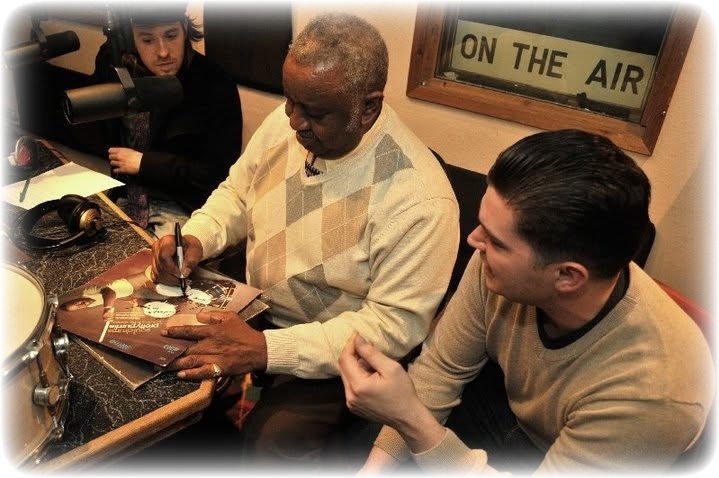
Pictured from left: Myself, Bernard Purdie, and STANDING 8 in the KBOO Studios, 2012.
STANDING 8: I have to ask you about the signs that used to go up behind your drum kit. Is that a myth, or did you actually use them for 30 years?
BP: Oh, no, that’s not a myth! That really happened.
STANDING 8: Do you still bring them on stage?
BP: No, I haven’t had to do that in the last 15 years or more.
SESQUI: For listeners who might not know what we’re talking about, fill them in…
BP: When I’d arrive at a gig, before I sat down to play, I’d put up my signs. One would say, “If you need me, call me: The Hit Maker.” Another would say, “You have hired the Hit Maker.” I actually had three signs, but I could only ever fit two on the stand at once, so I’d rotate them. Once those signs went up, I’d sit down, ready to play and make another hit record.
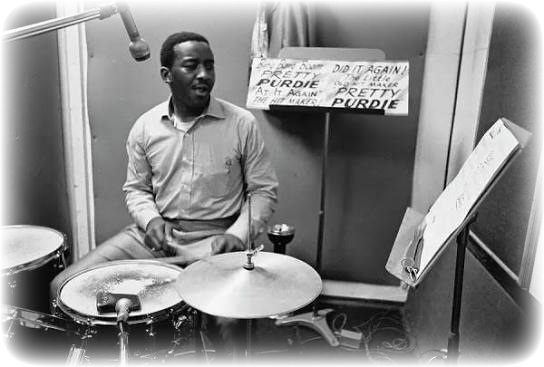
SESQUI: Did that put you in the right psychological zone?
BP: For me, it did! It was just a nice little gimmick. It wasn’t even my idea in the first place—it was my bass player, Jimmy Tyrell. He was the businessman. The best part was, I didn’t even put my phone number on the signs. People who didn’t know me would just tell club owners, “Get the kid with the signs! Get the kid with the signs!” And that’s how it spread like wildfire, because everything I was doing was turning into a hit—even the demos!
SESQUI: Amazing. People are still sampling you today. Speaking of the sound, we are massive fans of analog recording—the warmth captured by great microphones in legendary studios. You’ve worked in practically all of them from that era. What’s your take on the shift from analog to digital? Do you feel something was lost?
BP: Well, with the digital movement, they lost the feel. They actually lost the warmth that analog tape provided. That warmth is what’s missing in most digital records today. Now, people working in digital are trying desperately to emulate that warm sound using software plugins and saturation plugins to get that phasing back. The groups I’ve been working with in Japan are really obsessed with capturing that true warmth.
[Bands like Sharon Jones & The Dap-Kings and the Sugarman 3] came out with the right vision and worked hard to achieve it. It’s much more costly to do it that way, but they made it happen. For me, there is nothing like analog. But realistically, the cost factor of pure analog is ten times higher, which is why people try to simulate that warmth in digital today.
Above: The Sugarman 3’s 2002 LP “Pure Cane Sugar”; Bernard Purdie, drums.
SOUNDS VISUAL: Working at Atlantic Records, you got to work with virtuosic engineers like Tom Dowd and Arif Mardin…
BP: And Gene Paul! He’s actually featured in the new issue of Wax Poetics, sitting in a photo with his parents, Les Paul and Mary Ford. Gene Paul used to be their drummer back in the day, and from there he went right into engineering at Atlantic Records through the ’60s and beyond. Because his father was Les Paul, he had the best of both worlds—incredible engineering skills and he understood drums. He used to crack me up. I didn’t even know he played drums at first; I thought he was just messing with me because I was in the studio practically every day for a couple of years. He’s the one who taught me how to overdub and how to fix records properly.
Above: King Curtis’ 1971 LP “LIve at the Fillmore West”; Bernard Purdie, drums.
SESQUI: Where did you get the nickname “Pretty”? We know you’ve got a pretty sound, but who bestowed that on you?
BP: I actually got it when I first came to New York and people couldn’t pronounce my last name correctly. They’d say, “Bernhard Purr-dee… oh man!” It started as a joke, but within six months, the “Bernard” part got dropped, and I was just “Pretty Purdie” for the next 10 to 12 years.
Eventually, I asked for my real name back. People told me, “But the world knows you as Pretty!” And I said, “Well, they can know me as Bernard Pretty Purdie, too!” So that’s when my full name came back into rotation in the ’70s. Instead of just “Pretty Purdie and the Playboys,” it became “Bernard Pretty Purdie,” and I’ve kept it ever since. It still works!
Above: B.B. King’s 1969 classic “The Thrill is Gone”; Bernard Purdie, drums.
SOUNDS VISUAL: Let’s talk about the mechanics of your playing. When you put a beat together, it’s not just the snare by itself, or just the hi-hat—it’s the exact placement of the bass drum, when you open and close the hi-hat, and all those subtle ghost notes…
BP: And above all, it comes down to the tempo and the groove. It’s all about where the 2 and the 4 land. It’s on the 3 of the first bar and the 3 of the second bar. But you’ve also got your upbeat eighth notes and dotted notes off the hi-hat. When you add all those together, you have to remember that the bass drum is the pulse underneath it all—do-do, do-do.
SESQUI: And you said you weren’t going to be a teacher! Look at you now. You have some incredible instructional videos out on YouTube—watching them is essentially attending a masterclass. Your signature shuffle—playing those eighths and sixteenths seamlessly while looking completely relaxed and just talking us through it—is mind-blowing. You’re holding down strict time while casual conversation is flowing, which just showcases your incredible musicianship. Do you still maintain a daily regimen?
BP: I don’t do a rigid “practice” daily, but I do play daily—seven days a week. And everything I practice is done slowly. In order for a groove to make sense, to be clean and feel lovable, practicing at a slower tempo is essential. Playing slowly with a deep groove is the hardest thing to do in music. If you can lock down a groove at a slow tempo, you’ve got the job over everybody else. Everyone has fast chops, but when you strip it down to a slow tempo, you have to truly groove and feel good about what you’re doing.
SOUNDS VISUAL: That is golden advice. Every young drummer is told to keep it down, hold the pocket, and perfect things at a slow tempo before speeding up. Hearing it directly from you confirms it’s the absolute truth.
SESQUI: Let’s talk about another legendary collaboration: Steely Dan. How did you end up recording with them?
BP: That was back when they were on ABC/Dunhill Records.
SESQUI: Did you go out on tour with them when they played live?
BP: No, in the beginning, they didn’t tour for 20 years! People thought Steely Dan was just a traditional band, but they operated primarily as studio musicians early on. They had the resources to bring the top studio players right to them. And they were perfectionists—oh man, total perfectionists. Everybody thinks everything was driven entirely by Donald Fagen, but Walter Becker was right there too. Walter didn’t speak up very much, but when he did… in the studio he’d mostly leave us alone, but in the control room he’d be on the talkback mic going, “Ah, ah, ah, ah,” guiding us. We understood where he was coming from, and it always made the music better.
By the time I came in, they had already recorded some of those songs two, three, or four times with different drummers. Chuck Rainey was on just about everything, and Paul Griffin was playing piano and writing parts—like on “Green Earrings.” It was a great environment. I played on several of their tracks and even helped fix parts of their first couple of albums.
SESQUI: Bernard “Pretty” Purdie—legend, hit maker. Thank you so much for joining us tonight!
BP: Thank you very much. Wonderful night!
Leave a Reply
You must be logged in to post a comment.