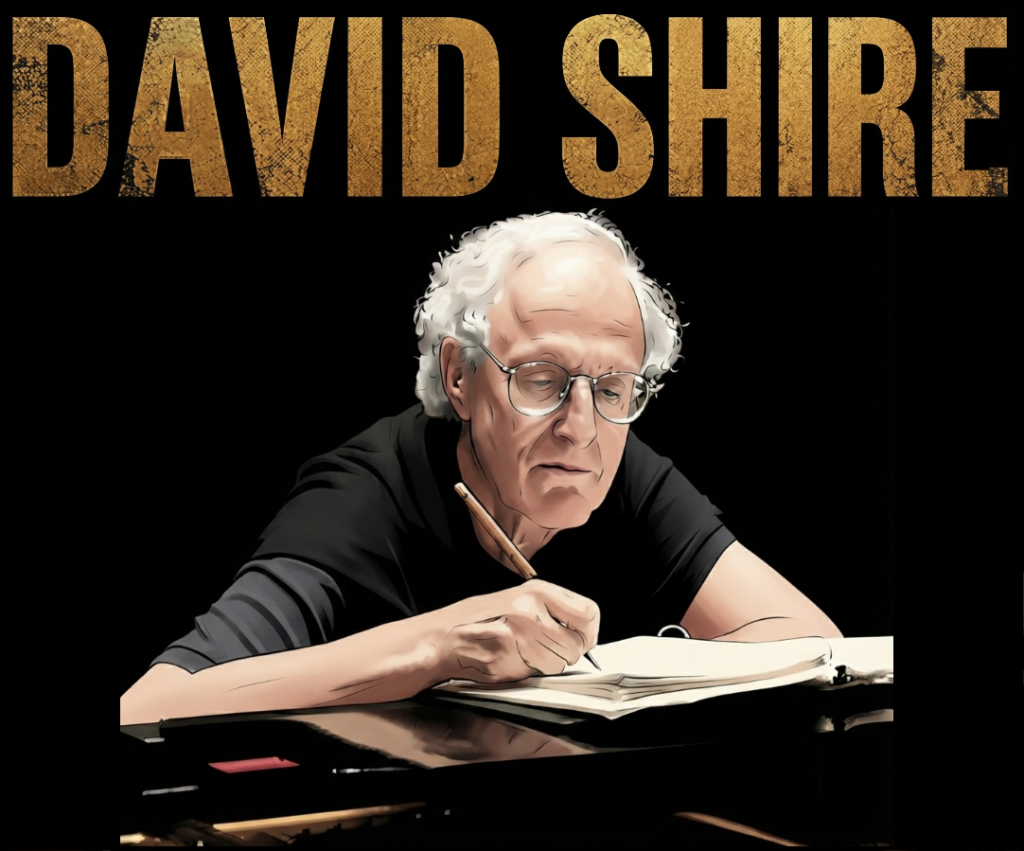
From the intimate, jazz-infused piano motifs of “The Conversation” to the avant-garde technical precision of “The Taking of Pelham One Two Three,” David Shire has spent a storied seven-decade career masterfully balancing the collaborative service of film scoring with the singular, thematic soul of a dedicated storyteller.
___
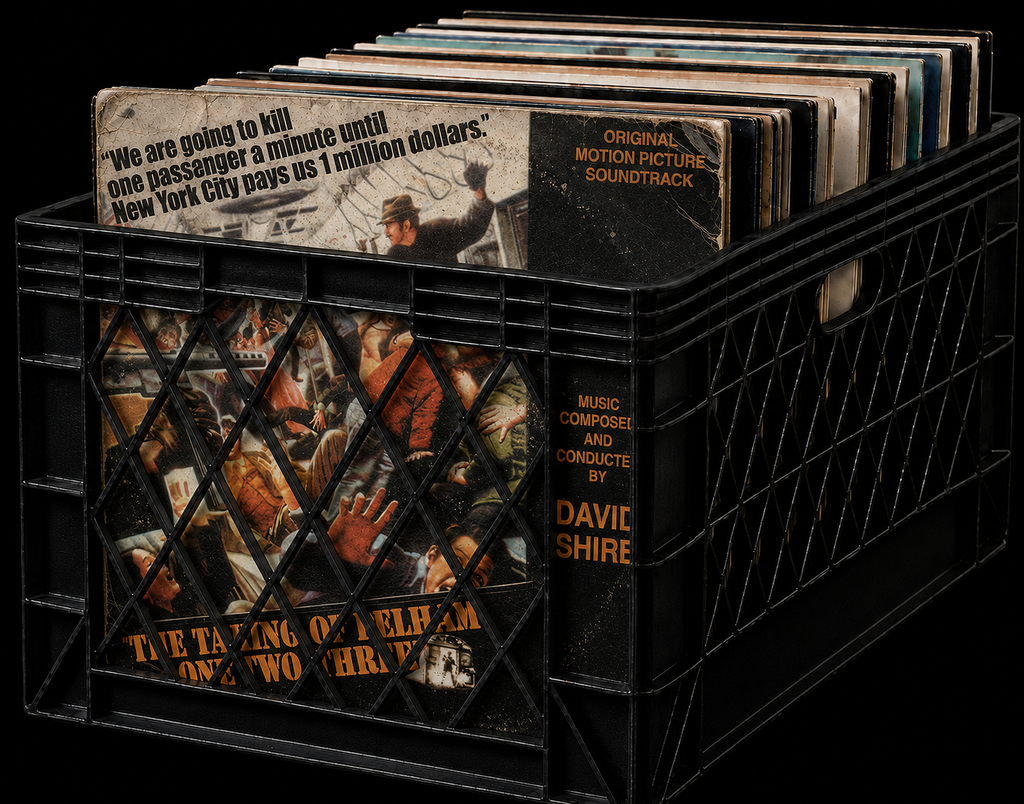
David Shire is a masterful composer whose sophisticated, genre-bending film scores, such as his work on The Taking of Pelham One Two Three, have made him a revered figure among jazz aficionados and crate diggers seeking complex arrangements. His seamless integration of jazz-funk, atonal composition, and atmospheric textures solidified his legacy as a brilliant architect of sound who elevated the art of the modern soundtrack.
Sounds Visual: You were raised in a musical household with a father who was a bandleader and a piano teacher. How much of your current philosophy and music can be traced back to those early lessons in Buffalo?
David Shire: The first music I was really inspired by was the music I heard drifting up from the piano lessons my father was giving downstairs. The students he taught were often people who already knew how to play, but wanted to learn how to take sheet music and turn it into jazz and create arrangements, which sheet music—being just basic melodies—never provides. I was hearing pop music flowing up from downstairs while lying in my crib, I guess. In those days, pop music was theater music; it was the Great American Songbook, as we’ve come to call it. That was the DNA of my soul before I could even talk.
When I got old enough, he sat me down—I still have a picture of it—and started teaching me basic piano. He wasn’t a classical teacher, so I had to go to a classical teacher to learn how to really play, but he taught me chords—jazz chords, pop chords—and how to interpret those standards. That was my first inspiration. Classical music came later. As I listened to more of it, my musical vocabulary expanded. I had a jazz group in high school, another one in college, and I played cocktail piano when I was home from college in the restaurants and saloons of Buffalo. I became a musical director at a summer resort, accompanied the Glee Club at prep school, and by the time I got to Yale, I was determined to be a theater composer. That was the beginning of a 70-year collaboration with Richard Maltby Jr., writing musicals.
Along the way, I had to make my living when I first came to New York. We wrote two shows at Yale that were big, produced shows, but when I hit New York, I made my living as a rehearsal pianist, playing dance classes, and playing club dates—I was a pianist for hire in the theater world. Eventually, I became the accompanist for Barbra Streisand for a couple of years. I played in the pit for Funny Girl and conducted 30 or 40 performances.
One thing I remember clearly: I was writing with Richard, and a year after being in New York, we had an Off-Broadway show. It wasn’t a big hit, but it was a “success d’estime,” as they call it. People in the business came down to hear it, including Steve Sondheim, who was very impressed with what we were writing and became our career-long mentor. That led to a lot of connections.
My career was basically New York theater until we were hired for a fully financed Broadway show. They didn’t like the original score, threw it away, and called us in. We wrote the whole show, tried it out in the Ahmanson Theatre in California, and it closed there. It had some success, but I didn’t want to go back to New York. A pianist and composer friend of mine from New York had gone to California a couple of years earlier and became a composer at Universal Studios, writing a lot of television scores like The Name of the Game. I told him I was a bit despondent about where my theater career was going, and he said, “Let me take you over to Universal and introduce you to the head of music.”
I had two tapes from some TV shows I’d scored in New York—CBS Playhouse—and within a couple of weeks, I was standing in front of a studio orchestra at Universal, conducting my first Western score for The Virginian. We kept busy doing that and writing “unimportant” television until I started getting better assignments, like McCloud.
That led to better movies. By that time, I’d married my first wife, Talia Shire, Francis [Ford Coppola]’s sister, and that led to my relationship with Francis and scoring The Conversation. It was a small movie at the time, but it became a big movie in his filmography. So, you can see I went through a lot of different branches of music. I always had my jazz group, but movie scores really expanded my vocabulary, allowing me to finally put my jazz chops to work. My style has always been a combination of many styles, which is what writing for the theater and film requires.
SV: You’ve described film scoring as “set design” for a director’s vision, but theater as being the “prime creator.” Is it difficult for you to transition back into the service mindset of film after reclaiming the lead voice in a theater project?
DS: No, they’ve kind of reinforced each other. Writing for films required more compositional technique and “head work,” which I drew upon for theater. But the theater gave me a stronger sense of dramatic storytelling through music, which helped me with the individuality and emotional force of my film scores.
It had a downside, though: in New York, I was a theater composer; in L.A., I was a film composer. In New York, Steve Sondheim would say, “Why are you wasting your talent in California writing movie scores when you should be writing musicals?” In California, people would ask, “Why are you wasting your time in a dinosaur industry like musical theater?” I was constantly asked to give up one for the other.
SV: You mentioned The Conversation a few minutes ago. The score is notoriously sparse and piano-heavy. How did you use the piano to mirror the protagonist’s psychological isolation, especially when Francis explicitly forbade traditional thriller tropes?
DS: It wasn’t just a piano score; it was a true piano score. Although we put it through a soundtrack to give it texture, it was always the piano. When I discussed the movie with Francis—it was my first big studio picture—I expected to use a big, John Williams-style orchestra. The first thing Francis said was, “I don’t want a typical thriller score. I don’t want a symphonic score. I want it to be intimate. I want a reduced piano score.”
My heart sank, but he was absolutely right. He gave me an interesting exercise: he said, “Go back to Los Angeles, and I want you to write me some short piano pieces, not two or three minutes each. I’m going to give you titles. None are scenes from the picture, just think about these titles.” The titles were things like “Harry Caul goes to visit his grandmother,” or “Harry Caul goes to pick up his laundry.” I thought it was nerdy, but I went back and wrote five pieces. I played them for him, and when I played the third one, he said, “That’s the theme for The Conversation.”
I realized later that the inspiration for that theme was subconscious. When I was at Yale, I’d put on jazz stations while writing papers, and I remembered a solitary piano in the background of some track—just a basic, repetitive bluesy series of notes. The left hand of my theme came from my classical piano lessons—a simple, natural accompaniment. It was a combination of those two worlds. It ended up being the two sides of Harry Caul’s personality: the left hand being very measured and classical, and the right hand being the solitary, sad jazz melody.
SV: Let’s talk about The Taking of Pelham One Two Three, one of my favorite film scores. You described that score as an epiphany where you used a serial tone row as a grid to map the chaos, but filled it with jazz intervals. Do you still rely on those rigid mathematical frameworks to solve creative stalemates?
DS: That was really a one-off. I had the assignment, and for several weeks, I kept improvising to find the emotional center, but everything coming out was garbage—it was just bad Schubert! I was almost ready to give up. One night, I was talking to a composer friend about serial music. I said I never wanted to write that because it was boring, but he said, “A row can be anything. A chromatic scale is a row. Three diminished chords piled up is a row.”
I realized if I constructed a row that was essentially jazz—major thirds, minor sevenths—I could use that as a map. I charted the 48 variations of that theme, and once I had that chart on the piano, it just spewed out improvisation after improvisation. It was the greatest “Eureka” moment I’ve ever had.
SV: How do you think your experience as a live jazz pianist and accompanist influences the rhythm of your edits? Does your internal jazz clock ever demand a different pace than what the picture editors provide?
DS: “Internal” is the right word. That stuff is in my fingers. All of my composing starts at the piano, improvising. Sometimes you get gifts from the gods—the first five minutes I sit down, something comes—and other times, I have “morning sickness” for a week where there is nothing I can use.
SV: In terms of narrative subtext, do you see yourself as a storyteller helping the audience, or a composer tasked with keeping the audience’s suspicions alive?
DS: Basically, a storyteller. When you’re working on a movie like The Conversation, it’s a pleasure. If you’re writing a Western with a gunfighter, it’s mechanical; it doesn’t always come from the heart. But when you have a director-writer like Francis saying, “The score is the subtext,” you’re really writing a complicated character. You’re capturing the contradictions that music is wonderfully equipped to handle, because the rhythm can say one thing while the melody says another.
SV: How do you maintain your own musical voice while operating within the tight, non-negotiable structures of a film?
DS: With a good director, it’s negotiable. But the worst assignments are when a director is married to a “temp score” and wants you to copy it. You need freedom. Sometimes it’s not negotiable, and you get thrown off the picture—it happens to everyone in Hollywood. John Williams has been brought in to replace scores that were thrown out; it’s just the nature of the business.
SV: Regarding the economy of motifs: in Monkey Shines, you used a simple four-note motif. How do you decide when to nudge an audience with a recurring theme versus when to let silence do the heavy lifting?
DS: It just happens. It’s unconscious decision-making. The film tells you where you want to shut up and where you need to do something. I usually spot more music than will wind up in the picture because it’s cheaper to have the music recorded than to find out you need it later.
Take Kramer vs. Kramer: I saw the movie and told the producer, “This movie is so powerful, I don’t think it needs a score. The acting says everything.” He said, “Well, you’ve been very polite, now go write the score.” I wrote 40 minutes of music, but after the first preview, he cut 10 minutes. After the second, he cut more. I finally said, “Stanley, why don’t you just cut the whole score?” That’s how it goes sometimes.
SV: When you’re writing for musicians capable of incredible improvisation, how do you balance your composed structure with the need for them to bring their own unpredictable personality?
DS: I give them very little leeway on the “heavy lifting”—my charts are carefully timed—but I hire players for their individuality. For Farewell, My Lovely, the solos in the score were written to allow for that. You want the personality of the player to come through the notes you’ve written down. It’s a case-by-case judgment.
SV: You told a story about Mike Nichols on The Fortune, where his direct questioning of your choices ended in an impasse. Did that change how you approach initial spotting sessions? Do you now invite that level of challenge?
DS: I’m open to everything. I want the director to challenge me because they have lived with that picture for a year. On The Fortune, I started writing something, and Mike just looked at me and said, “You mean that… thing… you’re going to use?” That was the end of that. I changed it immediately. Every collaboration is different; you just have to feel your way through and size up what the director knows and what they’re looking for.
SV: Now that you’ve revisited your archives, like the release of the full Norma Rae or Apocalypse Now scores, does listening to “rejected” music change your opinion of it?
DS: No, I don’t think it’s “ahead of its time.” I just think it’s a correction that wasn’t made at the time. With Apocalypse Now, I was in an ideal situation, but Francis was going crazy in the Philippines, and the reels would come back to be scored after they had already been shot. There were weeks in between where I wouldn’t have anything to do. It was a unique process.
So, when I signed on to the producer of Norma Rae, I thought, “Well, that isn’t going to be that demanding, and I can certainly handle that in the time I’m sitting around waiting for reels to come back.” One day, Francis called and said, “Are you working on another picture?” I said, “Yeah, but I’m not taking time away from you, I’m doing it on my own time.” He said, “Well, I don’t want you working on another picture,” and he fired me.
The punchline is that a few years later, a film score producer asked if he could put out a record of that unused score. I said, “Well, I have to get permission from Francis.” This was many years later; Francis and I had patched up our relationship. I called him up and said, “Francis, can I put out a record of my unused score for Apocalypse Now?” There was a silence on the other end, and then he said, “Go ahead.” I was happy to have the record come out. Walter Murch, who was always a very close friend of mine, told me later, “David, I felt so bad about that,” but the score we found and released was pretty much what I had originally written. We had a bunch of synthesizers—it was a very experimental score.
SV: Is there a specific cue, film score, or theater piece that you feel didn’t get its due recognition, or that you personally feel represents some of your best work?
DS: I’m sure there are a number of them. You mentioned The Taking of Pelham One Two Three—that was a wonderful score. It was a great experience. As a point of interest, there is a lot of mallet percussion in that score.
There was a group in Toronto called Nexus—a concert percussionist group. They were five percussionists who played every tonal and non-tonal percussion instrument in existence. Since I wanted to use a lot of mallet percussion, we decided to create one massive setup for the five guys. We had a line of instruments starting with a contra-bass marimba and whatever else came next, all the way up to the tiny xylophones on the other end. Five players covered everything. That was fun.
SV: You’ve seen the evolution of the film composer’s role over many decades. Looking at the next generation of composers, what is the one piece of advice you find yourself giving most often, or wish people were asking more about?
DS: I don’t know if they ask me for my advice, but the music industry has changed so much. It started with the big studio scores of Korngold and Rózsa, and now it’s different. Styles are constantly changing. I don’t know how much advice I can give them because their world is different from mine.
SV: We live now in an era of “ambient” or sound-design-heavy scores, yet you are a master of the “thematic” score. How do you approach writing a melody that remains memorable in an industry that sometimes prioritizes texture over tune?
DS: When I was still active in the business, people came to me because they knew the kind of score I could deliver. If they wanted a rock-and-roll score, they would go to somebody else. I could imitate anything, but it’s different with me—I want it to be authentic. When I was starting out, people couldn’t have imagined the way movies are scored today with pop-heavy soundtracks. But for those who like the kind of music I write, my advice is always: you have to take each picture as an individual case and get to the heart of the subtext. I can only teach them how I compose, because I don’t feel qualified to teach anybody else how to do it their way.
You know, people ask me what’s the difference between scoring a, playing for musical, and a movie. In one, when I went into the theater, I’m in charge… [In the other], I consider myself like a costume designer or a production designer, set designer. I’m working for somebody else.
SV: A lot of your music has been sampled in hip-hop; did you know that?
DS: I haven’t had any cases personally where someone approached me, but I’ve heard scores that I feel were influenced by my work. I’d love to hear them!
Above: David Shire’s 1979 track “Books and Basketball [Montage],” sampled on Chill Rob G’s 1989 song “Wild Pitch.”
We are all influenced by each other. I remember trying to write something “John Williams-ish” or “Lalo Schifrin-ish,” but as soon as I found a way to stop imitating them, I came up with something that was me. If people want to take what I do and do something else with it, that’s just how art works. People might want to take what I do and do something else with it.
SV: Looking back over this incredible career, what would you like your legacy to be?
DS: I just like that my music is out there, that people have heard it and enjoyed it. Like any writer, I just want my work to be circulated and appreciated. Knowing that my music is being sampled or used elsewhere makes me feel very good. It means it’s still alive, still inspiring people, just like I was inspired by those who came before me.
SV: David, thanks so much for taking the time to speak with me today!
DS: All I can say is that yours are some of the most intelligent questions I’ve been asked in a long time. It’s great when you can talk to somebody who’s also a musician. Call me anytime.
Leave a Reply
You must be logged in to post a comment.