
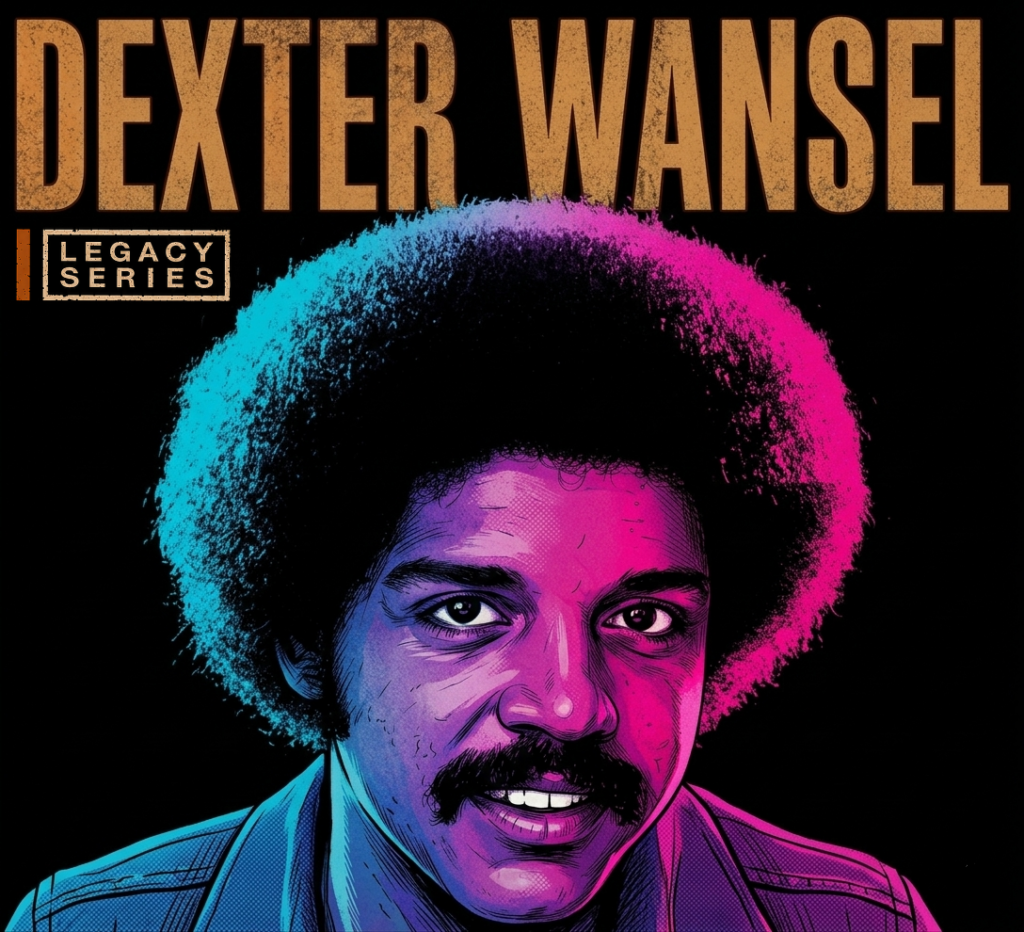
The Legacy Series cuts through the static to pay dues to the departed masters. From a backstage gopher boy for jazz legends to Philly’s lone synthesizer wizard, Dexter Wansel weaponized the ARP 2600 to sculpt a space-age blueprint for disco, hip-hop, and R&B.
___
Dexter Wansel: The music journey started for me when I was a young kid. I was an errand boy at a theatre in Philadelphia called the Uptown Theater from the age of eight or nine to thirteen, fourteen, something like that. The Uptown’s a lot like the Regal Theater in Chicago and the Apollo in New York, where primarily black R&B/jazz artists would come and perform. Not just for a day or two or a week, but for 10-14 days. So they would make a home there, and I would be their little gopher boy, going for sandwiches and coffee. Helping them get dressed for the performances and all that kind of stuff.
My stepfather was, at the time, Clint Woods, and his brother was [Philadelphia radio personality] Georgie Woods, and he had all the major shows at the Uptown. Clint would count the people coming in the front door, and they had me work backstage and I absolutely loved doing that. The bandleader at the Uptown was [musician] “Doc” Bagby. He was truly unsung and was my mentor. He showed me my first keys on an organ, and he and Dave “Baby” Cortez used to show me a lot of stuff. And “Doc” Bagby is actually responsible for rockabilly. He sued Bill Haley & the Comets for “Rock Around the Clock,” because it was his music. [laughs] He didn’t win, but anyway.

I got to sit with the band and watch them rehearse for all the shows: the Miles Davis Quintet, Dizzy Gillespie, even my father, who was a drummer. He would play with Dexter Gordon when he would come through. My father had a group called the Suburban Echoes, which was the first integrated group on the main line of the Philadelphia area. And when Dexter Gordon came through, my father’s band would be his backup band sometimes. My mother said that my father asked Dexter to be my godfather, and Dexter agreed to it, so that’s why I’m named “Dexter.”
So, Dave “Baby” Cortez would show me notes and chords on the organ with “Doc” Bagby. When I really started playing was many years later when I was studying the cello at junior high school. I went to theory, harmony, and composition classes at Settlement Music School. I also took cello lessons.
One of the things you had to learn [also] was piano, because piano played such a big part in that. I didn’t really study piano, but I kind of learned it as a way to write music, especially for instrumentation and stuff like that. And writing original pieces. By the time I got to high school, I was playing the piano good enough that me and my best friend, [bassist] Stanley Clarke, had our first little groups together in the ninth grade, called the Speakers. Me, him, and Johnny Moore. Then I wound up going into the army at a very early age—the day I turned 17 I was on a train to Fort Bragg, North Carolina for basic training.
When I went overseas to China and Taiwan, I was playing piano with some of the Taiwanese groups over there. And then when I got back to Fort Hood, Texas, I would play shows with a few musicians there, I would sit in on keyboards.
In 1970, after being honorably discharged from the United States Army, Wansel quietly joined the ranks of synthesists like Wendy Carlos and Dick Hyman. He began programming the EMS VCS 3 ‘Putney’ and the ARP 2600 for both credited and uncredited sessions at Sigma Sound Studios.
DW: That’s what really got me started with keyboards. After I was discharged from the Army, I would sit at Sigma Sound in ’71, ’72, to see if anyone would use me on a session to play keyboards.
I got a couple of sessions where I played keyboards for the band that was there at the time, whatever group of musicians needed me. But what really got me started was: Sigma had a synthesizer called the Putney. And they asked me if I knew how to program the Putney.

I said, “Well, I can try…” Of course I didn’t know. [laughs] But I learned how to program it, plug the pegs in the right places, turn the knobs and got some pretty good sounds. And then they started calling me in for fifty dollars a session to basically program, not necessarily play, but come up with sounds for other keyboard players on the Putney.
Al Pearlman [engineer, founder of ARP Instruments] actually sent me the 2600 also. [laughs] It was very different from the Putney, because the ARP 2600 was in a suitcase, and you had chords where you had to really link the ADSR’s with the modulators, and the sine wave modules on there. The very first song that I did in ’74 for PIR [Philadelphia International Records] that got accepted was “Billy’s Back Home” [on Billy Paul’s 1975 LP, “Got My Head on Straight”]. I used the synthesizer, the 2600, for the first time.
In the early to mid-1970s, Wansel played keyboards for several groups, including Instant Funk, Yellow Sunshine, and MFSB. After signing with Philadelphia International Records as an in-house songwriter, producer, and arranger, he formed a songwriting partnership with lyricist Cynthia Biggs.
So I said, “If [using the synths] is gonna make me different, then every time I write an arrangement, nine times out of ten, I’m gonna add synthesis and merge sounds together.” I really wanted to find a way to work with synthesis. Once I started programming that Putney, I wanted to make it work with what I did. It was a challenge in many ways, and of course the label didn’t know what to do with it. Radio didn’t know what it was. [laughs] But, experimentation is what it is. I was the only one in Philly that had their own synthesizer. So I kinda started getting a lot of sessions because of that.
Sounds Visual: Let’s talk about some of these early sessions and records. One of your first credits is on the self-titled debut by the short-lived, funk-rock band Yellow Sunshine. [Gamble, 1973]
DW: [Yellow Sunshine] members Karl and Roland Chambers were members of MFSB, the orchestra that played behind all the Philly sound stuff. They later became known as Salsoul Orchestra, but they were the same musicians that were [behind] [vocal group] The Ritchie Family, and the [disco band] John Davis and the Monster Orchestra, and so on. But Karl and Roland actually heard me playing piano on a session and asked me to join Yellow Sunshine.
So I became a member in ’72 when the band was being formed. Right after we made that record, we started touring, but some reason, Karl and Roland decided that they didn’t want to do it anymore. And in less than a year after the album came out, Yellow Sunshine no longer existed.
With Instant Funk, Bunny Sigler asked me to join his touring group, which I did, and we went out. He asked me and [producer/songwriter/guitarist] T Life to go out with his band, and the band was the early Instant Funk, before they had any records. So me and T Life became members of Instant Funk in early ’74, and we toured with Bunny Sigler and backed him up for about a year. As an arranger, I kinda wrote their first arrangements when they were signed temporarily at PIR with “Float Like A Butterfly” [TSOP, 1975]. Bunny actually had me writing all the arrangements for projects he was doing.
One thing led to another, and Gamble and Huff heard some of the arranging I was doing for Bunny, and asked me to write some arrangements for them in ’74 and ’75. Some of that was for an album for MFSB, who, by that time, I was the keyboardist for them live. [laughs] Bobby Martin was still a conductor.
After I left Bunny, he immediately became MFSB’s live keyboard player. And don’t forget, MFSB was forty pieces: strings, horns, winds, a rhythm section. At that time, Baker, Harris and Young, who were the original MFSB rhythm track people, had started their own label [Golden Fleece], and kinda broke off from MFSB. [Violinist/arranger] Don Renaldo had to hire some new rhythm section members, and by that time, we were on the road performing. We did numerous performances with Bobby Martin as the conductor.
When Gamble and Huff asked me to write for MFSB’s album “Philadelphia Freedom,” [PIR, 1975], I wrote the arrangement for the [title song] and then they asked me to come up with a couple things, and that’s really what got me started—between Bunny, and writing for MFSB got me started as an arranger/producer.
The iconic “Philly sound” of the 1970’s—soul music interlaced with funk influences, and featuring lush instrumental arrangements–with dramatic, sweeping strings and piercing horns–ultimately laid the groundwork for disco. In addition to the work of Bunny Sigler, the Philly soul sound was also largely attributed to Gamble and Huff, as well as producers like Thom Bell and Bobby Martin.
SV: Dexter, this past week before our chat, I went back and listened to a lot of these PIR albums and Philly soul records. They still sound so incredible, almost fifty years on.
DW: The Philly sound had great writers, producers, and arrangers. But my argument is—I really think that people like Bobby Martin and Thom Bell are really more instrumental in the sound of Philly than they’re given credit for.
Most people don’t realize that Thom Bell was a great arranger and really came up with some early Philly soul stuff. I’m talking about especially The Delfonics. That really jump started that era of Philly sound. And of course Gamble and Huff, and their work with Bobby Martin as an arranger, with the stuff they did with Gamble Records. Bell and Martin’s arrangements really set a standard for people coming out of Philly at the time.
Don’t forget, in the early and mid ’60’s, that was basically the end of doo-wop. So, for Thom to come up with the with the orchestral sounds he was doing, especially with The Stylistics, it really helped to fuel a whole other aspect. People took that sound and added beats to it, especially for disco music. They took his full orchestral approach and kind of abided to the stuff they were doing with disco. They had done as good as it ever was gonna be done, or was ever gonna get done. [laughs]
In 1976, Wansel co-produced, arranged and composed songs on the self-titled album for Jean Carn [PIR], a jazz and R&B singer with a five-octave vocal range.
DW: Working with her was fantastic. She had come into the label early on in ’76, and I was asked to work with with her. It was one of my earliest projects as a producer. I knew everybody was gonna come up with the R&B-flavored stuff. Her and her husband [Doug Carn] had done some pretty good jazz stuff, so I wanted to keep in that in the loop with the stuff I did with her. That’s how I approached it on that first album, trying to be different.
SV: Clearly, the partnership worked: in 1978, you produced and arranged one of Carn’s most beloved tracks, a great rendition of “You Light Up My Life.” [from her album “Happy to Be With You,” PIR; the track was later sampled by artists including M.O.P, Kool G Rap, and Madlib.]
DW: She wanted to do it. She liked that song and asked me to do a version of it. I approached it from a semi-jazz/popular/easy listening kind of thing, where it starts off with a jazz flavor—not smooth jazz, but jazz. [laughs] And then it goes into aneasy-listening kind of vibe, and then I kick it back into the jazz. [laughs] I had fun producing and arranging that one.
Actually, the first major, 30-city tour I ever did was with Jean and Billy Paul, and Jean was a part of the group I put together for that tour. She didn’t have her own band at the time, so she toured as a part of the band that I had. And it worked out. [Wansel also produced, arranged, and composed Carn’s 1979 dance classic “Give It Up,” from her LP “When I Find You Love.”]
Around 1976, Wansel began working with the Jacksons, whose seven-year deal (as the “Jackson 5”) with Motown had ended. He co-produced their self-titled 1976 LP [PIR/Epic] and wrote the songs “Keep On Dancing” and “Living Together.” Wansel also co-produced, arranged, and composed songs for their follow-up, “Goin’ Places,” in 1977.
DW: When they came through, they were familiar with stuff I had been doing at PIR and really liked it. They actually had stuff that they wanted to record, their own songs. They told Gamble and Huff they wanted to do those because Motown would not allow them to record their own material for the most part. Also, they didn’t let Tito play on sessions, and Tito complained to me about that. And I said, “Well, you’ll be playing on every session that I do.” [laughs]
So, we really became close and they asked to arrange all of their original stuff that they did on those two albums at PIR. I really enjoyed working with them. We tried to bring a different feel to their stuff. I did a song with them called “Jump for Joy” that, to this day, I really like.
And the arrangements on [songs like] “Blues Away” and “Different Kind of Lady”—I really liked that stuff because Michael’s voice was changing, even from the first to the second album. And I think those songs really helped him through that, and then when they went back to CBS and did other albums, his voice was set by then. I think we helped him transition quite well.
SV: You also did a lot of great work with Lou Rawls.
DW: Me and Lou became very close, so close that even after he left PIR, he asked me to be his executive producer of his next album [“Close Company,” 1984] for Epic, which I did. My kids called him “Uncle Lou” and whenever he was on the east coast, me and Judy would be with him and whenever we’d be on the west coast, we’d be with him and Cece [Rawls].
I really loved working with Lou. That first album we all did together [“All Things in Time,” PIR, 1976], I played on a couple of things but only did production and arrangement [on the song “Pure Imagination”]. We were sitting down, talking and I said, “Lou, I really love this song from ‘Willy Wonka.’” And he started singing, “Come with me, and you’ll be…” [laughs] So me and Lou hit it right off.
Wansel also co-produced, arranged, and composed Rawls’ 1977 LP, “Unmistabkly Lou,” for which Rawls won the Grammy Award for Best Male R&B Vocal Performance for the album in 1978.
SV: You wrote “It’s Our Anniversary Today” from this record.
DW: What’s funny is, I wrote that for my former wife. It was very personal. And when I told Lou about it, he just laughed. [laughs] But of course he did it. If you listen to that, I [did it] in a way that was really reminiscent of productions from the ’50’s and ’40’s.
Other Wansel-associated tracks include Shirley Jones’ “Last Night I Needed Somebody” and “She Knew About Me“; The Stylistics‘ “Hurry Up This Way Again,”; The O’Jays’ dreamy ballad “I Really Need You Now“; Phyllis Hyman‘s radio-aired track “Living All Alone“; The Jones Girls‘ “We’re a Melody“, the exotic “Nights Over Egypt,” “Love Don’t Ever Say Goodbye,” and “Why You Wanna Do That to Me“; Archie Bell and the Drells‘ “Old People“; and Evelyn “Champagne” King‘s “Till I Come Off the Road” and the radio-aired LP track ballad “The Show Is Over.”
In 1976, Wansel released his first solo album, “Life on Mars” [PIR], a record filled with futuristic funk, spacey R&B, swirling oscillations, deep sub-bass textures, and ethereal, metallic melodies—all sculpted with his trusty ARP 2600.
DW: I’ve always had a great affinity for looking at the night sky. Part of my life as a kid was on a farm in Lewes, Delaware, and of course there were no lights, so the sky was totally dark there on clear nights. You could see everything, and one night I saw a meteor shower. And it wasn’t like a normal meteor shower, where you see one or two meteors a minute, or every couple of minutes. This was like fifteen, twenty meteors every minute. I’ve never forgotten it. I’ve always liked the planets and the stars, even to this day.

How [that record] began was I wrote a song called “Life on Mars” in ’73, ’74 when I was on the road with Bunny Sigler. Me and Instant Funk would play it to open Bunny’s show, before The TNJ’s started singing. It wasn’t called “Life on Mars” back then. Later, I heard a song by David Bowie called “Life on Mars?,” and I said, “Yeah, I think there is.” So that’s why I named it that.
When I got to PIR, and did those early arrangement/productions for MFSB, they asked me to sign to the label, but before I signed, they had me start making songs in the studio even before I signed as an artist. That album sat in the can about a year before it came out, because it was completed by ’75. But it didn’t really come out till ’76. That’s another story.
It’s very experimental, there’s nothing on there that’s replicating what PIR was doing at the time because what I decided to do—what Billy Paul always told me to do—was, “Look, dude, always use that synthesizer, man.” Which, don’t get me wrong, I could really experiment with those in ways I didn’t so much with the in-house stuff I was doing for other artists. Most people don’t know except for one song, I’m singing on that album. All the other songs I’m singing were demos for other artists that got rejected. [laughs]
On the B-side of “Life on Mars” was a song called “Theme from the Planets,” which opens up with a classic drum break that’s been sampled over 300 times by artists including Wiz Khalifa, DJ Premier, the Chemical Brothers, Janet Jackson, Depeche Mode, Eric B. & Rakim, Lil’ Wayne, and Drake.
DW: The drummer was Darryl Brown, who became a doctor, an internist later in his life. He passed away [in 2017]. That group of musicians [would come into help me], Billy Johnson the drummer, Pete Rudd the drummer, Herb Smith the guitar player, Derrick Graves the bass player. They did a lot of work with me in the studio. But Darryl Brown was very important because he was such a wonderful drummer.
Above: The intro to Wansel’s “Theme from the Planets,” later sampled by J. Cole on the 2009 song “Lights Please.”
Unfortunately, he left to join Stanley Clarke’s group, and he also became the drummer for Weather Report. So, he was an amazing drummer, and he came up with that beat [from “Theme from the Planets”]. I asked him to come up with a beat before we introduced the first counterpoint melody for [that song], and that’s the drum beat he came up with. And then by the early ’80’s, I would hear it on early hip-hop stuff. And I still hear it on movies and commercials, and I’ll say to my wife Judy, “Ah! There’s ‘Theme from the Planets!’” [laughs]
SV: And DJ Shadow sampled the opening track of the album, “A Prophet Named K.G.” In fact, I think every song on this record has been sampled! [laughs]
DW: Yeah. Everybody thought I wrote it [“A Prophet Named K.G.”] about Kenny Gamble. It was actually written about [writer/poet] Khalil Gibran. He wrote a book called “The Prophet.” [laughs]
Above: Wansel’s “A Prophet Named K.G.,” later sampled by DJ Shadow & the Groove Robbers on 1993’s “In/Flux.”
And “Rings of Saturn” is me and the ARP 2600, and Darryl Brown on the drums and Bobby Malach on saxophone. I think that’s my favorite track on that album because it really spoke to what I thought about looking up at a dark sky, and also at the time what I was thinking about jazz-fusion—doing jazz in a way that includes synthesis.
“One Million Miles from the Ground” was a song I wrote because I wanted to sing it, and [it was about] hopes of the future and my relationships with anyone at the time. I wasn’t in a relationship at that time, so I was kind of by myself and kind of lonely, imagining myself in a good relationship.
And singing on that song with me is Barbara Ingram, and she was one of the Sweethearts of Sigma [a trio that sang backing vocals on numerous Philadelphia recordings]. They sang on more hit records than anyone in history. I tried to sign them as a group at PIR, but for some reasons the powers that be wouldn’t allow it.
Wansel’s second album, “What the World Is Coming To,” [PIR, 1977] saw him stepping away from the sci-fi themes that characterized his debut. “What the World Is Coming To” showcased a rich variety of styles, blending smooth quiet storm tracks like “Holdin’ On” and “Dreams of Tomorrow” with polished disco-funk anthems like “Dance With Me Tonight.” It also featured instrumental pop-jazz pieces such as “First Light of the Morning,” (later sampled by J Dilla) “Ode Infinitum,” and the title track (sampled by Mobb Deep and others.)
DW: I was really trying to talk about what was happening worldwide. All the struggles so many countries were going through. You know, poverty exists as part of world culture, and I will never understand that, and at the time, there was so much going on. I remember that “What the World Is Coming To” starts out with the voices of children. What’s the world gonna be like for them? And I often wonder, to this day, as I look around what continually goes on…some people will take their cultures and turn them into weapons of destruction, and their religions as well. That’s so unfortunate, and it continues to this day. That’s what “What the World Is Coming To” is about in my mind.
I loved coming up with sounds [for songs like] “First Light of the Morning.” Not just sounds, but melodic counterpoints with synthesis in ways that hadn’t been done before.
Above: Wansel’s “First Light of the Morning,” sampled by J Dilla on 1998’s “Another Batch.”
On those two albums, it was me and [arranger] Jack Faith that were writing the arrangements. So we were trading arrangements when we worked for PIR. He would say, “Listen, I can’t do this thing, would you do it for me?” And I’d say, “Jack, I can’t do this, I’m gonna be on the road, would you do it for me?” It showed the great partnership that we had.
Wansel’s third album, “Voyager,” [PIR, 1978] presented him in the garb of an astronaut, a and, of course, a plethora of spacey keyboards–Wansel was clearly no stranger to the idea that exception. The record alternated between funk gems like “All Night Long” and “I Just Want to Love You” to the silky embrace of Philadelphia soul in “I’m in Love.” The title track was a bold fusion piece that would make Chick Corea’s Return to Forever or John McLaughlin’s Mahavishnu Orchestra proud, and was later sampled by Kendrick Lamar.
DW: I was trying to get the band members to participate, to come up with material. I really pushed the band to do stuff, like the saxophone player on “Time is the Teacher,” one of the songs I composed and orchestrated, the lead sax was George Howard. He took that song and got a record deal and went on to do about twelve albums for his label, and became very popular in the smooth jazz genre. And [rhythm guitarist] Herb Smith, I tried to get him to sing for years, because I always liked his voice. But he wouldn’t do it, then on a song called “New Beginning,” [from Wansel’s next album] he finally did. This was a way for me to get them out there and started.
Wansel’s fourth and final album for PIR was 1979’s “Time is Slipping Away.”
DW: “Funk Attack” I wrote in honor of George Clinton, and just had fun in the studio. I wanted to be in Parliament-Funkadelic at that moment. [laughs] When I met George a few years ago, I told him about that. He said, “Oh yeah!” Next thing I know, he walks up to his board and “Funk Attack” starts playing. [laughs] He said, “Yeah, you was imitating.” [laughs]
I also did a song on that album that I produced and arranged called “The Sweetest Pain” that I have to perform when I play live. I was just in Europe last week, did shows in Manchester and Oxfordshire and London, and the people love “The Sweetest Pain.”
And that song [featured singer] Terri Wells, and that got her a label deal at WMOT Records. [laughs] (“The Sweetest Pain” has been sampled by artists including Mac Miller, Tyler, the Creator, and Grand Puba, among many others.)
Wansel wrote the opening track on the record, “I’ll Never Forget (My Favorite Disco)” for the [R&B vocal trio] Jones Girls, but they passed on it.
DW: They didn’t think it fit them at the time, so I put it my album. [Wansel did end up writing their 1982 song “Nights Over Egypt.”]
In 1979, as the conductor of the renowned MFSB Orchestra, Wansel served as the music director for the historic White House event celebrating the inaugural Black Music History Month in 1978. From 1978 to 1980, he was the A&R Director at Philadelphia International Records, where he oversaw numerous album releases for the label’s artists, including MFSB’s “Mysteries of the World” and The Stylistics’ “Hurry Up This Way Again.”
When Patti LaBelle joined PIR, she recorded Wansel’s “Shoot Him on Sight,” originally meant for Jackson Browne, for her 1981 album “The Spirit’s in It.” Another song co-written by Wansel, Kenneth Gamble, and Cynthia Biggs, the beautiful unrequited love ballad “If Only You Knew,” topped the R&B charts for four weeks in early 1984. This track was featured on her “I’m in Love Again” LP, which achieved gold status and reached number four on the R&B chart.
DW: I did a couple more albums at PIR. I did the “Universe” album [in 1991]—that was a Dexter Wansel album but when they put it out, they changed it to “Universe featuring Dexter Wansel.” That’s a long story, contractual things. I was struggling because the contract that I was signed with at PIR as an artist/producer/writer didn’t really cover [everything it should have.] They had a tool that record labels were using back then called cross-collateralization, so if you were an artist, whatever you did as a producer/writer was used to cover marketing costs and cost of making the albums.
After leaving PIR, I was struggling—my roles as arranger, musician, and synthesist were behind me. I started helping others with their companies, including Grover Washington Jr., who had a group of young artists he was mentoring. That didn’t work out, so I moved on to Teddy Pendergrass’s production company, helping him recover vocally after his accident. I spent weeks at his home teaching him solfeggio and breathing techniques so he could fulfill a commitment to sing the title track for the sci-fi film D.A.R.Y.L. I then became producer for his company and worked with his artists. Later, I went to England to record “Captured“ (1986) for Virgin/Ten, did some work with P.P. Arnold, and met Loose Ends, who brought me back to write arrangements with Nick Martinelli.

I was also going on the road with Grover, and I did an album of my own “Digital Groove World” [2004] and then my son, Andrew, started doing well as a producer. He and Nicki Minaj had a hit together, “Your Love,” and the next thing I knew he was having hit records on all kinds of artists: Usher, Wiz Khalifa. Then he asked me to start writing arrangements for him, which I did. I’ve been performing and I met up with a young label out of the UK, and did an album for them [“The Story of the Flight Crew to Mars,” 2021, Digital Jukebox Records]. I really like it a lot. Some friends helped me as musicians and vocalists, and of course I’m sticking with Mars. [laughs]
SV: Dexter, thanks so much for joining me.
DW: Well thank you so much and thank you for bringing up memories and thoughts of all the wonderful artists and musicians and engineers that I was able to come in contact with. God bless.

Wansel passed away on May 31, 2026.
Leave a Reply
You must be logged in to post a comment.