
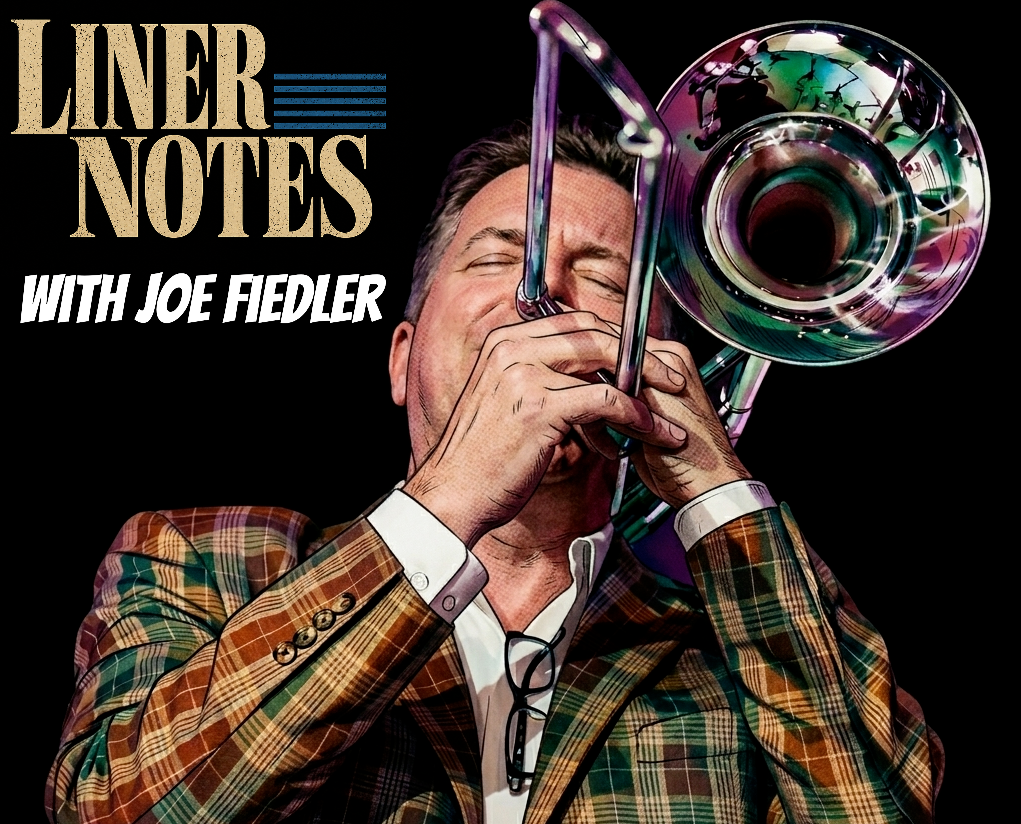
“Liner Notes” is a Sounds Visual Media spinoff series where musicians, composers, DJs, beatmakers, and collectors dig into their crates to share favorite records. In this installment, Joe Fiedler discusses his latest album “Journey to Bowerbird”, a project that blends “New Music” classical complexity with avant-garde jazz, and traces his artistic lineage back to the blues-inflected techniques of Ray Anderson, the rhythmic momentum of the World Saxophone Quartet, and the multi-phonic innovations of Albert Mangelsdorff.
Joe Fiedler: I’m here to talk about the latest recording from my group, Big Sackbut. This is our fourth recording and my 15th overall as a bandleader, which is a milestone that’s honestly hard to believe. The new album is titled Journey to Bowerbird, and it will be released on May 15th via Multiphonics Music.
Originally, Big Sackbut was conceived as my “trombonistic” answer to the World Saxophone Quartet, which is one of my all-time favorite jazz groups. While the original lineup consisted of three trombones and a tuba, I’ve augmented the group for this record with a drummer/percussionist to introduce a different kind of momentum and energy. The ensemble features myself, Ryan Keberle, and Luis Bonilla on trombones, the great Marcus Rojas on tuba, and for this session, the incredible Satoshi Takeishi on drums.
Track Spotlight: “Journey to Bowerbird”
The title track has quite a backstory. About a year ago, the legendary bass trombonist Dave Taylor called me to perform a brass quintet piece at a festival in Philadelphia celebrating the music of composer Lucia Dlugoszewski. I hadn’t actually heard of her at the time, but Dave—who has always been a friend and mentor—convinced me to join.
A few days later, he sent the music. To be frank, it was the hardest music I have ever seen. I’ve played a lot of difficult “new music,” avant-garde classical, and outside jazz, but as I dug into this piece, I realized I was in a jam. After two weeks, I wasn’t making any progress. I almost called Dave to quit, but then I realized: Dave could have called any trombone player on the planet, and he chose me.
I ended up practicing that one nine-minute piece for four hours a day for three months just to get it up to speed. It was a transformative experience. I became calmer and more patient, and my playing grew in directions I didn’t see coming. Once the festival ended, I was so “jacked up” that I immediately started writing music modeled loosely after Lucia’s style—leaning toward a “New Music” classical feel while still incorporating improvisation. I eventually rearranged that material for Big Sackbut, and I’m thrilled with how it showcases classical orchestration within a jazz scenario.
Track Spotlight: “Portrait of Tito Matos”
This piece is a tribute to Tito Matos, a dear friend and bandleader who sadly passed away way too young a few years ago. I met Tito in New York in the ’90s. He was from Puerto Rico and led a band called Viento de Agua, which fused Bomba and Plena (indigenous Puerto Rican rhythms) with Songo and Jazz. That group was vital to my formative years.
When he passed, I considered doing an entire tribute record. “Portrait of Tito Matos” features the Bomba rhythm—a powerful, hypnotic beat. Since Tito was an adventurer who played both “inside” and “outside,” I wanted the song to reflect that balance. It features a solo by Luis Bonilla over traditional Latin chord changes, followed by an interlude leading into my solo over an open pedal point for a freer, more avant-garde feel.
Track Spotlight: “Elements of Know”
This is another Bomba, though the rhythm is more disguised than in the tribute to Tito. It has a “floaty” feel with less overt Latin phrasing. I focused on shifting textures and orchestrations, utilizing mutes and extended techniques. There is even a section of solo trombone featuring multi-phonics. Having released an entirely solo trombone record a few years ago, I’ve been looking for ways to integrate those solo moments into my ensemble compositions.
Sounds Visual: Let’s pull a few highlights from the crates. If you had to pick the records that best define your internal compass, what are we pulling out?
DF: Ray Anderson, Blues Bred in the Bone (Enja, 1988). Ray Anderson is my hero of heroes. In the ’80s, I was driving home late at night in Pittsburgh and heard him on the radio. I was so hypnotized I had to pull off the highway just to make sure I didn’t miss the announcer identifying him. Blues Bred in the Bone is a powerhouse record featuring John Scofield and John Vidacovich. Ray’s ability to take avant-garde extended techniques and place them into familiar, blues-based forms provided the template for my entire career.
World Saxophone Quartet, Live in Zurich (Black Saint, 1984). As I mentioned, this group was the impetus for Big Sackbut. Live in Zurich blew my mind. The idea that four instrumentalists—David Murray, Julius Hemphill, Oliver Lake, and Hamiet Bluiett—could create that much momentum without a rhythm section was staggering. They were four powerful leaders with no egos, all pushing in the same direction with incredible abandon.
Don Pullen & George Adams, Live at the Village Vanguard (Soul Note, 1983). If Ray Anderson is my trombone hero, pianist Don Pullen is my favorite jazz musician of all time. I discovered the Don Pullen/George Adams Quartet through my love of Charles Mingus. Their Live at the Village Vanguard albums showed me how to be completely “outside” while remaining within the form of a traditional tune. Don’t even get me started on George Adams—his four-octave range and sheer power were a masterclass in individual language.
Eddie Palmieri, Mozambique (Tico, 1966). I spent 19 years in Eddie’s band, touring the world. Mozambique features his early group, La Perfecta, which used a unique frontline of two trombones and flute. One of those trombonists was Barry Rogers, arguably the greatest Latin trombone soloist ever. When I first joined Eddie, we played songs from this record like “Sujétate La Lengua.” It felt like being called by Miles Davis to play songs from Kind of Blue.
Bill Frisell, This Land (Elektra Nonsuch, 1994). I’ve always been drawn to Bill because he is a “searcher.” This Land features a unique sextet with Billy Drewes, Don Byron, and Curtis Fowlkes—a frontline of soprano sax, clarinet, and trombone. The way Bill orchestrates those voices using “rubs” (half-step intervals) is hauntingly beautiful. It’s a masterclass in patience and texture that often inspires my own writing for Big Sackbut.
Albert Mangelsdorff, Purity (Mood Records, 1990). Finally, I have to include the great German trombonist Albert Mangelsdorff. His solo record Purity changed the way I thought about the instrument. He was a pioneer of multi-phonics—the ability to sing one note while playing another to create chords. He blazed a trail for monophonic instruments to perform solo, and my own solo work is deeply indebted to the path he started 50 years ago.
Leave a Reply
You must be logged in to post a comment.