
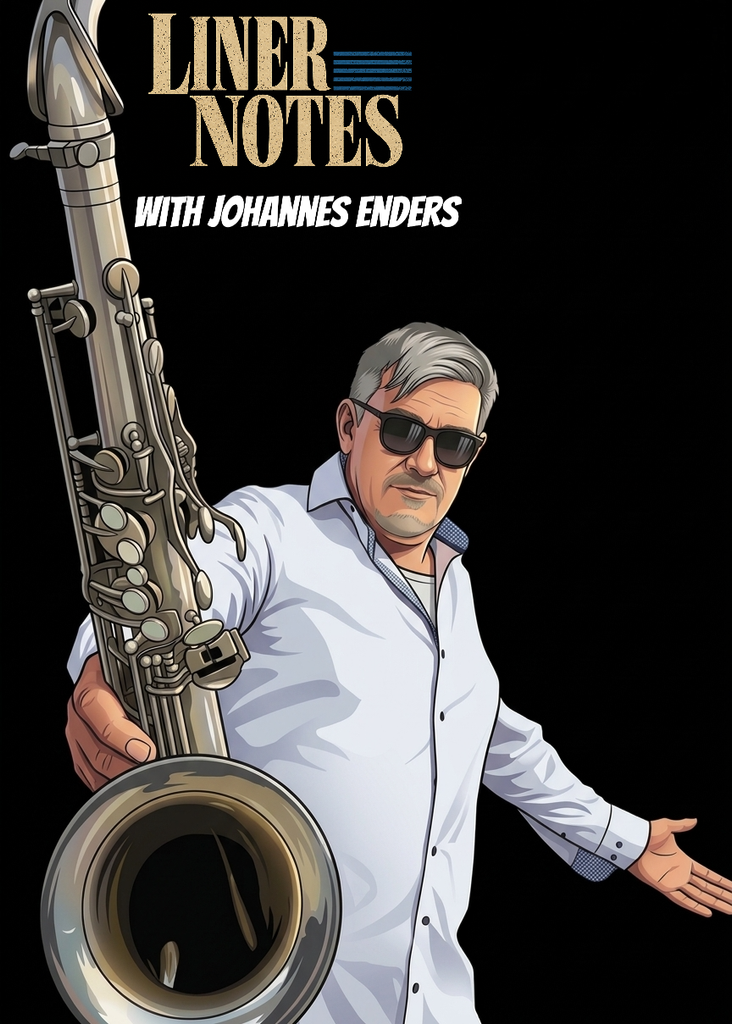
“Liner Notes” is a Sounds Visual Media spinoff series where musicians, composers, DJs, beatmakers, and collectors dig into their crates to share favorite records. In this installment, saxophonist Johannes Enders talks about his new album, Phantom Happiness, where he leads an international quartet through a versatile program of evocative originals ranging from reflective ballads and homage to Wayne Shorter to gospel-tinged blues and funk. He also shares some of his favorite LP’s by Wayne Shorter and Stan Getz.
___
Hi, my name is Johannes Enders. I’m a saxophonist, composer, and teacher from Germany.
I started playing saxophone when I was about 14, listening to Earth, Wind & Fire, soul music, funk, James Brown, Stevie Wonder. That led into listening to fusion — Weather Report, Steps Ahead, the Brecker Brothers, that kind of stuff — which led me to more “serious” jazz: John Coltrane, Charlie Parker, Wayne Shorter, and all those beautiful recordings from the ’60s, all the Blue Note stuff. I just got addicted to that kind of music.
Biographically — when I finished school, I went on to study in Graz, Austria, at the university. Back then, Cologne and Graz were the only real options for studying jazz in the German-speaking countries. In Graz, I had the chance to meet all kinds of great and amazing musicians passing through — Dave Liebman, Jerry Bergonzi–who was a big thing for me–Kenny Washington, Horace Parlan, and Reggie Workman, who ended up helping me get a scholarship at the New School.
My long-term dream was to move to New York, the capital of jazz. I got that scholarship at the New School, and that opened the door for me to move there and study with the greats and legends — Vincent Herring, Donald Byrd, Jimmy Cobb, Joe Chambers — all these guys were teaching at the New School at the time. I also got to be around fellow students like Brad Mehldau, Chris Potter, Roy Hargrove, Peter Bernstein, Larry Goldings. It was kind of a jazz paradise. Hanging out in the city all night long — Augie’s, Sweet Basil, Visiones, Fat Tuesday’s, Bradley’s, and so on. It was a paradise for me as a young up-and-coming saxophonist.
But at some point, since I was playing much more in Europe, I moved back after two years and settled in Munich. I played a lot of studio dates, became an ENJA recording artist — which I still am — and eventually became a professor at the Mendelssohn Bartholdy University in Leipzig, where I still teach. I keep touring in Europe mainly, and I’m just about to put out a new album on ENJA called Phantom Happiness, with a new quartet: the great pianist Rainer Böhm from Cologne, the amazing bassist Doug Weiss, who moved to Germany a couple of years ago, and the wonderful Jonas Burgwinkel on drums.
We recorded all original material about a year ago, and I’m really happy with how it turned out. We’ll be on tour in November — I hope at some point I can play some gigs in the U.S. too.
Track Spotlight: “Phantom Happiness”
“Phantom Happiness” is a tune about that feeling when you get flashbacks of happiness — an old, really old feeling, maybe from childhood, or from when you were a teenager — and you think, “Wow, I forgot this feeling.” For a couple of seconds, you’re really happy that you had it again.
Track Spotlight: “Destination Peace”
“Destination Peace” is about the longing for peace in the world. There’s so much turmoil right now, and as a musician, that’s the only thing you can really do — put some positive energy out into the world. That’s what I try to do when I play concerts: give the audience a feeling that, for an hour or two, they can forget about all this turmoil.
Sounds Visual: If you were pulling a few records from your crate that really defined your path as a listener, which ones would you put on?
JA: Definitely A Love Supreme. (Impulse!, 1965)
Then there are so many Stan Getz records — I love all of them, honestly, but The Master (Columbia, recorded 1975, released 1982), with Billy Hart, is probably my favorite. I’ve had the chance to play quite a bit with Billy Hart myself.
I’m a huge Stan Getz fan, and all the stuff with Wayne Shorter, for sure — Adam’s Apple (Blue Note, 1967) comes to mind, with Joe Chambers on drums.
And everything Miles did with Gil Evans, especially Birth of the Cool and Sketches of Spain.
Leave a Reply
You must be logged in to post a comment.