

Describing his creative process as a “cobbler” of sounds, Miles Newbold explains that rather than being a traditional musician who reads or writes music fluently, he instead finds musical shapes and forces or collages them into unusual sonic places to create the Natural Yogurt Band’s distinctive, anarchic style.
__
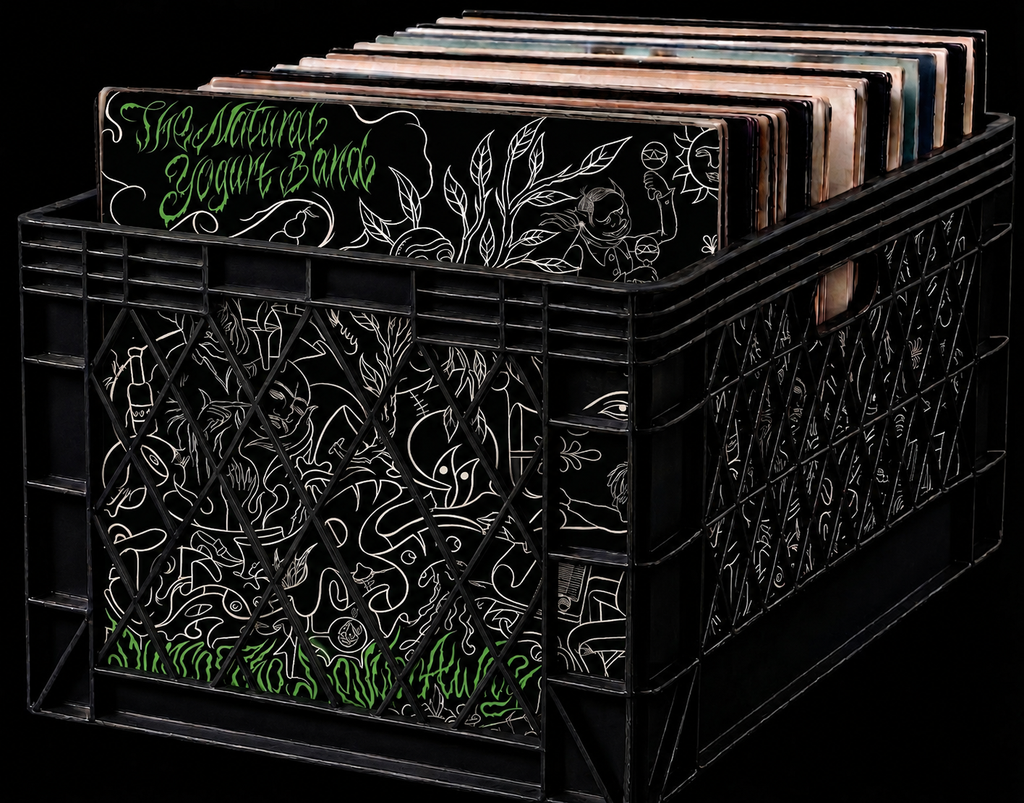
The Natural Yogurt Band is a mysterious UK-based project led by composer Miles Newbold, channeling the vintage, cinematic brilliance of legends like Galt MacDermot, David Axelrod, and Ennio Morricone. The group crafts psychedelic, beat-heavy library music by effortlessly lacing 1970s-inspired jazz fusion with modern hip-hop sensibilities, capturing that nostalgic spark across acclaimed releases like Away With Melancholy (2009), Tuck In With… (2011), and Parasol (2026).
___
Sounds Visual: You’ve described yourself as a “cobbler” of sounds rather than a traditional musician. What does that philosophy mean in practice, and how has it shaped the way you’ve built the Natural Yogurt Band?
Miles Newbold: In the sense that I am not a true musician, one that can read and write music well, or even play one instrument competently. Instead, what I tend to do is find a shape musically,whatever instrument that may be on and trim the edges, or force it to fit into a sonic hole, or stick it onto an existing background like a collage that perhaps it shouldnt really fit in–but somehow and sometimes it works. Perhaps this is why my music sometimes has a disjointed and anarchic outcome! [Laughs]
SV: You seem deliberately detached from modern musical trends. Is that distance a conscious choice to protect your own creative voice, or simply a reflection of what genuinely inspires you?
MN: I rarely listen to music and am not in touch with much modern music, not because I have any opinion about it–its just that I’m usually making it, or at least practicing, fixing equipment or busy doing other things.
SV: When you begin a new Natural Yogurt Band piece, what usually comes first—a groove, a melody, a texture, an image—or is every track different? At what point do you know you’ve found the song?
MN: There is usually no exact method and refering back to my answer in your first question might help explain somewhat as to the process, or lack of it, involved. I might start with a groove, or a bassline,or a drum pattern, or just a texture to suggest something and that might be the background. Then I might apply something more theoretical on a keyboard, or just a texture on a synth, whatever I think it needs and this might be where I force my sometimes odd ideas into unusual places. Eventually I think there comes a time when you realise that it is finished, or at least you cant go any further without it turning into something else that I might not like as much.
SV: Your music feels meticulously arranged while still sounding loose and spontaneous. How do you balance composition with improvisation without losing that sense of discovery?
MN: I do try to keep some elements improvised to a degree–you see, in my imaginary, fantasy mind, I’m a jazz musician and after studying it and playing music for so long I pretend to myself that im capable of doing it…but the truth is that in the real world I am of an amateur standard and I’m usually trying to run musically when I should be concentrating on walking properly. [laughs]
SV: Your records often blend library music, jazz, funk, psychedelia, soundtrack music and vintage pop into something completely cohesive. Do you consciously think about genres while writing, or do you simply follow whatever serves the piece?
MN: I never think about being in a certain genre, or trying to emulate anyone else conciously. I just do what I feel is right–I never think about what you might like, just what I want to do. The instruments and equipment I use contributes alot to the sound of yesteryear–for example, playing an old Hammond B3 or an old Minimoog will sound more dated, because they are! Likewise, recording onto a good tape machine,with good tape will help create the sense of a different time.
SV: The Natural Yogurt Band has such a distinctive analogue warmth. How much of that comes from the instruments themselves, and how much comes from your approach to recording and producing at The Chicken Shack?
MN: Well, the instruments are real and the equipment is too. Not software or virtual stuff, It’s all real. This makes a huge difference to the overall sound. I do use a computer from time to time and they are certainly good for editing, but the temptation is when recording on a computer is to fix it after you’ve recorded your efforts–but this doesnt make you a better musician, which is what I want to be. It just makes you better at editing on a computer.
As for my recording technique–well its pretty simple really, no fancy mic configurations, or ridiculous amounts of mics on drums, I mean, why do people put mics on top and bottom of toms and snare–totally uneccesary! We don’t do that with a piano, do we?
SV: You’ve spoken about learning through tape manipulation, bouncing tracks, and experimentation. What have those early limitations taught you that modern recording technology still can’t replace?
MN: Like I mentioned before, the recording process in my eyes and for my music is kept as simple as possible, or at least I try too. As an example, recording onto a 4 track reel to reel limits options, as it forces me into commiting ideas to tape after conscious thoughts on arrangements, instrumentation etc, rather than opening up countless channels on a computer and just smashing out ideas here and there in a desperate hope to find something that suits the need.
Apart from that, there is the width of sound within the stereo field when recording onto a good tape machine. It’s incredible, but computers lack this and seem very narrow and thin sounding, almost 2 dimensional instead of 3 dimensional, llike tape.
SV: Many listeners assume they’re hearing samples, even though so much is performed live. Is capturing that authentic “found soundtrack” aesthetic still central to the project?
MN: No samples at all. I don’t on purpose try to make the sound vintage or old fashioned in any way. The instruments and equipment do that for me to a degree. It doesn’t sound old to me–perhaps I’m just used to it.
SV: Beyond jazz, what artists, records, films, or even childhood memories have had the biggest influence on the Natural Yogurt Band’s sound?
MN: When Electro came out and early hip hop, like Grandmaster Flash, Roxanne Shante, The Real Roxanne, Captain Rock, Afrika Bambaata and then Biz Markie, etc. For me, that was a real head turner and opened up electronic music, scratching and sampling in a really big way for me! That was the start of drum machines and synths and my love for them.
SV: The project has evolved from its early, almost chaotic beginnings into collaborations with musicians like Neil Tolliday and Catherine Bellhouse. How has your role changed as the band has grown, and what do collaborators bring that you couldn’t achieve alone?
MN: It’s mainly myself that plays all the instruments, but sometimes I may call somebody in if I want it done properly! Tom Dempsey played drums on “Dance the Devil Away” and I’m very glad he did, too.
SV: Your music communicates a lot without lyrics. What do you hope people feel—or imagine—when they listen to a Natural Yogurt Band record?
MN: I don’t really think about what other people will think or feel. I wouldn’t make my music sound more commercial on purpose just to help sell records or get in with a publishing company. It is what it is I suppose.
SV: Your arrangements often leave plenty of room for silence and restraint. Do you think knowing what not to play is just as important as knowing what to play?
MN: Absolutely, leaving room is as important as the melodies themselves. I’m often trying to restrain myself from overplaying. Thinking of the entire arrangement and instrumentation is crucial to making music work well.
SV: You’ve said you rarely dwell on finished music and prefer moving straight to the next idea. Looking back, what do you think has changed most about your approach since the first Natural Yogurt Band records?
MN: I think I still have the same slightly haphazard way of making a track, but the recording techinques and sound have changed more than anything–hopefully for the better! [Laughs]
SV: Where do you see the Natural Yogurt Band heading next? Are there sounds, instruments or ideas you’ve yet to explore that still excite you?
MN: I would like to experiment more with electronic music, but as a textural idea rather than a rhythmic one, possibly creating a sense of physical movement–as well as tape loops too–creating sounds that you can’t recognize, or really know where they have come from originally.
Listen to/purchase music from the Natural Yogurt Band here.
Leave a Reply
You must be logged in to post a comment.