
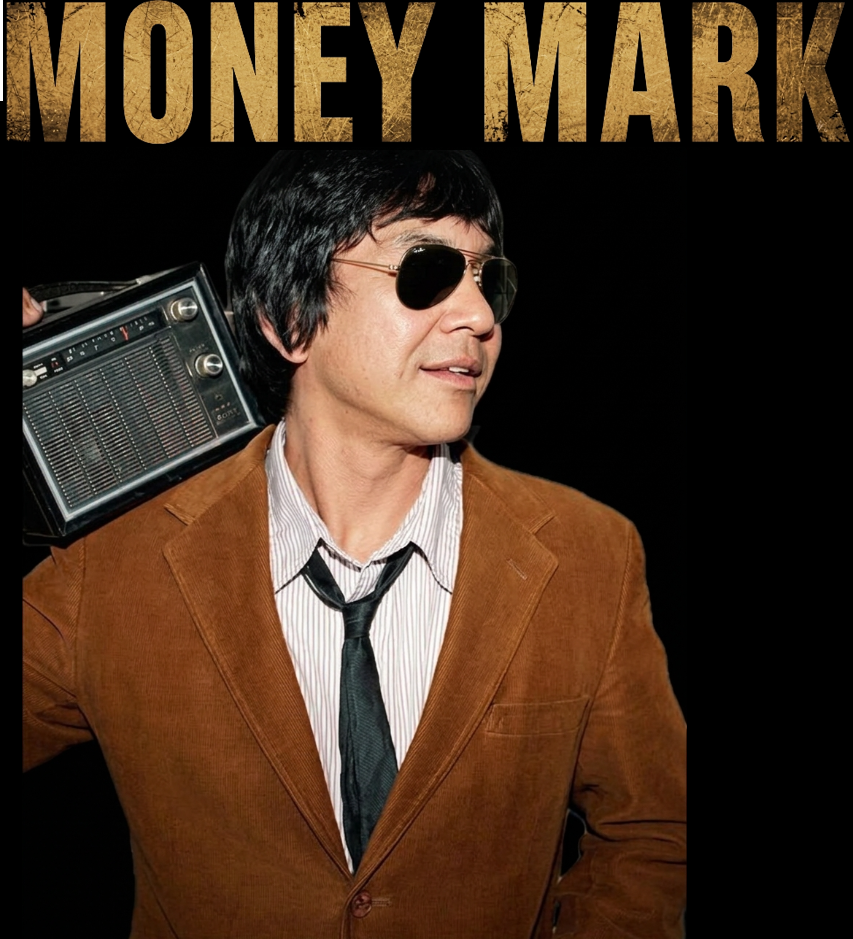
A candid, wide-ranging conversation with Money Mark as he traces his creative philosophy—from the raw, unedited production of Keyboard Repair to Brill Building songcraft, custom circuitry, and film scoring. Through it all, he returns to one core belief: above all else, good music has to carry love in it.
___
Born Mark Ramos Nishita in Detroit to a Japanese-Hawaiian father and Chicana mother, Money Mark spent his childhood in Los Angeles before embarking on a career as a carpenter and musician. He became a core collaborator for the Beastie Boys after meeting them in the early 1990s, going on to co-write, perform, and contribute keyboard work across every studio album from Check Your Head to Hot Sauce Committee Part Two. Beyond his signature work with the group, his versatile musicianship has shaped recordings for diverse icons including Beck, the Red Hot Chili Peppers, the Mars Volta, and Atarashii Gakko.
___
Sounds Visual: You once described creativity as having to make your own ice cream because all the obvious options were already taken. Does that instinct still drive you or is it evolved now that you’re more an established artist?
Money Mark: That’s just part of my DNA; I don’t even think about it. I’m either doing it, or I’m not. There are so many amazing things that exist right now, and because my father taught me the mechanics of how these instruments actually work, I have a true measurement of what’s happening—from how my brain and motor functions connect to how my fingers hit the keys, strings, or drums. I know what’s going on, and that is liberating.
I think more musicians—especially young ones—should have more education on that side of things. When I look at social media, I see young people who are really hungry for that kind of depth. When they discover an album or an artist they admire, they go deep into it, and that’s cool.
There’s a kid in the Netherlands who invented this whole world of surf-sounding keyboards. He’s 22 years old and an absolute genius—a real instrument maker. I reached out and made friends with him, sent him some money, and took a chance on him. He sent me the instrument, and it’s killer; I’ve told everybody about it. That’s just how it works: when you work at a high level and you stay curious, wanting to be as original as possible, that’s what happens.
SV: I also really like the way that you were describing songs as kind of buildings where texture provides color and melody, and melody carries the emotional story. How do you know when a texture is helping the narrative kind of versus distracting from it?
MM: When you have good teachers—let’s say they’re teaching upright bass—they don’t just teach you the notes. They explain how the instrument works, even if you didn’t build it. It’s the same way my father taught me about the electronic shift. When you understand how a bass works, you play better. To me, it all starts with the ability to control and create your tone, whether you’re collaborating with the instrument maker or just pulling a variety of sounds out of the gear yourself.
Some of my favorite songs are just one key—they’re drones. Look at ‘Sabotage,’ or Sly Stone’s ‘Everyday People’—that’s just one note. If you’re only going to play one note, you have to make sure that tone is really good. If you play two notes, it’s gotta be good. If you play three, the tone has to be there.
Does that philosophy ever end? No. The tone is the most important thing. You have to go out there and hit people with emotion. That’s really what we’re talking about—the emotional connection you’re making with the audience. Beyond all the technical stuff, which is important, the emotion might be the most important thing of all. Think about when you’re a baby and your parents are interacting with you: there’s no technique there, just love. That translates directly into emotion, and in music, that might be the most important thing you can offer.
SV: You famously met the Beastie Boys while working as their carpenter, hired to fix a gate. Looking back, how did that outsider perspective—as a tradesman rather than a music-industry insider—influence what you brought to Check Your Head?
MM: It really comes down to my personality—or perhaps my hyper-awareness. It’s evolved into this way of being that carries over into music, jazz, and how I navigate the world. Growing up as an outsider—what they might call ‘neurodivergent’ now—you had to be hyper-aware just to survive. Because of that, I’m super sensitive to everything. I read rooms and people instantly. I’m only doing this interview because I got a [good] vibe after we conntected.
Take the Beastie Boys situation: I was a fly on the wall for a long time. Because of that awareness, I’d only speak up if things were going off the rails. If I saw the ship heading toward a storm, I’d say, ‘Hey guys, we need to go this way.’ And there was never any argument. I wasn’t trying to put myself out there as the leader—because Adam Yauch was the leader—but he listened to me. There were moments when he’d take me aside, and it was always about that deep connection.
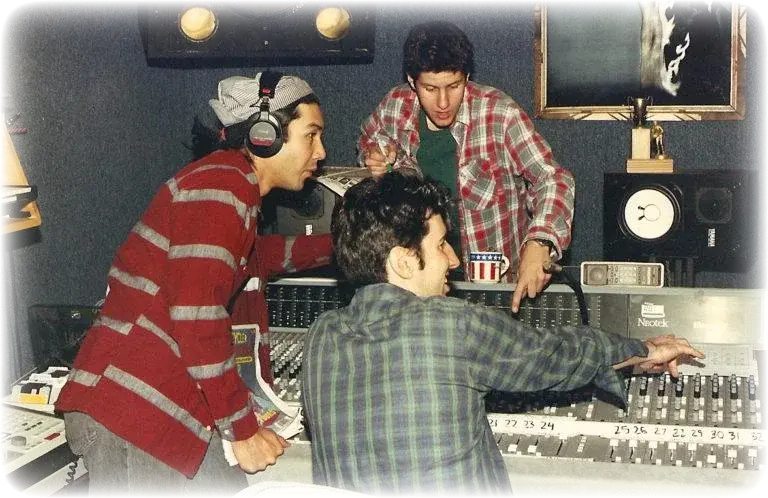
Above: Money Mark, Mario C., and Mike D.
A lot of our conversations were about me growing up as an activist, which for me, was about survival. He was always very sympathetic to that. I spent my time reading books—Angela Davis, Kwame Ture—because that was my survival manual.
Being an outsider in those spaces is its own kind of education. There are unwritten rules when you’re in those rooms: don’t talk too much, don’t try to be the leader, just notice everything. That’s how I’ve survived in every situation I’ve been in. Like when I ended up in the Plastic Ono Band—Yoko just looked at me and said, ‘You’re the dude. You’re going to play the piano, and you’re going to play my song.’ And that was that—I just got to work. [Money Mark performed and recorded as a member of Yoko Ono’s live iteration of the Plastic Ono Band during her late-2000s and 2010s reunion shows.]
SV: Being a fly on the wall requires some empathy and adaptation–that’s very Daoist.
MM: Absolutely. And that hyper-awareness isn’t just a survival mechanism; it’s a tool that can actually change the things around you. Time is your friend in that regard, because as the years go by, people look back and wonder, ‘Wow, how did that happen? That was extraordinarily good.’
When they eventually dive into the story, they realize there was this unseen force behind it. It’s a bit deep, but it mimics the ‘unseen hand’ of how society actually functions—how those who govern or influence things behind the scenes operate. They don’t draw attention to themselves; they do it quietly, almost invisibly. I feel a certain kinship with that way of operating. It’s a power that can be used for good.
Above: A classic instrumental featuring Money Mark’s keyboards.
I feel that same kinship with J Dilla. I was on that bus when we all met him—it was a chaotic, polluted scene, but being a fly on the wall through it all? That was my jam. That was always where I felt at home.
SV: You’ve talked about using a 20-minute timer as a creative tool. How do you reconcile that structure with your more intuitive, feeling-based approach to making music?
MM: My mother came from a family of musicians, so that’s where I got the music. But my father felt left out—he wasn’t a player, but he was a technician who understood electronics. He figured out how to be a part of it by mastering the gear and the recordings. Because of them, I’ve always been able to flex between emotion, subjectivity, and objectivity. It’s a long-learned trick, but it keeps you safe. When I’m in a room writing with someone, I can feel if we need to lean into the soul or the technical side, and I know how to sneak those elements in to build something that hits on every level.
One of the most important experiences of my life was being called into the Rolling Stones’ sessions—not to play, just to be in the room. I was there with guys like Jim Keltner, and I was just there to hold space, maybe crack a joke, or offer an idea if things stalled.
One day, I got to the studio early, and Mick Jagger was there. We hadn’t talked much, but he asked me to show him some stuff on the piano. I played a little bit, and he liked it. Then he sat down and played, and he had this amazing rhythm. His assistant came in and told him he had a phone call, so he got up, patted me on the back, and said, ‘Sounds good, man. Remember: it’s only about three things.’
He pointed to his head, his heart, and his crotch. ‘It’s only about those three things.’
I use that as a barometer for everything now. I’m not picking on anyone, but sometimes you hear music that has plenty of brain and heart, but it’s missing that third element. When you find something that has all three, that’s when it’s undeniable.
People ask me how I move between these different creative states, and it comes down to that. It’s those three things—and sometimes four, five, or six. When I hear Sonny Rollins talk about his music, I’m right there with him. When I hear Robert Fripp, I’m walking down that same road. I’m walking down all these different paths, and the beauty of it is that I can switch between them whenever I want.
SV: I want to ask about is the unfinished aesthetic of Mark’s Keyboard Repair. The raw, demo-like feel of that record is one of the things I love about it. Was that a deliberate artistic choice, or simply the most honest way to document those moments?
MM: Basically, those tracks were done on a four-track — some on an eight-track cassette. My son had just been born, and I was living in an apartment with my wife. The walls were paper-thin, so I couldn’t play or record loud. I’d have to quit by 5 p.m. and start around noon. I’d get knocks on the door: “Hey, turn it down.” That’s why it’s so subdued.
There was also something I’d read in Rick Rubin’s book about being influenced by Wong Kar-wai‘s films — I wanted to do no editing. So if a song took nine minutes to make and was going to end up three minutes long, I’d do one pass and not go back over it. I think that’s part of what people respond to — it’s charming to hear someone just make something and move forward, with all these little imperfections that I don’t really think of as imperfections.
Some of that was defiance, honestly. A lot of things were so slick at that moment — it was the height of Spielberg-style production. Those movies are great, but they’re very slick. Once people got hold of DAWs — the digital way to record — a lot of the feeling started to go missing from songs, in my opinion. So I just kept working the way I was working.
Yoko Ono put that record on her top-ten list that year, in Rolling Stone. Because of that, Sean reached out to me. He told me Yoko loved the album, and that John would have liked one particular song — “I’ve Got My Hand in Your Head.” She asked me to rerecord it with her son playing bass. I think maybe it was her looking out for Sean, trying to get him a gig.
So we went in and recorded it: Russell Simins from the Jon Spencer Blues Explosion played drums, I played the Wurlitzer, and Sean played bass. That became a new version of the song, which ended up on the Pushing the Button album. If you look at the credits, it lists the original as my copyright — so in a way, that defined the Keyboard Repair version as the demo, and the new one as the “real” version.
SV: You’ve described songs as “little worlds that explode in your head.” Looking across your catalog, do you think those worlds share a common DNA, or is every album its own universe with its own rules?
MM: That’s a good question. I believe every good song has its own universe — and I say “good song” because I think anyone can tell what a good song is. It has a kind of mystery to it, like the mystery of the universe. Even a short song, two minutes long, can hold so much. You can listen to it over and over.
That’s magical to me. Most things you glance at and move on from — unless it’s your kids, or a beautiful photograph. But some things stay with you, and you can look at them again and again. It’s the same with a good song — there’s a world in there. A great photo has so many things to notice, and even over time you keep seeing something new. “Oh, I didn’t notice that when I was eleven.” That’s the kind of song I mean.
So I get this little world in my head, and I know it’s going to be good while it’s still just in my head. Then I find a starting point — and that’s the exciting part, figuring out how to begin. A lot of people start with a beat, a bassline, or chords. Stevie Wonder would play the keyboard part first, then the drums second, because he already knew the groove — nobody else could have played drums on that keyboard part the way he did, because he knew exactly where the feeling was.
That’s exciting to me — the story of the rhythm running through a song. Sometimes, if I know a song is going to be good, I’ll go out of my way to find a starting point. I’ve set a fan next to Venetian blinds and waited for the string to hit the blinds, then recorded that as my click track — trying to make the process of recording exciting for myself, rather than just working off a grid. If you listen to Keyboard Repair, or a lot of my records, it’s just me playing, and I wanted that experience to be exciting.
Other times the starting point was guitar feedback — set the guitar up next to the amp, get the feedback going, and that becomes my pitch reference. It wouldn’t necessarily be tuned to 440, but it would be something, and I’d start there. All those starting points were exciting for me.
SV: You’ve compared songwriting to engineering, using texture as color and melody as the story. How do you know when a texture is enhancing the narrative versus distracting from it?
MM: A lot of that comes from studying Brill Building songwriters. When I think about song architecture, I think of the Brill Building writers — if you could read sheet music, you could look at a score and immediately tell, “This is an amazing song,” just from how it’s built. You’d see a drop-two chord voicing in one section, and think, that’s going to lead into the next part where the chord adds an eleventh it didn’t need the first time — but by the end, the finale demands it.
Sheet music is basically just the piano part unless you’re looking at a full score. So you imagine: does this need that? Take a tambourine — they’re all over those old Brill Building songs. I have seventeen or eighteen tambourines, because maybe one section needs a smaller tambourine and another needs a bigger one. I’d love for a section to be just tambourine and piano, but I know another texture is coming to add to the story. If the song is a world, this drum fill coming out of the chorus, or that ride cymbal in the bridge, is going to add to it.
There’s a moment when you realize, “We don’t need that cowbell.” I’d rather stop short than overfill it and have to take things away — I try to know when to stop.
Here’s another way to think about it: imagine a cube — a two-dimensional drawing of one. You can’t see it without light, and if there’s light, there’s a shadow. That shadow is the texture, because the cube only comes alive with a shadow. At high noon, there’s no shadow — you’re just looking at the shape. As the day goes on, the shadow gets longer, and there’s a point where it looks beautiful — a tree in the background starts to blend into that angular shape, or a telephone pole does. Go too far and it’s all just straight lines. But somewhere in between, that’s the moment — like flowers casting a shadow that bounces perfectly on a kitchen wall. Sometimes it’s the angularity, or an unexpected flourish — a technical trick or a gadget.
SV: How do you decide when a technical trick–that angularity– or even a gadget is just a gimmick, versus something worth pursuing for the sake of the song?
MM: Back in the day we loved Eddie Harris, because he was such a weirdo — a lot of his contemporaries didn’t care for him as much, but we loved that rawness, along with Rahsaan Roland Kirk. Harris played through that reed-and-mouthpiece box for saxophone, and it’s like — the song was already good, but then he played through that thing, and it became something else entirely.
I think what you’re getting at is similar to how Auto-Tune got overused — early on, artists like Lil Wayne or T-Pain made it their whole sound. That’s a different kind of thing, almost entrepreneurial — which we haven’t even talked about, and I go by the nickname “Muddy Mark” for that reason. Sometimes I just wanted a good song and used whatever tools were in front of me. People would call something “just a toy” — but go back to Bill Evans or Herbie Hancock, who resisted Miles’s idea of playing the electric piano at first. People said it was just a toy. But that’s the sound, and he could hear it.
A lot of what we’re talking about comes down to happy accidents — songs sitting in the vault, then someone adds a violin solo, or a woman sings an opera part on a Pink Floyd song and never gets paid for it. Without that addition, it’s not the same song. Who would have thought?
SV: Whether it’s the Echolodeon or salvaged electronics, what draws you to obsolete machines? Is it the imperfections, the history, or something deeper?
MM: I’m actually not drawn to obsolete machines — in my head, everything is high-fidelity if it does something amazing. I don’t fetishize the original voice or try to imagine what the original inventor was thinking. Take the piano roll — there were so many contributors over a hundred years, starting maybe with your card-punch systems, and I don’t even believe any single person did it all themselves.
What draws me in is getting inside the brains of people like Bob Moog. His daughter showed me some of his original schematics, and I thought, “You knew exactly when this capacitor was going to discharge, and that this would trigger that.” The only reason he figured that out was curiosity — and that’s what stuck with me.
So it’s really about curiosity. I’m not chasing a clone, because a clone is just marketing. I’m interested in what someone could actually do with a 555 timer chip — there are thousands of applications for that one chip: an oscillator, a light sensor that turns lights on at dusk, whatever. I love the idea of someone wiring it up and thinking, “If I put this pole to that pole, add a resistor here, now I can tune it.” I went deep on that kind of thing.
Same with when Dave Smith and the Japanese synth manufacturers developed MIDI — the idea that all these keyboards could talk to each other. How genius, and how simple: it’s basically a matrix with diodes. Someone was eventually going to figure that out.
When I got into the piano roll, I realized it’s essentially the original MIDI — some manufacturers even call it that. I bought some player pianos, took them apart, and figured out how the pneumatic amplification works: a tiny bellows, the size of your finger, moves with a small change in air pressure. That opens a valve, which lets a bigger bellows move, which makes a hammer hit the piano key. It’s amplification using air.
It’s the same principle as a float valve in a toilet tank, or the “trickle charge” indicator on a battery charger — these ideas connect in my head. So I thought: if I build a machine that detects when air is flowing through the holes in a piano roll, I can translate that into MIDI. That’s what I built. I’ve been using it with Brian Kehew on his Korla Pandit project — he found some Korla Pandit piano rolls, and we used my machine to extract MIDI performances from them. Brian also wrote a great book on George Martin’s Beatles arrangements.
So now that machine lets me find music — I found some just sitting on a shelf, put the roll on the machine, and got the performance out of it. That’s what we talked about with the Beastie Boys and other bands — using found sounds, things that weren’t being used, and putting them together. It comes down to value, authorship, and getting into other people’s brains from the past, then using that in the present moment.
SV: You’ve mentioned you’re always a student and a teacher. How do you maintain a sense of creative naivety when people might expect you to have all the answers?
MM: There are moments when you have to have all the answers — like when you have kids, you need an instant answer, at least as a starting point you can revise later. That kind of conventional knowledge matters because it can save someone’s life — knowing to move six inches to the left could matter.
But we’re not always saving lives when we’re being creative or teaching someone an instrument, or just talking about music. Here’s an example: someone once offered to shine my shoes for free on the street in Highland Park — he was trying to kickstart his shoeshine business. I asked what he was putting on the shoes, and he knew the exact ingredients of the polish, how the leather would respond, everything. I became a student of shoe shining, because I don’t know the first thing about it.
I’m a student to almost everything except music — where occasionally I get to apply that same kind of attention, especially with lyrics. If someone tells me a story, I might think, “I can use that line,” and write it down.
SV: Is there a specific habit or creative rule you’ve had to consciously unlearn recently to keep growing?
MM: When the Beastie Boys were huge and we were doing shows, I barely needed my left hand on the keyboards — just to turn a knob occasionally or do a slide across the keys. So in my off time, I had to relearn how to use my left hand as a musician.
Above: “Sabrosa” from Ill Communication; Money Mark, keyboards/co-composer.
Muscle memory is powerful — in how we speak, how we treat each other, how we parent, how we relate to our own parents. My mom is ninety-three now, and I’m taking care of her, so I’ve had to unlearn some of the ways I used to act — I can’t insist on having the only voice in the house anymore. She has the final say now, and honestly, it’s been a small blessing to have to unlearn that.
When I was making Keyboard Repair, there was a lot going on in the world — Rwanda, for one — and we were aware of it; we weren’t in our own bubble the way a lot of people were. Keeping that bigger picture in view probably made the music better.
A lot of careers depend on not having to unlearn anything — if you’re doing certain jobs, you shouldn’t need to. But other paths require constantly learning new things to keep going: figuring out MIDI, or learning FM synthesis on a DX7, which is a completely different approach than turning knobs on an analog synth — now it’s algorithms. Sometimes unlearning is really just relearning, or learning something new, not necessarily destroying what came before. Rudiments are genuinely important — maybe not for a punk musician doing something deliberately raw, but for most things, having rudiments matters. I’d even say rudiments of life — how you’re going to go about things — you learn those young. I was lucky to have parents who showed me what to do with all of it.
Unlearning, in a way, is just adding more rudiments as you get older, and you come back to the old ones with all the life experience you’ve gained. That’s beautiful, because it’s evolution — when you teach your kids what you know, they’re not just getting what you got; they’re getting what you got, plus what you’ve since learned. Then they add their own layer, and it carries on.
SV: Speaking of rudiments, specifically–that’s one of the things I love about the drummer Steve Gadd — at his core, when you really listen to what he’s doing, he’s playing rudiments. The simplest stuff there is, but it’s the funkiest stuff there is. You realize, “He’s just doing a double paradiddle” — but the way he brings it out, adding the seasoning to it, reveals a whole subtext you didn’t know was there.
MM: That’s exactly it — a lot of it is about the compositional side too. You want to become an “elder statesman” of the music, part of the lineage. Especially once you’ve studied enough and become an important musician, there’s a moment you realize people are watching and learning from you, and that comes with responsibility.
It’s also a gift when a musician knows how to teach — a lot of great musicians don’t. But some, like certain masters, love talking through what they did and why: “Now you know how my brain works.” Knowing someone’s musical “brain” lets you notice patterns — like when I was learning Stevie Wonder songs, I’d notice he leaned on certain moves a lot, then on the next record he’d pull back from them, maybe because he’d become self-conscious that those parts were becoming too recognizable, and wanted to sound different — adding more fourths here, less of a particular voicing there. It’s abstract, but real.
I’ve noticed the same thing in my own writing — my older songs leaned toward Stevie Wonder crossed with John Lennon, and now I’m writing more like Carole King crossed with Bill Withers. I love both, and getting into their brains means my brain now has these little pathways connecting both influences.
That’s the exciting part of the student-teacher relationship — when you’re a student and something finally clicks, you feel your head expand. It’s like being high, except you can always get that feeling back, because there’s always something new to learn.
SV: Let me ask a question about Yauch. Is there something about his creative process that you think the public still misunderstands, or a lesson from him that only clicked for you years later?
MM: He was an only child, and I think that shapes a person’s trajectory. Are you an only child?
SV: I am, actually.
MM: Then you can relate a little. He told me stories about how, as an only child, discipline worked differently — there’s no sibling dynamic where you’re comparing punishments. He experienced the world filtered entirely through himself, which gave him this gift of really attentive, present listening. He listened to everyone fully.
That was very different from the early media image of him — the beer-swigging, wild-eyed persona — which was mostly a media-built story. He was actually quite private. If you want more insight, there’s a podcast called Resistance Needs a Soundtrack — I did the opening theme for it. It’s hosted by Aaron Potts, his partner in the Tibetan Freedom Concert and the broader Tibetan freedom movement. It’s really her journey and how she met Adam, so I can’t speak to the specifics, but he listened extremely well and was open to a lot of ideas. He took care of his health, which makes what eventually happened especially ironic. He was also a genuinely good bass player, though I don’t think he fully realized it — he might have pursued it more if he’d had the confidence, but film was taking over his focus by then.
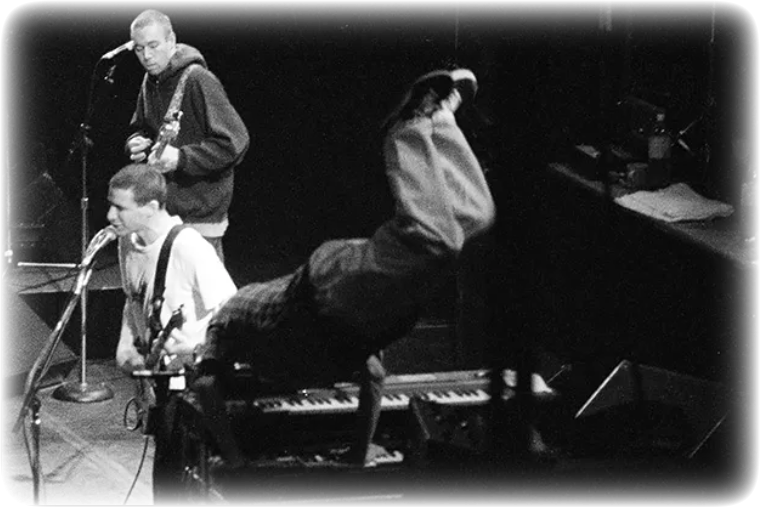
Above: Money Mark with the Beastie Boys, 1995.
SV: In terms of film scoring–I’ve read that you hold back on scoring until you’ve fully internalized the story. Can you describe the moment of clarity when you stop imitating the temp track and find the film’s actual soul?
MM: I learned a lot from a producer named Teddy [Shapiro] — let me send you something he wrote about our process on Sausage Party [pasted below]
When I first saw a rough cut of Fun With Dick and Jane, I knew I wanted to write the score in a different process than I had used before. Accustomed to writing all the music first and recording it at the end, I wanted this time to record music first and then use it as building blocks for the score.Randy Poster, the brilliant music supervisor, had cut the Money Mark track The Insects Are All Around Us into the film to great effect. Randy and I thought Mark was the ideal person to bring into the process. Mark put together a band, I wrote sketches based on a handful of scenes, and the result was something looser and fresher than what I could have achieved any other way. Those sessions provided the blueprint for the heart of the score, the part that accompanies Dick and Jane’s descent into comic depravity.— Theodore Shapiro
I used a similar approach later for Horrible Bosses — you can look up the history of that score. Both are comedies, and comedy is one of the hardest genres to score, because the music has to serve the joke rather than the narrative — you have to punch up the joke with sound. That’s probably what I meant originally when I talked about staying out of the way while still being present. That was basically my job with the Beastie Boys too — being a fly on the wall, but also controlling the rhythm in a certain sense.
When the story is already strong, you don’t need to help it much — I think of myself as ornamental. A Christmas tree is beautiful partly because of the ornaments, but it’s also beautiful because it’s a tree. Some scenes I score are already great, and my job is simply to stay out of the way.
SV: In thinking about sound as composition — do you approach environmental noise and mechanical sounds with the same compositional rigor as a traditional melody?
MM: For that one, I’d point you to Bernie Krause — I’d basically defer to whatever he’d say. He wrote about the “animal orchestra” and natural soundscapes. He was out recording bats in a field with a special microphone and picked up a strange sound — it turned out to be a cottonwood tree, so he put the microphone directly on it and recorded the tree itself. Back in the studio, he slowed the recording down, and it produced an incredible, legitimate rhythm — I’ve used that beat in my live show, playing along with a recording of a growing cottonwood tree.
So in that spirit — I found this “music,” or what some people interpret as music, in something that was simply growing. Trees make sound as they grow. Edgard Varèse said nothing of substance happens in this world without sound — anything important has a sound attached to it.
SV: Is there a sound you’re still chasing — one you’ve heard in your head but never managed to capture on a record?
MM: If you look through the Hornbostel-Sachs instrument classification system, you’ll see every acoustic instrument category except electronic ones — so those aren’t what I chase; they’re out there waiting to be built. Depending on the oscillator design — say, built around a 555 timer — it won’t necessarily be a great oscillator, but it will have a frequency, even if it lacks richness. A lot of what’s in my head simply can’t be recorded, because those particular sounds don’t exist yet as physical instruments.
The best example involves Harry Partch. His instruments are kept in a basement at UCLA — I keep meaning to visit. There used to be an experimental music program, no longer around, run by a teacher — I believe his name was Kuhn, possibly Swedish — who built enormous marimbas. The resonator boxes were something like twenty-two feet long and three feet wide, with a single hardwood bar shaped like a marimba key. There was a hole on top of the box, and when you struck it with a special mallet, it produced essentially one note — but it was so low you couldn’t really record it. You had to feel it, standing next to it; you could hear it down the block, but faintly.
That experience — an instrument so massive you’d need to gather a group of people next to it to really experience it — planted the idea for something I still want to build. In the meantime, I acquired a church pipe organ someone had installed in their home. The new buyer of the house needed it removed, and somehow the call came to me — I spent thousands of dollars moving it and it’s now in storage. It’s a modest-sized church organ, but the lowest bass pipes are still sixteen feet long: wooden ones for flute tones, metal ones for trumpet and trombone tones, plus bells and glockenspiel-type sounds. All told it was probably sixty or seventy thousand dollars’ worth of pipework, and another ten thousand just to dismantle and store it.
I found that the optimal air pressure for one note to hum properly was about six pounds per square inch. No church would ever run more pressure than that, because they want the tone sweet. But since it was sitting in my barn with my own blower, I took the pressure regulator off and cranked it up — eight, ten, twelve pounds of pressure — and these wild harmonics started coming out of the bass pipes that no one intended. I don’t know if I’ll live long enough to fully explore it, but it’s on my list.
SV: Mark, final question–when people hear your music years from now, whether it’s your solo records or your work with the Beastie Boys or other collaborators, what do you hope comes through — not just in the sound, but in the spirit behind it?
MM: Does that spirit come through to you? I think it does. A lot of people connect with Beastie Boys songs purely because of the spirit in them. It’s the same reason I love Stevie Wonder — he has huge hit songs, but also some tracks from the ’90s that are kind of cheesy, where you can tell he was chasing a hip-hop sound that wasn’t quite him and it didn’t fully land. Even so, you can hear the spirit — he was trying something, reaching for it, and there’s love in that reaching.
I hope that when someone hears something I was part of, they feel that love was involved. James Brown has some genuinely bad songs too, and people could say the same about the Beastie Boys’ later, stranger choices — I’m not sure what we were thinking sometimes — but we had fun making them, and the batting average was pretty high. Maybe I’ve always been chasing a perfect average, and that’s part of my problem. But I think the love is the most important part.
SV: Thanks so much, Mark. Really enjoyed the conversation.
MM: Thanks man.
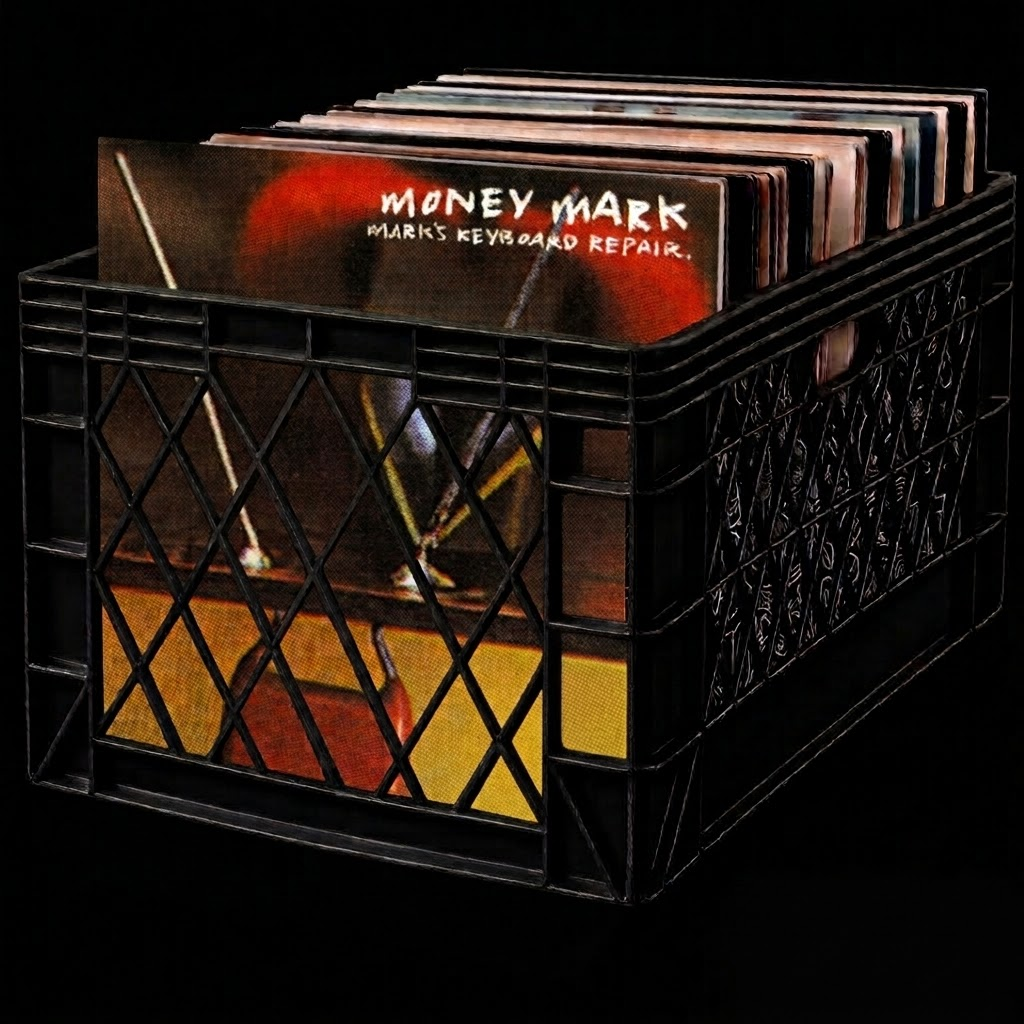
Further listening:
As leader
Mark’s Keyboard Repair (Mo’ Wax, 1995)
Push the Button (Mo’ Wax, 1998)
Mark on the Mike (Toy’s Factory, 1998)
Change Is Coming (Emperor Norton, 2001)
Father Demo Square (Rush! Production, 2005)
Brand New by Tomorrow (Brushfire, 2007)
Stand Up for Your Rice! (Rush! Production, 2007)
Songs from Studio D (Rush! Production, 2011)
As sideman
Beastie Boys Check Your Head (Capitol, 1992), Ill Communication (Capitol, 1994), The In Sound from Way Out! (Grand Royal, 1996), Hello Nasty (Capitol, 1998), The Mix-Up (Capitol, 2007), Hot Sauce Committee Part Two (Capitol, 2011)
Banyan Banyan (CyberOctave, 1997)
Danger Doom The Mouse and the Mask (Epitaph/Lex, 2005)
Omar Rodríguez-López Group Please Heat This Eventually (2006/2007), Se Dice Bisonte, No Búfalo (2007), Omar Rodriguez-Lopez & Lydia Lunch (2007), The Apocalypse Inside of an Orange (2007), Calibration (Is Pushing Luck and Key Too Far) (2007)
Big Sir Und Die Scheiße Ändert Sich Immer (2006), Before Gardens After Gardens (2012)
John Butler Trio Grand National (2007)
Hello Seahorse! Lejos. No tan Lejos (2010)
Red Hot Chili Peppers I’m With You (Warner Bros., 2011)
Boots Electric Honkey Kong (2011)
Halo Orbit Halo Orbit (2016)
The Claypool Lennon Delirium The Monolith of Phobos (ATO, 2016)
Shawn Lee & Tommy Guerrero Lord Newborn and The Magic Skulls (2009)
Joseph D’Anvers Kids (2008)
Kinky Those Girls (2009)
Mexican Dubwiser Nobody is Perfect (2018)
Atarashii Gakko! SNACKTIME (2021), AG! Calling (2024)
Leave a Reply
You must be logged in to post a comment.