
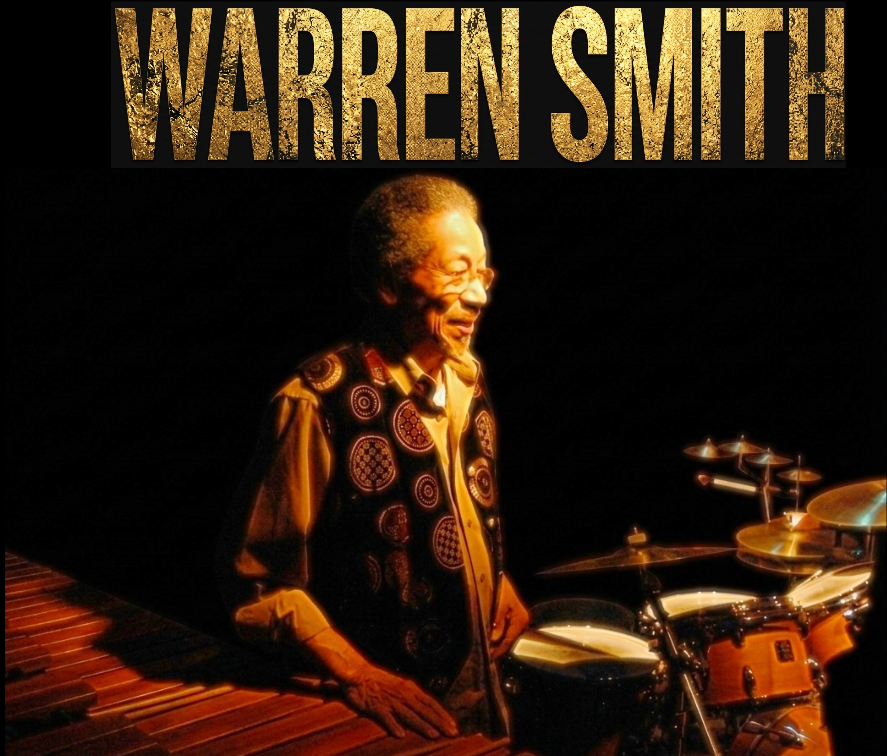
Across nine decades of music-making, Warren Smith has continually reshaped the drum set—from the melodic discoveries he first pursued on kettle drums after hours at the University of Illinois to the collective intensity of Max Roach’s M’Boom—turning percussion into an instrument capable of both thunderous force and intimate song.
___
Sounds Visual: How did growing up in a musical family with parents who played the saxophone and harp shape your musical style and career?
Warren Smith: I grew up in it. My dad was a saxophone player and my mother played the harp. She would wake up in the morning practicing—you cannot imagine how it feels; it is like you are already in heaven and still alive. Everybody in those times considered the harp a classical instrument that could only be played a certain way, yet she improvised behind whoever was singing, learning songs and chords by ear.
Above: “Impact” – Charles Tolliver | Impact (Strata-East, 1975) | — Recorded live with the Music Inc. Big Band, Warren Smith’s driving snare work and thunderous bass drum accents anchor Tolliver’s sprawling, high-energy orchestral jazz piece.
When my father was playing the saxophone, if somebody had come up with John Coltrane’s style ten years before he did, they would have been laughed out of the place: “We cannot dance to that. We cannot pat our feet to that.” Because they had not understood and been exposed to that particular style.
Her older sister was a classical pianist who played the organ in church and was the first person I ever heard try to improvise jazz on an organ. My mother’s brother was trained on the violin. My brother Frank was a much better piano player than I was before he became a visual artist and professor at Howard University. The intuition of improvisation was inside me from birth. That combination of classical training and free improvisation at home is what I carried into everything else.
Above: “Composition No. 51 (W-138)” – Anthony Braxton | Creative Orchestra Music 1976 (Arista, 1976) — Conducted by Wadada Leo Smith, Warren Smith takes to the kit on this track, grounding Braxton’s complex, modernist big-band arrangements with high-precision
SV: Since you started on saxophone every morning with your dad, do you think that makes you a melodic player at heart who just happens to play drums?
WS: Yes. The saxophone was my first instrument. That early melodic foundation never left me.
SV: Since you discovered those deep vibrations by sneaking in to experiment with the timpani after doing the cleanup work everyone else avoided, how did that physical connection shape how you hear and compose music today?
WS: At the University of Illinois I took the job nobody wanted—putting up all the percussion instruments after everybody finished. Once the building was empty, usually after the janitors left around eleven, I started experimenting because I could hear the possibilities of melody inside a kettle drum. In those days people were so restricted I could not do it during the daytime.
I found out with the timpani: you take a stick and you hit the timpani in a certain spot and it is like a dull thud with no tone at all. But then you hit the timpani near the edge and you can get a ring of a metallic sound. But there is just an inch or two in between those where you hit the timpani and you get this clear tone. These are things that you had to experiment at. Paul Price allowed me that opening. Most places were different—improvising could get you penalized—yet at home all the music was improvising. That tension shaped everything I did afterward.
Above: “Ethereal Spirits Divine” – Blue Reality Quartet | Ella’s Island (Mahakala Music, 2022) | — Joining forces with Jay Rosen to form a dynamic dual-drum engine, Warren Smith provides a fluid, inventive pulse in this chordless and bass-free quartet.
SV: Warren, since you spent your life fighting people who just wanted you to “maintain the beat” instead of treating drums as melodic, how did you help students see past those commercial restrictions and find the true musicality of the instrument?
WS: There were so many people who did not hear the drum itself as a melodic invention. Everybody you worked with was insistent that you maintain the beat—boom, boom, boom—so people could dance and sing and the music could make money. I had to put into my compositions space where musicians could use their own intuition. It took me achieving a college education and being able to teach at that level to sneak this into some of my students. The freedom I had from my family allowed me to experiment on my own; the institutional world required me to preserve that part of myself until the right people appeared.
Above: Sam Rivers – Sizzle (Impulse!, 1976) | Serving as one half of a two-drummer engine alongside Barry Altschul, Warren Smith provides a polyrhythmic, funky pulse on the kit while doubling on vibes and percussion to power Rivers’ expansive, groove-heavy loft-jazz opus.
SV: When you were playing alongside Max Roach and other strong-willed drummers, how did you manage to step outside individual egos and tap into collective listening?
WS: You are not by yourself. You grow up in a life stream. In the early days—every dance hall or entertainment—there was music particularly popular with African Americans, but everybody danced to it. Somehow a division developed between people who played symphonic classical music and people who played improvised music. With Max and the others in M’Boom we had to keep returning to that shared physical connection rather than individual display. Working with Max, who had an emotional range from gentle to volcanic, led to some real shouting matches between us. Those intense arguments ultimately strengthened the relationship and taught me a lot about resilience.
SV: Has the vital, theatrical, and intuitive side of percussion been overlooked in the way jazz history is written?
WS: Absolutely. I left room in my compositions for people to express themselves intuitively. Not many were doing that on the school level. A few composers were beginning to allow that freedom, but they were scarce and not lucrative. The instruments are age-old and carry different cultural rules. Classical music forbade improvisation while our tradition was responsive dialogue. I built that back-and-forth into the ensemble’s music.
Above: “Music is the Healing Force of the Universe” – Roy Campbell, Joe McPhee, William Parker, & Warren Smith | Tribute to Albert Ayler Live at the Dynamo (Marge, 2009) | — Warren Smith takes to the drum set to propel this explosive live free-jazz quartet tribute to Albert Ayler, recorded in Paris.
SV: Being dragged into solo performance by Ken McIntyre and leading the Composers Workshop Ensemble while balancing what a dance hall crowd needed to move: when you faced that immediate, critical crowd reaction if the music strayed too far from what they knew, how did that push-and-pull shape the way you structured the ensemble’s music?
WS: The Composers Workshop Ensemble was an example. We had to play dance music that people could dance by. But if you do some very symphonic stop music in front of a dance hall where people are dancing, they say, “What the hell is that? We cannot move to this.” They needed to have something that they were familiar with in order to respond to it that way. Those restrictions were primarily economic, yet I stayed committed to my own pieces by keeping the ensemble integrated and by refusing to let profit alone dictate the form.
Billy Harper – Capra Black (Strata-East, 1973) | Featured on the album’s elite drum roster alongside Billy Cobham and Elvin Jones, Warren Smith delivers propulsive kit work that anchors the dramatic horn arrangements on this cornerstone of the 1970s spiritual jazz movement.
SV: Looking back at Studio WIS and the New York Musicians Festival, how did keeping those spaces non-exploitative protect the different traditions you were bringing in?
WS: Just the experience of hearing all kinds of music. Certain types of music African Americans brought to the United States did not come from European aspects. Separations formed around the question: can we make money doing this? What will people in this community come out and dance to? Keeping the door open without that pressure protected the work.
Above: “Drumbutu” – Muhal Richard Abrams | Family Talk (Black Saint, 1993) — Sharing a dual-drummer and percussion engine alongside Reggie Nicholson, Warren Smith supplies aggressive drum kit patterns across this sprawling 17-minute centerpiece track.
SV: Artists like John Coltrane drew on classical training but chose to express their own culture. What made that personal cultural expression so vital?
WS: Coltrane knew classical music, but what he chose to express was different. He had to play a certain way first before he was allowed to perform the way he felt. People laughed him off the stage when the situation was improper; when he played something they understood, you could not get in the place. He was often left off because people did not know how to dance to his music. It took years for him to express his own feelings freely and still make a living. Each new evolution sets itself up for the next. When he used his own culture, that developed something that had to be taught in colleges.
SV: When television and media turned responsiveness into a profitable product, what do younger musicians lose when community is built online instead of face-to-face?
WS: Television helped create patterns of responsiveness that could then be treated as profitable. That shift from local, face-to-face cultural exchange to something more mediated and market-driven is one of the biggest differences I see. Younger musicians often miss the direct physical community that used to form around the music.
Above: “Lament” – Composer’s Workshop Ensemble | Composers Workshop Ensemble (Strata-East, 1972) |— Recorded for the legendary Strata-East label, Warren Smith composed this piece and played full kit for the session, highlighting his ability to lead a brass-heavy ensemble from the drum throne with dynamic, conversational cymbal and snare accents.
SV: Do you think of yourself primarily as a percussionist, an improviser, a composer, or simply a musician?
WS: An improviser and a composer, someone trying to make music that has not been heard out of percussion. There are so many ways you can use these instruments—hitting a drum at a particular spot and getting a crack that sounds like a pistol. People have been doing that all our lives; we only know about it if we have heard it from somewhere else.
Above: “Sunset to Dawn” – Kenny Barron | Sunset to Dawn (Muse, 1973) | — On Kenny Barron’s debut album as a leader, Warren Smith works alongside drummer Freddie Waits and conguero Richard Landrum, adding delicate vibraphone accents and rich percussion to anchor the track’s post-bop foundation.
SV: When people still misunderstand your improvisational work—just like how they used to misunderstand Coltrane for choosing the outside over the inside—what is the most important part of that music you feel gets overlooked?
WS: Improvisational music comes out of your mind from three or four different sources combined that they never would have combined. A lot of people would not accept Coltrane for a long time. It was not that he could not play more “inside”; it was that he chose not to accept that permanently. It may be a long time before a lot of people can understand that.
Above: “Someday” – Ken McIntyre | Year of the Iron Sheep (United Artists, 1962) | — In one of his earliest sideman recording dates on drum kit, Warren Smith delivers snappy hard-bop patterns behind multi-reedist Ken McIntyre, outlining the tricky metric shifts of early 1960s avant-bop.
SV: What advice do you give young musicians about following their own instincts?
WS: Each of us has an impulse inside that says, “That sounds good to me” or “I want to learn to do that.” A lot of us are taken off that path by “that would not be proper” or “so-and-so would not like this.” Follow your own instincts. That is the most useful advice I can give.
SV: Warren, thank you so much for your time.
WS: Thank you so much. I am just happy to be a part of it. You have made me think about a couple of things I had not thought about before.
Further listening:
As leader
Composers Workshop Ensemble (Strata-East, 1972)
We’ve Been Around (Strata-East, 1974)
Folks Song (Baystate, 1978)
Cricket Song-Poem (Miff Music Company, 1982)
Cats Are Stealing My $hit (Mapleshade, 1998)
Natural/Cultural Forces (Engine, 2007)
Old News Borrowed Blues (Engine, 2009)
As sideman
Van Morrison – Astral Weeks (Warner Bros., 1968)
Aretha Franklin – Lady Soul (Atlantic, 1968)
M’Boom – Re: Percussion (Strata-East, 1973)
Billy Harper – Capra Black (Strata-East, 1973)
Sam Rivers – Crystals (Impulse!, 1974)
Gil Evans – Plays the Music of Jimi Hendrix (RCA, 1974)
Max Roach / M’Boom – M’Boom (Columbia, 1979)
Julius Hemphill / Warren Smith – Chile New York (Black Saint, 1998)
Leave a Reply
You must be logged in to post a comment.