
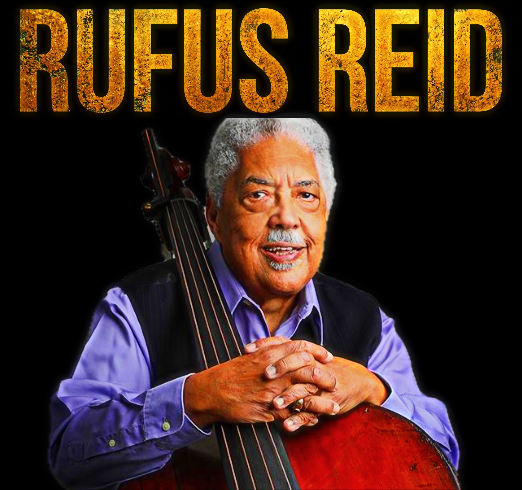
From touching a friend’s bass strings during a break, to teaching himself in empty Air Force practice rooms, to decades leading the jazz program at William Paterson, Rufus Reid has treated sound as something earned through listening and discipline rather than chased for its own sake — a philosophy he carries from sideman work with Dexter Gordon and Eddie Harris into his late-career turn toward composition.
___
Sounds Visual: You’ve described the physical sensation of first pulling the bass strings, and how it resonated against your body in a way that the trumpet never did. So my question, Rufus, is: looking back, was that purely a sonic and physical discovery, or did it also feel like a shift in identity as a musician at that point?
Rufus Reid: It was strictly an emotional thing. I was playing in the band, and we would take a break, and I always found myself going over to the bass that my friend had put down on the floor during the break, and I’d just touch the strings and feel the body as it resonated. I guess I did that more than once, but in retrospect, that was just the initial infatuation with the bass — I didn’t even know it was really happening at the time.
SV: When you were teaching yourself bass in the Air Force, late at night after duty — what did those solitary hours sound and feel like? Were there specific records or mental models you kept returning to when there was no one there to guide you?
RR: My brother had given me Miles Davis: Walkin’ a couple of years before that, so I was listening to some of those kinds of records, and Louis Armstrong too, at that point. But I had the opportunity to mess with the bass in the Air Force because, as my job, I was in the band. We’d meet from eight to noon, and then from noon until the next day, nobody used the practice room except me. So I was constantly with the double bass, just learning. I didn’t even own one at the time, but the band had one, and the tuba player — whose job also included playing double bass — could not have cared less about it. So I pretty much had it to myself for almost two years, just trying to figure it out.
I had a Bob Haggart book — he was one of the first to actually publish a book about playing the bass. It had pictures showing where E-flat was, or F, or half position, whatever — and I was just doing what the pictures showed. Everything was totally by ear at that point, because I had to learn how to read bass clef separately, and I wasn’t all that concerned with that yet. It really began to take shape when I went to Japan, which was my last two years in the Air Force — that’s when I really began to zone in on what I wanted to do.
SV: You mentioned you didn’t know the double bass when you started, and you came up playing electric, in the James Jamerson and Chuck Rainey mold. What did that grounding in groove-first, function-first bass playing give you that a purely classical entry point might not have?
RR: Well, that’s all I was concerned about — the way it felt and the way it sounded. I would just try to emulate what I heard. I didn’t even have a concept of style, I just knew what I liked. At that time, there were 45s on the jukebox at the places where we played, and the band I played in had to learn songs off the jukebox — the new songs hitting the streets that people wanted to hear so they could dance to them. So we’d learn straight off the record, and I’d figure out what the bass player was doing and try to emulate it, and then retain it.
Those are the things I think I was subconsciously dealing with, without knowing it was necessary — but it was fun. And once the band actually sounded as close as we could get to the record, that was very satisfying. Then, of course, when you’re playing and people are dancing to the groove — there’s nothing better than that. As far as I was concerned, that was it.
Above: “As Time Goes By” – Dexter Gordon | Manhattan Symphonie (Columbia, 1978) — Rufus Reid provides a deep, perfectly locked-in quarter-note foundation behind Gordon’s laid-back tenor sax line, demonstrating how to hold a groove steady without getting in the soloist’s way.
But eventually I began to understand what Paul Chambers and Ray Brown and Oscar Pettiford and all those guys were doing. Percy Heath was basically the first bass player I ever heard on a recording where I actually knew the name that went with the sound. That was the beginning for me.
SV: When you ended up studying with classical players like Warren Benfield and James Harnett, you said you deliberately didn’t want them to teach you jazz. What were you protecting in that decision, and do you still believe that separation of approaches was necessary for your development?
RR: Well, I wasn’t protecting them from anything — they couldn’t have taught me how to play jazz anyway, because they were the ones wondering how I could do whatever it was I did. It was so foreign to what they did. But I knew for a fact they could help me play the instrument better technically. A couple of people along the way showed me things with the left hand, or with the bow.
James Harnett was the first real classical teacher I had, and I didn’t even know the things he could do on the bass were possible. But he got me to produce a basic sound out of the instrument that was good enough to make an audition tape — to see if I could get into a college and get a bass teacher. So it was all about the sound. I had no idea what I was doing — I was just doing what he told me to do. By that time I was really learning to read well in bass clef, and understanding there was a difference between just playing what my ear told me and actually playing a piece with real technique behind it, because I had to audition with something substantial. Otherwise I wouldn’t have been accepted into the school. That was really tough for me, but something worked.
Above: Above: “Samba Rasta” – Andrew Hill | Eternal Spirit (Blue Note, 1989) — Rufus Reid navigates Hill’s notoriously complex, angular post-bop harmonic shifts, anchoring a rhythm section featuring Bobby Hutcherson and Ben Riley with remarkable clarity and intonation.
SV: Your first acoustic bass — the one you got after leaving the Air Force — that same instrument appeared on recordings with Thad Jones and Mel Lewis, Dexter Gordon, and Jack DeJohnette. When you think about that bass now, do you remember particular musical moments attached to it, or mostly the physical experience of playing it?
RR: Interesting question. I still have that instrument.
SV: Oh, cool!
RR: I bought it from my high school buddy — the one whose bass I used to touch back when I didn’t know what I was doing. So that’s the same instrument that’s on the Dexter records and so on. I have another instrument now, but I’m not sure how to answer your question beyond that.
SV: I want to talk about Eddie Harris, because you’ve described him as one of the most influential figures in your career — not only musically, but in business ownership, integrity, and the push behind The Evolving Bassist. So looking back, decades later, — is there a specific lesson or moment with him that still surfaces when you’re mentoring younger players, or making compositional decisions today?
RR: That’s really an excellent question. I think the initial thing is being able to actually play. When people hire you, they want you to be able to play — not just show up. Eddie always said, “I need you to be on time, and I need you to be able to play.” Back in the day, a lot of people were drinking heavily or doing a lot of drugs, and they weren’t able to play at a certain level when it was time to play. Eddie was always able to play at an incredible level, no matter what. To me, I’ve passed that down to a lot of young players — taking care of your health.
Especially now, everybody’s got so many recordings on their phones that they’ve made but never even listen back to. But if you’re going to play a blues, it has to sound like a blues — it can’t sound like an exercise. It has to have feeling behind it, something somebody can dance to, tap their foot to. It’s got to feel good. Those are the initial things, to me. And then, basically, being responsible for what comes out of the instrument at all times. That’s what Eddie was really drilling into us — being consistent. If you’re going to play, play. If you’re going to bullshit, he didn’t want you around.
Above: Above: “Instant Death” – Eddie Harris | Instant Death (Atlantic, 1971) — Rufus Reid lays down a dirty, funk-driven electric/acoustic bass groove on this title track alongside pianist Muhal Richard Abrams and guitarist Ronald Muldrow.
That’s kind of the approach I take too. I don’t do much teaching anymore, but the people who do come to me have somehow figured out that I’ll be candid with them right away. I listen to them, then ask them to tell me what they’d like to know, and if they can’t even convince me they’re really into it, I tell them right away. I’m not doing them any favors by bullshitting.
SV: Eddie put band members’ names on the copyrights, and he paid you by company check. So beyond the practical lesson, Rufus, how did that early experience of being treated as a co-creator shape the way you later led your own groups, or mentored students?
RR: Oh, immensely. I think the mere fact that we were in a band together — myself, Eddie, Muhal Richard Abrams, and Ronald Muldrow — for about three years before it started to change — you can’t buy that kind of longevity, a band that’s been together year after year. I don’t care how well a person plays individually — they can’t just jump in. Even really incredible players can’t truly become part of a group they haven’t grown with. That was very impressive to me — that Eddie allowed us to become a band. We didn’t even realize we were a family until he told us, “We’re a band now,” so we look out for each other, we play off each other. That’s a very important, unwritten thing that, in my mind, doesn’t get talked about enough in schools.
SV: Let me ask you about Bobby Hutcherson for a second –there’s an anecdote where Bobby Hutcherson called out your playing after a bad gig, or when your playing had “dropped off, “and it clearly stayed with you. Why do you think that moment cut deeper than any technical critique, and what does it say about real accountability among musicians who respect each other?
RR: Well, the thing is, he didn’t have to say anything to me at all — he could’ve just paid me and never called me again. But I think people who care about you, and who know you really satisfied them at a certain point, and then — maybe not suddenly, but two or three years later — you’re nowhere close to that anymore — it would take a lot for him to say something unless he cared. And it hurt. It hurt real bad, because I wasn’t doing it intentionally. You lose your concentration if you’re not being demanded of constantly. Everybody would come from New York or L.A. — or, when I was in Chicago, they’d bring energy that didn’t exist locally, and when they left, they took it with them. That was hard for me.
Above: “Come Rain or Come Shine” – Bobby Hutcherson | Cruisin’ the ‘Bird (Landmark, 1988) — Rufus Reid plays this relaxed, mid-tempo ballad with incredible warmth and spaciousness, laying down an expressive, melodic counterpoint underneath Hutcherson’s delicate vibraphone phrasing and giving the track its deep, emotional weight.
And then he actually singled it out, and it made me very aware that I couldn’t be complacent — even though it’s difficult to be super creative every single day, which is impossible anyway. But when I played with him, it was amazing — the way he played. I loved playing with him and Harold Land so much, we became friends, but it was bigger than that. I’d never been around people who played at that level consistently, since I’d played with Eddie Harris. It stays with me very much.
SV: Between Eddie Harris’s discipline, Ray Brown’s relentless practice, and the ensemble listening of the Thad Jones–Mel Lewis Orchestra — is there a lesson among those three that’s actually been hardest to live up to over a full career?
RR: They’re all the same, really. They’re all ingredients that help you become successful at whatever you’re doing, if you can keep them present in your mind. You’ll project that. People can feel talk, conviction, passion, and intent right away — “Oh, I need this in my band.” To me, those are the things all those people taught me, and I try to keep them present every time I play, whether with another ensemble or my own group. I try to play at such a level that everyone else has to play at a higher level than they thought they had to.
SV: You said that Eddie Gomez sounded like Eddie Gomez on your bass, and Ray Brown sounded like Ray Brown on your bass, meaning the sound doesn’t live in the instrument itself. So my question — if sound is that portable and personal, what do you think it’s actually made of?
RR: Wow. Another great question. The individual, I think. You know — at the Rudy Van Gelder studio, Bill Evans, McCoy Tyner, and Herbie Hancock all played on the same piano — all recorded on the same instrument — but they each have their own individual touch. Not just the physical touch, but the content itself identifies and separates them from one another.
That amazed me the first time Ray Brown played on my bass — he sounded just like himself, so strongly, that it was almost startling. That’s why people get on me sometimes about always taking my own instrument when I travel. A lot of bass players don’t — they go with whatever’s available, and if it’s a playable instrument, they sound pretty good. But I try to take something I’m familiar with, so if I don’t play well, I have no real excuses, because it’s my own instrument.
I’m right in the middle on this — sometimes I wish I didn’t have to haul my bass around, because I can still play fine if the instrument’s set up and playable. But I’m even more adamant about having my real sound — this is my bass — because I think I can project myself better that way.
Above: Quintergy: Live at the Village Vanguard – J.J. Johnson (Verve, 1988) — Rufus Reid anchors the rhythm section alongside drummer Victor Lewis and pianist Stanley Cowell, elevating classic hard-bop cuts like “Commutation” and “It’s All Right with Me” with his steady quarter-note drive and driving acoustic pulse.
SV: One of the things I think is remarkable about your playing, Rufus, is that you tailor your sound to the horn player — a more robust sound for Dexter, more pliable for Eddie Harris, a different sound entirely for Stan Getz. Is that adaptability — and I think I know what you’d say to this, but it’s worth asking anyway — is that a form of erasing your own identity, or is that your identity — the capacity to disappear into what the moment needs?
RR: Interesting question. I really feel it’s my job to try to make whoever I’m playing with sound better than they would with someone else playing. Whatever the music is, I try to play it the best I possibly can — I can’t be thinking about whether I’m being liked. Just playing the situation itself is a full-time job. I’m in service.
There are a lot of people who are really trying to still — what I call “get the house” — play in a way that gets people to applaud more. I’ve never been a quote-unquote flashy soloist — I like to solo just like everybody else, but I’ve never really thought of myself as “a soloist.” I’m an ensemble player, and when I play, I can make the band jump and fly. That’s my job, and that’s where all my concentration goes.
SV: Let me ask you about Dexter for a second. What do you think a bassist actually has to hear differently when accompanying someone with Dexter Gordon’s enormous sound and time feel?
RR: Well, Dexter never told us how to play, but he loved the power of the rhythm section, and he wanted us to really support him — he had a huge sound, and he wanted a full-bodied rhythm section behind it. George Cables was a full-bodied pianist who orchestrated a lot at the piano, in terms of arrangements, and then Eddie Gladden and I just hooked up and became the trio.
Dexter basically had to play with us, but we also had to be able to play a ballad for twenty minutes — a lot of people were amazed by that, because it’s slow. But to me, it was just a song, the way he played it. If you’d put a metronome to us, we were all over the place — but that’s not what music is, a metronome. Dexter wanted power underneath him, wanted us to always be there, and we were, and we could feel it — it became a quartet, as opposed to four separate people.
Above: “The Chase” – Dexter Gordon & Gene Ammons | The Chase! (Prestige, 1971) — Early in his career, Rufus Reid anchors this intense tenor saxophone battle recorded live in Chicago, maintaining an unyielding, heavy-centered walking bassline alongside pianist Jodie Christian and drummer Wilbur Campbell to give the two giants total freedom to turn up the heat.
SV: Rhythm section independence was a hard-won lesson for you — from Wilbur Campbell, for example, who would leave you hanging. In today’s educational environments, where students often have really strong technique but still lean on one another, what practical exercises or listening habits have you found most effective for building that independent pulse?
RR: Well, I think the moment I can exhibit real digital technique isn’t really it. It’s whether you can breathe together, articulate — I always talk about marking the phrases. Rhythm section players — if they’re playing songs, there are phrases. Even chord changes have phrases. You don’t need a sledgehammer to punch out bar nine or bar thirty-two, but if you’re together, it has power, and you have to stop leaning on each other, so to speak — listening, and trying to play, not too much, but clearly marking where the phrases are.
If you’re going to play songs and you can’t do that, everything just runs together — there’s no breath, no dynamics, nothing. And people will completely shut you off if you can’t do that.
SV: You’ve talked about the rhythm section being the ceiling on a band’s quality. So what’s the difference, to you, between a rhythm section that’s technically excellent and one that actually swings? Can that gap be taught, or does it have to be felt?
RR: I think it can be taught, but it’s really more about listening, and being able to physically control the dynamics of your instrument — being able to crescendo and decelerate together, or just listen. For instance, years ago there was a player who really wanted to become more well-known, and he had a chance to audition for Billy Taylor.
I told him, just listen, go with him — he could read fine, but Billy Taylor didn’t say, “I’m going to play a blues,” he just started playing. The player didn’t know when to come in — came in too late, or too soon — and then Billy would deliberately put in a huge ritardando, and the player just kept on playing, not listening, not understanding. He wasn’t really ready for that gig, and he couldn’t understand why he didn’t get hired, because he could technically play. He just wasn’t pliable enough — rhythm section players have to be pliable, and still convincing.
Above: “Third World Anthem” – Jack DeJohnette’s Special Edition | Album Album (ECM, 1984) — Rufus Reid locks into a syncopated, groove-heavy bassline alongside DeJohnette’s drumming, demonstrating his remarkable ability to ground avant-garde and fusion-influenced jazz compositions.
SV: When you join an unfamiliar ensemble, what are the first things you listen for before deciding what the bass needs to do?
RR: I might hookup with the drummer, first of all, if there is one. If they specifically ask me to play, then maybe they did some homework and knew what they were asking for. I’d try to play with them, and if it wasn’t working, I’d ask questions — do you want me to do this, do you want me to do that? And if they said, “You have to do this, not that” — okay, fine. But I basically try to use my gut instincts before I get too theoretical about anything.
SV: In your playing, Rufus, as you’ve moved toward placement and economy in your playing, what kinds of silence have become most meaningful to you?
RR: I mean, as long as you can still get the job done, whatever that happens to be — I’ve always believed, not because I try to play more — I’ve never really been asked to play more than necessary. But I even tell young players who have some incredible digital ability: if it doesn’t feel good, it’s not worth it. They’ve got to think about rhythmic placement — where I put the beat, and the space between the notes. Unless somebody specifically wants a lot of space, I don’t leave a lot of space between the notes.
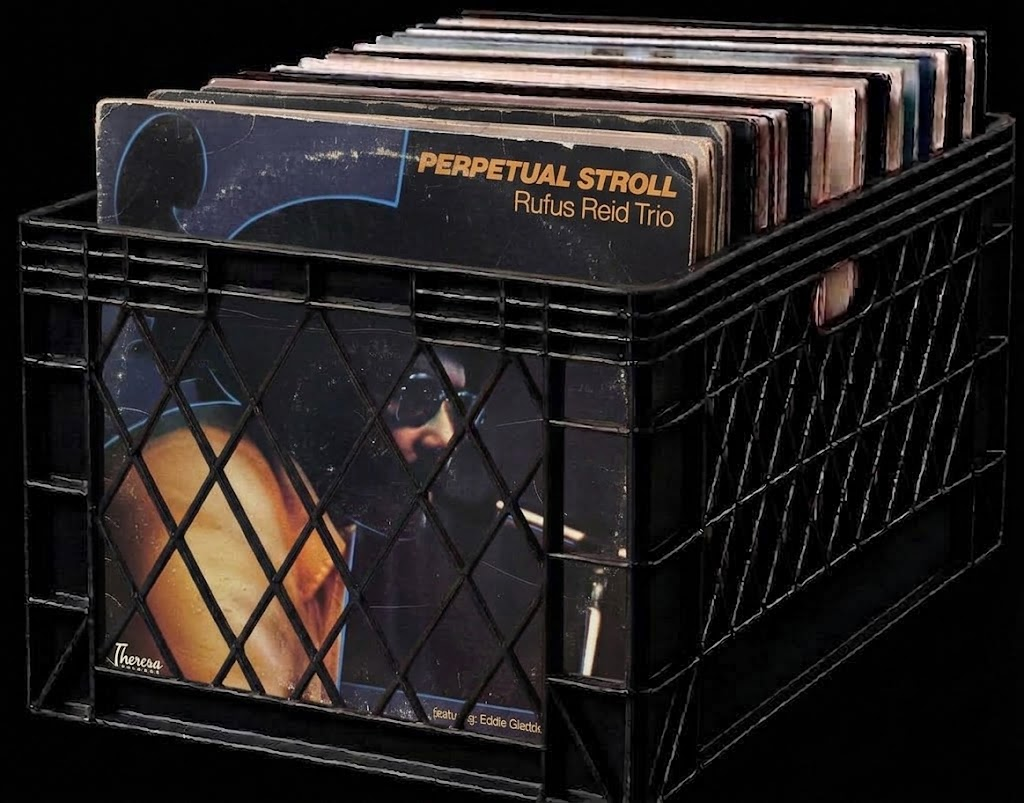
Above: “Perpetual Stroll” – Rufus Reid Trio | Perpetual Stroll (Theresa, 1980) — The title track of his debut as a leader showcases Reid’s warm tone, soloing chops, and melodic lead line alongside pianist Kirk Lightsey.
SV: Let’s talk about composition and visual art in the creative process a little. You’ve talked about how composition shifted your approach to the bass — from note data toward shapes and colors and transitions. When you return to the instrument after a long composing stretch, one where the bass hasn’t been in the picture, what’s the first physical or sonic adjustment you notice, and how does that feed back into the next writing session?
RR: I don’t know if it really does — that’s what I’m actually working through at this stage of my life, because both the instrument and composition require time, and if you leave one to focus on the other, when you return, you somehow pay for it. The instrument physically makes me pay for it. So I use a lot of warm-up — long tones with the bow — not only to get the instrument to resonate more, but to get my body to become more one with the instrument. Because if you’re not one with your instrument, it’s not going to happen, no matter what.
So it’s very important for me to physically get the instrument to sing more. It’s hard to explain without showing you, but it’s playing long tones, open strings, just getting the instrument to resonate — full body, and I don’t mean playing loud, I mean really getting it to resonate. Then my hands, and the instrument, let me get into it more physically.
One of the problems for me is that if I haven’t actually performed in two weeks — rehearsing and practicing alone just doesn’t get it — I still need to get my hands moving. If I haven’t played with anybody in a week, I practice with what they call DrumGenius, software with different drum patterns, and if I just want to walk a bass line, I might play a blues for half an hour — not loud, just to get into it.
I just finished a trio tour with the wonderful pianist Randy Ingram and Joe LaBarbera — we made an album — and before going out on the tour, I was playing along with the record just to get my chops up, so I wasn’t wiped out once things got going. I guess everyone has their own way of doing that, but that’s kind of what I do.
Above: “Off Minor” – Frank Kimbrough | Monk’s Dreams: The Complete Compositions of Thelonious Sphere Monk (Sunnyside, 2018) — Reid handles Monk’s difficult, off-beat rhythmic structure with ease.
SV: You’ve also said that composing changed the way you play bass — that you think now more about the shape of a line than simply the notes that fit a chord. Was there a particular composition or performance where you suddenly realized, “I’m not playing bass the way I used to”?
RR: I can’t actually pinpoint a specific moment, but I do remember the fact that songs I thought I already knew how to play gave me new ideas for approaching the playing — even the bass lines, but particularly soloing. You have a lot of options as a performer, because you’re composing in real time, but when you put a blank piece of paper in front of yourself and ask, how am I going to start, and where — I realized composition meant I didn’t have to start on the downbeat, or the root note, every time. But you have to be convincing that it still works, that it’s still good. That was always somewhere in my head, I guess, but I never thought of it that way before I really started dealing with composition — I mean, truly thinking about composing. I hadn’t been doing it at all before.
SV: Let me ask you about Quiet Pride— that grew out of Elizabeth Catlett’s sculptures. Have there been other visual artists or poets, or other non-musical forms whose work has jumped out at you similarly since then, and how did it alter your large-ensemble writing process?
RR: Well, I got an opportunity — I was asked out of the blue to do something with another artist, Faith Ringgold. She did all kinds of quilts and paintings, very different work, and that was interesting to do. Her work, along with Catlett’s, really catapulted me into another zone — especially getting the chance to meet her and be in her presence more than once. So, to answer your question — each one has affected me in its own way.
Above: “Moment’s Notice” – Dexter Gordon | Manhattan Symphonie (Columbia, 1978) — Reid locks into a surprisingly danceable, heavy groove on this John Coltrane classic, holding down a fast-moving walking bassline while soloing authoritatively over the rapid chord changes.
SV: You’ve described learning to delete your own ideas — for example, Art Farmer suggesting you remove eight bars. How did learning to cut change you as a composer, and do you think ego is more dangerous for a composer than for an improviser?
RR: I think ego is dangerous, period — especially if you bring it to the bandstand. But that incident with Art Farmer really shocked me at first. It wasn’t that what we deleted was wrong — it just didn’t get missed after he took it away. That’s what really shocked me. There was something he heard, maybe from more experience playing music than I had, but he had a real knack for picking really good songs — every time I played with him, he had two or three new pieces that really challenged all of us. I said, wow, that’s really interesting. He wasn’t willing to just call the same standards every time.
So that was very interesting to me, but I really learned a lot when he said, “Well, why don’t we just take it out and see what happens?” And when I didn’t miss it, that taught me a lot. So now I try to carry that with me when I’m working on things, and ask myself what I think — learning to delete something that, well, if it doesn’t bother you when it’s gone, that’s very telling.
SV: Let me ask you about the deleting idea again, from another angle. You write with pencil and paper because computers can interfere with the creative process—which I actually agree with. But my question is: what’s different, psychologically, about the physical act of erasing versus just hitting delete?
RR: Well, with pencil and paper, I write with a fair amount of pressure on the page, so when I erase something, I can still kind of see it, if I want to go back to it. But if you delete something on a computer and don’t label it, it’s totally gone. I found that I got severed from the process every time I messed with the computer. So, yeah — it’s a little more laborious with paper, but if I spend more time with something I like, come back to it after a day or two, and I still kind of like it, then I might put it into the computer to see if it really changes anything. But invariably, if I can mess with something and return to it two or three days in a row and it either grows or becomes something — then I think I have something. The computer, to me, is only useful for making sure I’ve got the notes written down properly.
Above: “Blue Wail” – Art Farmer | Ph.D. (Contemporary, 1989) — Anchoring a classic flugelhorn quartet, Reid delivers a punchy, low-end walking line that propels the track forward, emphasizing clean attack and rock-solid timekeeping.
SV: Let’s talk about The Evolving Bassist —in the book, you’ve emphasized wanting players to become more responsible for what they actually play, and to learn to love their own sound. So my question is: when a student plays something technically correct, but you can tell they don’t yet love it — what do you actually say or do in that moment?
RR: I think about it differently, depending on the player. There’s an exercise I do with players who play pretty damn well, but still aren’t really connected to the instrument — I ask them to play the song they chose to play, but on one string. And all of a sudden, I realize they don’t really hear the song — they’re focused on the physical mechanics of what they’re doing, but they don’t hear the sound of the song. Every song has a sound, and if you can get that sound — because if you break a string, say, not the top or bottom string, but one in the middle — all of a sudden you’re screwed if you don’t actually know the sound of the song. It becomes really apparent, and it opens up their harmonic ear. I think it makes them stronger players harmonically, because they suddenly discover things they’d never been able to get to before, because they’d always been doing the same thing — whatever was easy to play.
SV: If you were revising or expanding The Evolving Bassist now, accounting for things like contemporary techniques, global influences, or the physical longevity demands of the instrument — is there a new chapter you’d include, or an emphasis that would feel most urgent right now, in 2026?
RR: Honestly, I don’t think so. I really feel the essence of The Evolving Bassist is that whoever picks it up, if there’s activity in them, it’ll unleash it — it’s just basic stuff that I think everyone should have. I don’t talk about styles so much, because everybody’s got a different approach, but if a player can’t make you dance or emote some feeling, they’re in trouble, period — I don’t care how many books they’ve read.
SV: You spent two decades or more building the jazz program at William Paterson. What did that administrative and curriculum-building work teach you about jazz that playing alone maybe didn’t?
RR: In a different way, it taught me to codify everything. A lot of people wanted to learn how to play, and they had the ability, but there wasn’t a place with someone they could trust to tell them what was working and what wasn’t. I think that was probably the best thing we could offer. Everybody wanted to come to William Paterson because it was close to New York City, and my administrator, Dr. Kriven, wanted a direct conduit to the city from the school — so when a person graduated, they could go to New York and stand on their own two feet.
Learning to play the music — people think they’re playing, but nobody’s ever told them, “What about this? No, don’t do that here, do that there.” There’s so much to work through — there’s no single way to play. And if you don’t have somebody who can push even the most astute players — the ones who already have a lot going on — to want more control over it, then something’s missing. I think that was the key thing that made us successful in that way.
So you had people like Bill Stewart coming through — he knew more than almost anybody in that school, he listened more, he knew more records than anybody, more than even the horn players thought they knew. And you see where he is now — still at such a high level, twenty-five, thirty years later.
Above: “You Make Me Smile” – Rufus Reid Trio | Seven Minds (Sunnyside, 1984) — On this uptempo Latin-to-swing burner, Reid drives a high-energy rhythm section alongside a young Terri Lyne Carrington, turning in a lightning-fast, articulate bass solo.
SV: You’ve also voiced concern that academic programs can produce players who are technically pristine but rhythmically fragile, or maybe emotionally a little stiff. If you could strip away one contemporary dogma of collegiate jazz pedagogy, what would it be?
RR: That’s really a good question. I think it’s the overemphasis on having a lot of technique, because that can be very misconstrued. What is technique — is it digital technique, meaning how fast and accurately you can play, or is it about how well it just feels good? Even if it’s not fast, does it still feel good? It’s the urgency of trying to prove something — that’s what I’d take away, because that gets in the way of understanding that proving how well you can play isn’t about being loud, fast, and high.
SV: You advise musicians to internalize a solo by singing it before transcribing it. So the second part is: in an era when players can slow everything down, notate it, and visually analyze every detail — what human element is most at risk of being lost in that process?
RR: It diminishes what the ear has already been telling you. If the eyes are being used a lot, the ears shut down. So, as far as I’m concerned, that’s what I mean about transcription — real transcription is oral, whistling or singing along, and then, to archive it, you might write it down so you can look at it ten years from now. But beyond that, it’s worthless if people try to write it down without really being able to read it back — they don’t know how to actually notate what they heard.
So with the ears, in terms of learning, you might want to start with a Coltrane solo, or maybe a Hank Mobley solo instead, which is totally different and much more accessible — go toward Mobley first, and deal with the inflections, not just the notes. Some things sound like they might be a wrong note, but it’s really the inflection. That’s why everybody wants to do things the way Miles did — sound first, but slow things down. You’re asking good questions here.
RR: I appreciate it.
SV: You’ve described a genre-based mindset as “absurd,” but you still view yourself as fundamentally an acoustic player. So my question is: where’s the line, if there is one, for you, between staying open to any style and losing your musical identity?
RR: Because I think Eddie taught us not to be afraid of any kind of music — you could have a style, some people say, “I only want to play bebop,” okay, fine, but there’s a lot more music out there. Muhal Richard Abrams always told me, “Just listen to everything, man — even stuff you don’t like, because you might hear something that moves you.” So I think it’s important to let things in.
Everyone has a forte, or a style they gravitate to, something that just feels good — and of course you can grow into other things too. I didn’t like Charles Mingus at first, especially some of the stuff I thought was kind of weird, but I was still learning how to play the blues and play the right notes in tune — I wasn’t thinking about structure and all those kinds of things yet. Eventually I figured out, wow, this opens up all kinds of music — but I wasn’t there yet.
So I think it’s important to just let things come in. And of course, I don’t like everything — nobody really likes everything. But at the same time, I listen to all kinds of music now — I listen to different combinations, different structures, and I think, wow, that’s interesting. Even listening to European classical music, you hear all kinds of things you never even thought existed before. And I think we, as jazz players, have always listened to everything — J.J. Johnson loved Mahler, that was obvious, and Mingus loved all kinds of classical music from two, three, four hundred years back. And George Gershwin, Ravel, Debussy — they were listening to jazz and putting it into their own music. So all of a sudden we’re seen as “weird” because we want to incorporate other sounds that aren’t thought of as jazz.
Above: “Harlem Blues” – Donald Byrd | Harlem Blues (Landmark, 1987) — On the title track of this bluesy hard-bop session, Reid anchors the rhythm section alongside pianist Mulgrew Miller and drummer Marvin “Smitty” Smith. He provides a deep, grounded low-end groove that drives Byrd’s soulful trumpet phrasing.
SV: You’ve worked across mainstream, avant-garde, and large-ensemble settings, and you’ve maintained a really distinctive, singing sound throughout. So my question, Rufus, is: when you’re collaborating with other musicians — especially younger musicians who might be bringing different rhythmic or harmonic vocabularies — what do you listen for first, in order to find common ground without diluting your own voice?
RR: First of all, I try to really understand what it is I’m playing — intellectually, whether it’s a time signature, or harmonically a combination of different things. I try to figure that out, and then see how I can interject myself into it. But until I’m comfortable with the setting, I feel obliged to try to do whatever the composer suggests, and it may be very obtuse to me at the outset, until I learn it. The more I play, and the friendlier I become with the keyboard and things like that, I realize there’s not much out there that hasn’t existed before in some form. So I just take time to see if I can incorporate it, and eventually, if I have the luxury of playing something more than once, maybe “Rufus Reid” can come through.
SV: You’ve gotten a lot of well-deserved recognition — lifetime awards, ongoing invitations — and from what I’ve seen in some of your other interviews, that still seems to surprise you. You’ve described yourself as still evolving. So my question is: after all these decades, with all the awards and invitations and praise that’s been heaped on you, what is Rufus Reid still trying to figure out musically?
RR: Well, composition is really helping me explore myself a little more. I’ve spent a lifetime trying to play what other people wanted me to play. When I’m dealing with composition, I’m really trying to find out what I want to play, or what I want to sound like — and the BMI Composers Workshop really taught me that, because the first thing they said was, “Write what you want to write.” And I didn’t know what I wanted to write. It wasn’t TV music, it wasn’t movie music, it wasn’t music for a bar mitzvah, it wasn’t circus music — none of that. Just, write what you want to write. That was the most difficult thing, and I still think it’s something I’m learning to do — you might like what I write, but I don’t need you to.
We’ve learned how to play so that we can play with other people, get hired to do this or that — but the question is, why? Just play what you want to play. Write what you want to write. That is the most difficult thing I’ve ever had to do, and I’m still learning how to do it, because you have to get it out of your brain — well, I hope somebody — I want to know how people are going to think about this. That’s the worst thing you can think. So that’s something I’m still working through.
SV: Looking back at nearly sixty years in this music — from a kid touching a bass during breaks in a Sacramento dance band, to a Guggenheim Fellow — what do you know now about sound that you didn’t know when you were chasing it?
RR: I didn’t even know I was chasing it, until people started telling me, “Wow, you have a wonderful sound.” I never really thought about the sound consciously. But when I started thinking more about the sounds I was making — and then I’d play somebody else’s bass, and they’d say, “How do you get that sound? I can’t get that out of my own instrument” — I realized there’s something inherent, something I’ve learned about how to touch the instrument, or how the instrument can meet me halfway, where I don’t have to work hard to get a sound.
I like the sound that I make. If you don’t like the sound you make, I don’t know why you’d think someone else is going to like it. If you don’t love it, why should anybody else love it? And I think those who have that — I mean, when you hear Frank Wess on saxophone, and then you hear John Coltrane play a note on a ballad — my God, the sounds are so different. How did they do that? So I always wanted to have that kind of sound, where people would hear me as opposed to Ray Brown, or Christian McBride, or Eddie Gomez — because each one has their own sound. And I think the sound I make, I enjoy, and I try to keep it consistent as much as possible.
Above: “Seven Minds” – Rufus Reid | The Gait Keeper (Sunnyside, 2002) — Originally the title track of his 1985 trio album, Reid revisits Sam Jones’ classic composition on The Gait Keeper with his expanded quintet. Reid pays direct homage to Jones—one of his biggest influences—by delivering a deep, fat-toned, blues-infused walking groove that anchors the track’s modal sections. His bassline serves as a powerful melodic counter-voice underneath saxophonist Rich Perry and trumpeter Freddie Hendrix, showing off his signature percussive attack, impeccable intonation, and effortless swing.
SV: When listeners look back on your incredible body of work, what would you hope they recognize as the thread connecting the sideman, the bandleader, the composer, the author, and the teacher?
RR: Even I listen to some of the recordings I made twenty, twenty-five years ago and wonder why I did certain things — but that’s where I was at that time. Sometimes it amazes me that I got away with a lot of it. And yet, I feel really good about all the recordings I’ve made, even the ones where I didn’t play that well, because that’s where I was at that time, and that’s what it was. I don’t think anyone can do more than that. If I can consistently play and make Andrew Hill feel okay, and play with Michael Rodriguez and have it still feel good — to me, that’s what I want people to hear when they listen to me play: the consistency, so they know what they’re going to get.
SV: Rufus, this has been such an honor and a treat, spending an hour-plus with you. I just want to say thank you!
RR: Well, it was very interesting — I appreciate the time.
Leave a Reply
You must be logged in to post a comment.