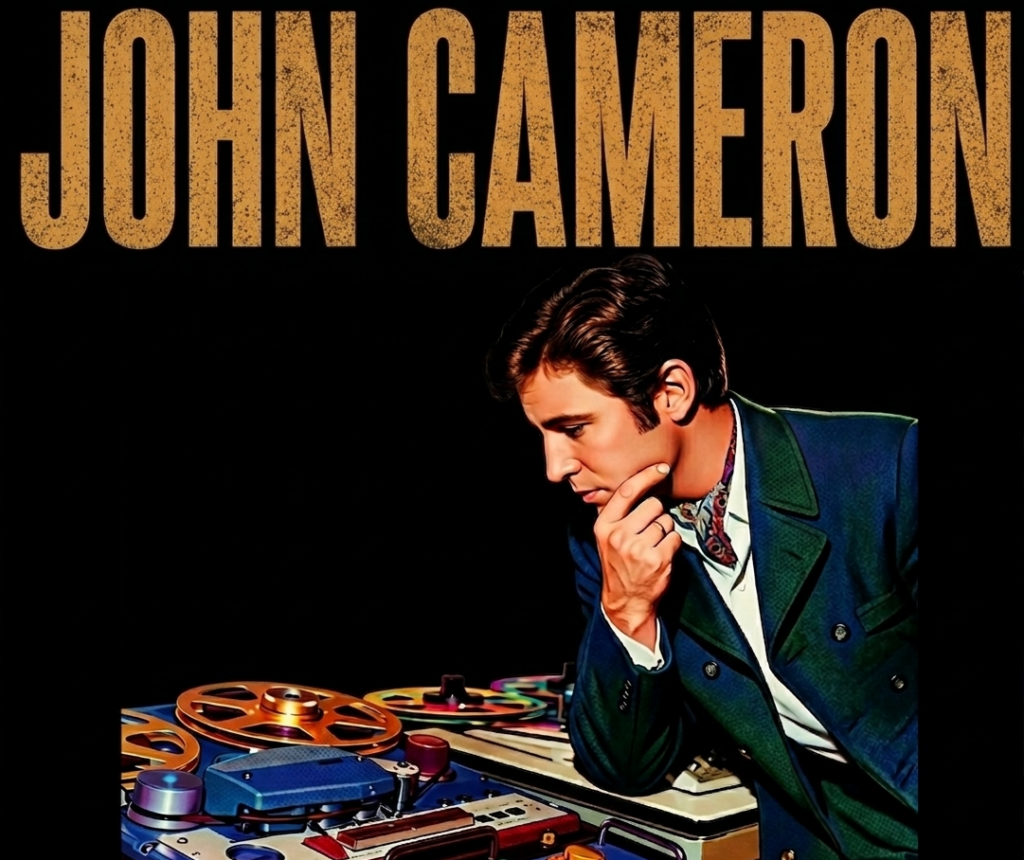
From the smoke-filled pubs of Croydon to the prestigious stages of Cambridge and Broadway, John Cameron has navigated an amazing career by saying “yes” to every sonic adventure—whether that meant reimagining Shakespeare through the lens of Tudor court music or defining the funky, “in-your-face” grit of the 1960s library music scene.
Sounds Visual: What was the musical atmosphere like in a house where your father played jazz fiddle and your mother played piano?
John Cameron: It was pretty lively. The party was never accompanied by a gramophone; it was my mum on piano, my dad on fiddle, and other people joining in. I suppose that’s why, around age 11, I thought, “I want a piece of this,” and started to learn. I was playing Beethoven sonatas by then, but I figured I could learn the popular stuff too. I think “Snging the Blues” by Guy Mitchell was the first thing I worked out.
My dad basically said, “I can teach you this,” and he taught me loads of hits from the ’30s, ’40s, and ’50s—show tunes and things—usually in the wrong key because he was a fiddle player, not a piano player. He had played a lot of semi-pro stuff before the war and would have loved to be a musician, but his parents were frail, so he went into advertising. It was a buzzy atmosphere. When Bill Haley burst on the scene, my parents were about the only ones on the street who actually liked rock and roll.
By the time I was 12, I was doing talent shows at holiday camps, playing “I Got Rhythm” and all kinds of stuff. I was playing in pubs by 14 in Croydon.
SV: You’ve described switching from History to Music midway through your time at Cambridge as a moment of realization. How did that foundational training in history—researching and contextualizing the past—inform your approach to music theory or composition once you made the leap?
JC: Unfortunately, the school I was at couldn’t teach me A-level music to get to university, so I ended up getting into Cambridge on a history exhibition. But as soon as I hit Cambridge, I linked up with local jazz musicians and started playing Tuesday nights at the Red Lion with greats like Ronnie Ross, Danny Moss, and Art Themen. My jazz education took place alongside the history.
About halfway through my second year, I realized, “This is ridiculous. I’m doing all these gigs and playing in big bands; I’m a musician.” I went to the Master of the College—Cambridge consists of Part One after two years and Part Two after the third—and switched from history to music for my final year. I had some really good people teaching me, like Peter Tranchell, who was very influential.
At the same time, I was right into the Footlights with Eric Idle. People like Clive James and Germaine Greer were part of that buzzy scene. It was an atmosphere where people said, “I’m going to make movies” or “work in the theatre,” and most of them did. It was a “can-do” situation. Eric and I wrote quite a few things together, including an outrageous spoof of the Beatles singing Handel’s “Hallelujah Chorus.” That actually ended up on Broadway, which was crazy for a couple of undergraduates. Every month, a blue envelope would arrive at the Footlights Club with a royalty check in it. We thought, “Hey, this is good!”

SV: You also mentioned in an interview that your history degree gave you an analytical edge. Can you give an example from Hamlet, Jack the Ripper, or Witness for the Prosecution where a historical detail changed how you composed a score?
JC: Well, for the Hamlet that John Caird directed at the National Theatre, we set it in the period when Shakespeare wrote it, when the Court of Denmark was in a state of flux. We investigated the court composers of the time—Orlando di Lasso was the “flavor of the month.” We took di Lasso pieces and reconstructed them so they fitted the play but felt contemporary while maintaining that early 16th-century feel.
For Jack the Ripper, I researched what kind of music was played in pubs and bars of the era. Nothing used as “found music” in the show was written after 1888. At the same time, I built the main theme on the symphonic feeling of 19th-century England, then “corrected” it for the nastiness of the story. I threw in sample stuff I invented, like hitting a metal door with a crowbar, or recording my daughters screaming. I even recorded myself breathing and dropped it a fifth to give it a cavernous feel. The history degree helped me analyze the construction of a script and understand the reactions to certain events in, say, Tudor England.
SV: Talking about scoring, I wanted to ask about Poor Cow. You said “yes” to scoring it before you really knew how to do it. What was your biggest “rookie mistake,” and what was the most significant advice Elizabeth Lutyens gave you during that 10-minute phone call?
JC: It all happened so fast. I didn’t even know the whole exchange with the producer, Teddy Joseph, about who was going to write the score. When they asked if I could have it ready by “a week from tomorrow,” I just said yes. My mantra is: whatever the question is, the answer is “yes.” You never know what you’re turning down. I took on a movie called Psychomania thinking it would just be fun and “the kids need shoes,” and it’s become a cult hit.
Elizabeth Lutyens was great. I was terribly cheeky, asking “How do you write a full score?” She just gave me the facts: look at the film, choose where the music goes, get exact timings. It was chapter and verse. It was only later, working in California with music editors like Kenny Johnson—who learned from Earle Hagen—that I learned the true depth of technicality. In England, timings were to a third of a second; in the States, they were to a hundredth. I actually enjoyed the precision of the States; it was like a competitive sport.
Poor Cow had none of that expertise; it was just what we felt. Same with Kes. We’re actually presenting Kes at the Royal Festival Hall soon with a live score for the South Bank’s 75th anniversary. Jarvis Cocker is introducing it; it’s his favorite movie.
Following his time at Cambridge, Cameron joined various jazz ensembles—frequently leaning into satirical performances—and released his 1966 album, Cover Lover. During this period, he established himself as an arranger for pop and rock acts like Alex Harvey, a path that eventually led to his introduction to folk-pop star Donovan. For the recording of “Sunshine Superman,” Cameron utilized a two-tier Morley harpsichord. Following the song’s success, he became a frequent collaborator for Donovan and Most, arranging and performing on numerous subsequent tracks.
SV: Let’s move to the 1960s studio circuit. I have to ask about Donovan’s “Sunshine Superman.” You recorded it in three hours alongside John Paul Jones. Was Jimmy Page on that session too?
JC: Jimmy Page wasn’t actually on that session. I gathered he re-did the guitar solo later. Eric Ford played the main guitar parts. John Paul Jones was there on bass with Spike Heatley.
I was doing a jazz cabaret at a place called “Take One,” and Spike Heatley came in and said he’d been talking to an old friend, Ashley Kozak, who was managing Donovan. He asked if I fancied doing some arrangements. According to my mantra, I said yes. We met at Ashley’s flat, which was psychedelic before “psychedelia” existed—silver and purple walls and stars. Halfway through the meeting, Chas Chandler came in to say he’d found a fantastic guitar player in New York named Jimi Hendrix.
Spike and I came up with the idea of using two basses: the click of the bass guitar and the meat of the upright. And a harpsichord, why not? We cut it at EMI Studio 3. I remember the producer, Mickie Most, saying, “This is a hit,” and it was. But because Don’s management was in a legal dispute, the record couldn’t come out in England initially. It was a massive hit in America while I was still unknown here, doing pantomime in a theater.
Cameron eventually became Donovan’s musical director, but a lawsuit between Pye Records and Epic Records over Donovan’s U.S. deal halted their momentum. The legal battle delayed the UK release of “Sunshine Superman” and barred Donovan from performing for much of early 1966. During this hiatus, Cameron returned to the Watford Palace Theatre to conduct pantomime.
SV: How did that feel? Having a #1 hit in America while doing panto in England?
JC: It felt a bit weird! But three months later, it resolved itself and was #1 on both sides of the pond. After that, I did a fair bit with Don. John Paul Jones did “Mellow Yellow,” but I did “Jennifer Juniper.” Mickie Most phoned me on a Tuesday, I saw Don on Wednesday, and we recorded it Friday. We used oboe, bassoon, harp, shaker, and acoustic bass. I don’t think there’s ever been another hit record with that lineup. It was on the radio by Sunday. There was no three-month period of mulling over the mix. Mickie Most was a producer who made a decision and that was it. He was the commercial side, Don was the expressive side, and I was the intermediary in the middle.
Following the 1966 resolution of his lawsuit, Cameron became a mainstay of Donovan’s career, arranging and performing on iconic tracks like “Epistle to Dippy” alongside the albums Sunshine Superman and Mellow Yellow. His influence extended into television as a music director for Julie Felix’s Once More with Felix and the BBC’s In Concert series, where he supported legends such as Joni Mitchell and James Taylor. Additionally, he found success as a songwriter with the UK hits “Sweet Inspiration” for Johnny Johnson and the Bandwagon and “If I Thought You’d Ever Change Your Mind,” later covered by Agnetha Fältskog.

SV: You’ve talked about the “hustle” of the ’60s, with string sections traveling between studios on motorbikes. How did that frantic energy find its way into the grooves of your music?
JC: I don’t know, but I’m called about the period of 1967 to 1975 more than any other. There was an enormous energy. Politically, things were in turmoil—the three-day week, the miners’ strikes—but in the midst of it, there was this energy. I did about 40 movie scores in the ’70s, as well as hits with my own band and Hot Chocolate. I was the right age; by the time the ’70s finished, I was still only 36.
During the 1970s, Cameron emerged as a pivotal figure within the KPM Music Library, leaving an indelible mark on the legendary KPM 1000 series. His contributions included the seminal albums Jazzrock (1972), Afro Rock (1973), and the gritty track “Swamp Fever”—have earned lasting acclaim for their foundational influence on funk and jazz. Today, these tracks remain celebrated staples of the era, frequently cited for shaping the distinct sonic landscape of 20th-century television music.
SV: Let’s talk about the KPM years. I actually worked for a music library for 25 years, so I’m immensely curious about this period. Library music was often dismissed as “elevator music” until the late ’60s. How did Robin Phillips revolutionize that label?
JC: He was someone who took production music seriously. He wanted to give people something as funky or exciting as what was in the charts. People like Keith Mansfield really paved the way. It’s a weird thing—I’ll see a Spotify playlist and there are all these tough-looking hip-hop artists sampling me. I’m in the corner thinking, “What am I doing there?”
Robin was like Mickie Most; if he liked an idea, he’d jump on it. We’d be outside a pub at lunchtime and he’d say, “We’ve got this record coming out with a band called CCS, it’s big band rock-funk. Someone is going to copy it; why don’t we copy it before they do?” And we’d make “Jazz Rock.” Or I’d finish a spy movie and suggest doing a library album of spy music, and we’d be in the studio two weeks later. He encouraged people like Keith, Brian Bennett, and Alan Hawkshaw to be individuals.
SV: You’ve noted that library music was anonymous. Did that lack of credit allow you to take weirder risks than you would on a high-profile film?
JC: Possibly. We experimented a lot with synthesizers and funky feels. But if I wanted to try something experimental in a movie, I did. Robin’s attitude was “go for it.” The idea [with a lot of the library tracks] was to be as “in your face” and objectionable as punk. We wanted to be funky and punk at the same time.
SV: How did you balance making something usable for editors while keeping it personally expressive?
JC: I don’t know! I just wrote music and people liked it. With Jazzrock, as I said, it was CCS—I wanted catchy bits of funk with a big band and a double rhythm section. With Afro Rock, I wanted a different vibe. I wanted to use Tony Carr’s “conga” drumming—which was on “You Sexy Thing“—and Harold McNair’s flute. It was just a vibe I had in mind, using much more upright bass than bass guitar. It seemed to work.
SV: Who were your inspirations in the jazz-funk world?
JC: Quincy Jones, to start with. From the time I was a teenager watching In the Heat of the Night—seeing a guy run across a bridge to a jazz rift—I thought, “This is incredible.” And, of course, putting Ray Charles in it. I realized that’s what I loved for film scoring; not just concertos and strings, but something funky. But also Earth, Wind & Fire, Blood, Sweat & Tears, Sly & the Family Stone, and Stevie Wonder. All the legends. And people like Oliver Nelson and Bill Conti, who really “split the cup.”
SV: Regarding sampling—so many people I talk to have their music find a second life through hip-hop. Do you feel that once a rapper samples your work, it becomes something else entirely?
JC: I quite enjoy it when it’s inventive. If people want to use it and they’re going to pay for it and monetize it, fair enough. It’s had a good 50-year life on its own; if it inspires people in the hip-hop world, I’m happy. I try to learn from hip-hop as well. I don’t want to make divisions. My dad taught me there’s no “right” or “wrong” music, just good and bad music in every genre. Take what you can and enjoy it.
Above: Cameron’s 1986 piece “Sympathy,” later sampled by Busta Rhymes feauturing Kendrick Lamar on the 2020 song “Look Over Your Shoulder.”
SV: There is a dedicated audience for library music now. Do you think it’s still possible in 2026 to create authentic library music, or has the collector market made the genre too self-conscious?
JC: I don’t really know. I’ve done some things for KPM recently—a classic rock thing—but I don’t know if I can still add constructively to it. There is so much material out there now that it’s hard to see the wood for the trees. I’m sure there are people forging ahead like we did in the ’60s and ’70s, but I’ve become much more involved with musical theatre and smaller movie projects.
SV: It’s a bygone era, but the arrangements on those records are so exquisitely done.
JC: It seems to resonate. Last year, I was knocked out that my Off Centre album was released as a 12-inch vinyl special as part of the “British Jazz Explosion” series. That session featured Danny Thompson, Harold McNair, and Tony Carr. Our Instagram account shows our biggest demographic is 25 to 35. Something is still clicking after all this time.
SV: Can you share a thought on the late, great Alan Hawkshaw? He was another great library composer, a personal favorite.
JC: “The Hawk.” He used to live just up the road in the next village. He was a great writer. He told me he recorded the Countdown theme in his home studio, and to get the right reverb, Brian Bennett played the percussion in the bathroom!
SV: Is there one “hidden gem” from the KPM years that defines your sonic fingerprint?
JC: No, I can’t think of just one. I listen to “Half Forgotten Daydreams” or “Liquid Sunshine” and they bring me back to those days of rushing about. At first, I didn’t want to know about library music, but then I realized there was something much more there than “elevator music.”
In the early 1970s, Cameron formed CCS, a jazz-rock big band featuring a powerhouse lineup including Alexis Korner, Mickie Most, and Herbie Flowers. The ensemble achieved significant commercial success with four UK chart hits: a largely instrumental cover of Led Zeppelin’s “Whole Lotta Love” (reaching number 13), which famously served as the Top of the Pops theme for over a decade; a version of Donovan’s “Walkin’” (number 7); and the Cameron-Korner originals “Tap Turns on the Water” (number 5) and “Brother” (number 25).
SV: Let’s talk about collaborations. Did your vision for those “battering ram” brass arrangements with CCS ever clash with Mickie Most’s commercial instincts?
JC: No, we had a deal: as long as he had the big riff in the middle, he didn’t mind how outrageous the brass or saxophones were. The band was born after I saw the Don Ellis Band at Ronnie Scott’s. They played a number in 13/4 time. I told my producer at the time, Wayne Bickerton, that we could make something like that but more funk-driven and “in your face.”
A few days later, I was with Mickie Most. We were looking at numbers for Mary Hopkin as Eurovision contenders. At the end, he asked, “What else is new?” I told him about the band idea. He said, “I just signed Alexis Korner and Peter Thorup. Why don’t we put you together?” We called it Collective Consciousness Society—very Jungian. We agreed there would be no boundaries: blues, folk, funk, big band. Most musicians I know listen to everything, from Shostakovich to Charlie Mingus to drum and bass.
Cameron solidified his status as a premier pop arranger through his extensive work with Hot Chocolate, arranging hits like “You Sexy Thing” and “Every 1’s a Winner.” He held a similar role with Heatwave, contributing to three albums and classics such as “Boogie Nights” and “Always and Forever.” Additionally, he is credited for the score of Thunderthighs’ 1974 hit “Central Park Arrest,” collaborating with Lynsey de Paul and Steve Rowland.
SV: I heard that Rod Temperton wouldn’t give you carte blanche for the work you did together with Heatwave because he had a very specific concept in his head. How did your role change when working with someone so exact?
JC: Rod was amazing. He knew exactly what he wanted and I translated it into musicality. He had an analytical brain. I loved working with him because it was a different concept.
With Hot Chocolate, it was down to me to come up with ideas. Mickie and I would get the rhythm track and sing ideas back and forth until we wrote them down. Rod was different: “I want this, and I want that.” I still had scope to be inventive, but he was very precise.
In the late 1970s, Alain Boublil and Claude-Michel Schönberg tasked Cameron with arranging the Les Misérables concept album. Following its Paris debut, the musical was produced in the UK by Cameron Mackintosh and the Royal Shakespeare Company, earning Cameron a Drama Desk Award for his orchestrations. He also worked on the London Palladium revival of Joseph and the Amazing Technicolor Dreamcoat, as well as Honk! and Spend Spend Spend. His extensive television career includes The Protectors, the Emmy-winning Jack the Ripper, Little House on the Prairie, and an Emmy-nominated score for The Path to 9/11.
SV: John, could you share the “three teddy bear” story involving your daughter? I thought it was great.
JC: After I lost my first wife to breast cancer, Barbie and I met and blended our families. We had Amy. We bought her a pink teddy bear, but when we went to our apartment in the French mountains when she was six months old, we forgot it. She was inconsolable. We actually had it couriered out to us through the snow!
To make sure we never got caught out again, my wife bought two more identical pink bears. They were named after the Three Tenors: José, Luciano, and Placido. Amy took all three everywhere. Later, when we were recording in Barcelona with José Carreras—who was the most gorgeous, collaborative person to work with—Amy arrived at the studio clutching a bear. José asked its name, and she said, “This is Placido. I’ve got Jose and Luciano at home.” It brought the house down.
SV: You’ve worked with orchestras from Eastern Europe to Asia. How has the belief that music is a common language helped you?
JC: It truly is. I did a session with the Vienna Symphony Orchestra and José, and I’ve never seen so many different nationalities. But you put the music in front of them and wallop—they play exactly what you’ve written. We had strange conversations in combined languages, but it makes you realize that while some traditions are oral, the global tradition of notation allows you to transmit your ideas to anyone.
SV: Does modern technology like Auto-Tune and 300-track Logic sessions take the “performance” out of recording?
JC: If technology is used as a tool you control, it’s a boon. We recorded the score for Kes direct to mono with no mixing at all. We couldn’t have done Jack the Ripper without samples and modern technology.
What worries me with AI is the creative losing control. If a master brain writes movie scores, everything will go backward because you won’t have anyone saying, “I’ve got an idea.” I listen to certain Netflix scores and recognize the patterns—it’s just “Pattern 423.” [laughs]
SV: Does the intimacy of a small KPM session offer a satisfaction that a 100-piece orchestra like the LSO can’t?
JC: They are different and both great. In the KPM basement, you could barely swing a cat; that’s why so much was based on keyboards, guitar, bass, and drums. But when I did To End All Wars with the London Symphony Orchestra, it was thrilling. The entire string section moved as one man with your beat. Then I’ll go in with Derek Watkins and put up a chart that looks impossible, and the guys just play it.
SV: How does your process change when writing for an abstract concept versus a script?
JC: I prefer writing to a script or for theater. Storytelling is a great help. But then I’ll be asked to write a string quartet that isn’t based on a story—it’s just what I want to write. I used to have a mantra: if I was going to an orchestral session, I’d listen to the Eagles on the way in. If I was going to a rock session, I’d listen to the LSO. I always want to keep the Yin and Yang going so I stay restless.
SV: Is there a signature “John Cameron” voicing or instrumental pairing you sneak into everything?
JC: My wife will sometimes hear something and say, “You’ve written that before!” I learned an enormous amount from my supervisor at Cambridge, Peter Tranchell. I was trying to write things halfway between Charlie Mingus and Paul Hindemith. He taught me that the process of constructing and deconstructing is so rewarding.
We are playing a concert this week with a local choir, and one piece is a string quartet called Tara’s Brooch. We lost our viola player at the last minute, so we reconstructed it for two violins and a cello. By taking one voicing out, it removed the sweetness and made it much more contemporary and sparse. It was a happy accident. It’s all a big adventure.
SV: John, any projects coming up that you’d like to share?
JC: The big one is the Royal Festival Hall performance of Kes on July 19th. Also, Zorro, which I co-composed with the Gipsy Kings, is opening in Madrid in November. It’s bringing it home, in a way.
SV: John, thank you so much for your time today!
JC: It’s been a pleasure. I love to share music with people. Cheers!
Leave a Reply
You must be logged in to post a comment.